Company Law India: Read latest Company law news & updates, acts, circular, notifications & articles issued by MCA amendment in companies Act 2013. Article on Loans Company formation XBRL, Schedule VI IFRS.
Company Law : The article explains how Section 118 mandates the preparation and preservation of meeting minutes to ensure transparency and accou...
Company Law : Discover why LLPs convert into Private Limited Companies to attract investors, introduce ESOPs, and access Startup India benefits....
Company Law : The article explains how converting an LLP into a Private Limited Company can enhance credibility, improve governance, and unlock ...
Company Law : The FAQ clarifies that the Companies Act, 2013 does not restrict adjournment of a duly convened and commenced AGM. An adjourned AG...
Company Law : This FAQ examines the statutory authorities empowered to convene an Extraordinary General Meeting under the Companies Act, 2013. I...
Company Law : The MCA has widened CSR eligibility by recognizing subscriptions to Zero Coupon Zero Principal Instruments as a valid CSR activity...
Company Law : Provisional list of audit firms of listed companies yet to file NFRA-2 for 2023-24. Filing deadline was 30.11.2025; fines apply fo...
Company Law : ICSI recommended restoring public access to basic company master data without mandatory login requirements. The representation sta...
Company Law : The issue concerns eligibility and participation rules for the convocation. ICSI has clarified that members who do not attend will...
Company Law : NFRA introduced guidelines to evaluate audit firms’ compliance and quality control systems. The framework emphasizes governance,...
Company Law : The NCLAT held that unregistered profit-sharing agreements do not create leasehold or occupancy rights in immovable property. The ...
Company Law : While approving the resolution plan, NCLT clarified that exemptions relating to taxes, duties, and statutory compliances must be o...
Company Law : A Successful Resolution Applicant (SRA) could not avoid a CoC-approved resolution plan by claiming that the Letter of Intent (LoI)...
Company Law : NCLAT held that the order appointing the Resolution Professional under Section 97 was obtained on the basis of misrepresented a...
Company Law : NCLAT held that challenges to the approved resolution plan could not be reopened after earlier proceedings had attained finality. ...
Company Law : The MCA has amended the valuation rules to require Registered Valuer Organisations to maintain a minimum paid-up capital of ₹25 ...
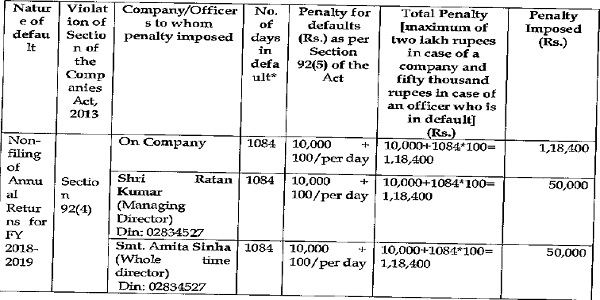
Company Law : The Registrar of Companies penalized the company and its authorized signatory after an incorrect document was attached with Form A...
Company Law : MCA amends Schedule VII of the Companies Act to include subscription to zero coupon zero principal instruments on Social Stock Exc...
Company Law : MCA has amended the CSR Rules to recognize zero coupon zero principal instruments issued by Social Stock Exchange-listed NPOs. The...
Company Law : ROC Mumbai held that repeated return of official notices proved non-maintenance of a registered office under Section 12(1) of the ...
Among the provisions outlined in the act, Section 185 has garnered substantial attention due to its impact on loans and advances to directors. This article aims to provide a comprehensive overview of Section 185 and its implications for companies and directors.
Section 2 (94A) of companies act of 2013 refers to winding up under the act or juxtapose as per IBC, 2016. To begin with the prima facie understanding of the said procedure, a company winding up will always have an administrator who will act like a liquidator responsible for the distribution of remaining resources by assuming control.
Uncover insights into common errors in the Company Auditor’s Report Order (CARO) with our comprehensive analysis. Discover the significance of CARO in ensuring transparent corporate reporting and learn how auditors can address errors to maintain credibility. From inadequate compliance to insufficient audit evidence, inaccurate reporting, and non-disclosure of related party transactions, each section provides a deep dive into key challenges auditors face.
Learn about private placement in companies, including its regulations, conditions, and compliance requirements. Understand the advantages and limitations of private placements for businesses and investors.
Understand the enforceability of circulars and notifications in relation to their publication in the official gazette. Explore the landmark cases of Harla v/s The state of Rajasthan and Gulf Goans Hotels Company Limited v/s Union of India for insights.
Explore the ethical dilemma of euthanasia – a concept aiming for a ‘Good Death.’ Delve into the arguments for and against it, the changing global perspectives, and the need for stringent regulations. While some view it as a humane choice to end unbearable suffering, others argue against interference with the course of life. As the world grapples with this controversial topic, striking a balance between individual autonomy and responsible use is crucial.
Learn about related party transactions, their definition, and significance in accordance with Section 188 of the Companies Act, 2013, and IND AS 24. Explore the meaning of related parties, their classification, and the requirements for disclosure and approval.
Many fintech startups in India have set up foreign holding companies (HoldCo) for attracting investment from offshore venture capital and private equity funds, taking advantage of favourable foreign regulatory regimes, better protection of intellectual property, easier access to capital and product markets and option of overseas listing.
Ministry of Corporate Affairs (MCA) has announced an extension in the due date for filing Form DPT-3, allowing companies to file without paying additional fees until July 31, 2023. Get the details and implications of this decision in the official circular, General Circular no. 06/2023.
Section 2(34) of the Companies Act, 2013 defines directors. A director is a person appointed to the board of a company. In case of a one person company, there shall be at least one director. Every public company shall have three directors and every private company shall have two directors appointed to it.