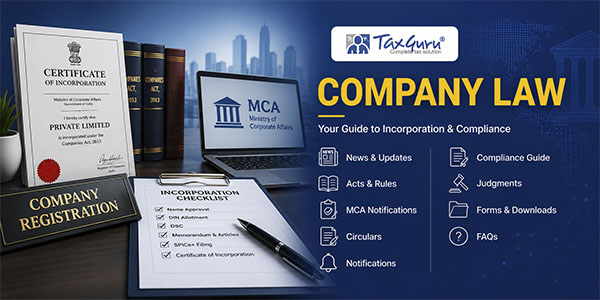
The Companies Act 2013 is a crucial legislation in India governing the incorporation, functioning, and management of companies. Learn about the key provisions, compliance requirements, and legal framework under the Companies Act 2013.
CA, CS, CMA : A comprehensive guide covering 175 legal compliances for July 2026 under FEMA, Income Tax, GST, SEBI, Companies Act, Labour Laws, ...
Company Law : The Companies Act, 2013 requires most companies to hold four Board Meetings annually, while OPCs, Small Companies, and Dormant Com...
Company Law : This guide provides a complete AGM compliance tracker covering pre-AGM, AGM-day, post-AGM, and IEPF obligations under the Companie...
Company Law : MCA has revised the Director KYC framework, requiring DIR-3 KYC (Web) only once every three financial years. The changes reduce co...
Company Law : Learn how the Companies Act, 2013 regulates managerial remuneration through profit-linked limits, approval requirements, and gover...
Company Law : MCA has cautioned stakeholders against phishing calls, WhatsApp messages, emails, fake websites, and ZIP attachments impersonating...
Company Law : ICSI has urged the Government to amend the law to allow Company Secretaries in Practice to appear before DRTs and DRATs. It argues...
Company Law : ICSI has urged the MCA to ensure eligible companies comply with Section 203 by appointing Whole-time Company Secretaries. The repr...
Corporate Law : NSO has launched the Annual Survey of Incorporated Services Sector Enterprises (ASISSE) to collect comprehensive economic and oper...
Company Law : ICSI has requested the MCA to grant compliance relaxations following technical disruptions caused by the Data Centre fire. The pro...
Company Law : Madhya Pradesh HC dismissed a winding up petition, holding that a bona fide dispute over liability required adjudication before th...
Company Law : NCLT retained the freeze on assets citing serious SFIO findings but ordered defreezing of the salary account and family members' a...
Corporate Law : The Court ruled that, without a transfer application and parallel insolvency proceedings, shifting a winding-up case to NCLT was u...
Company Law : NCLT permitted stakeholder meetings after accepting clarifications on forfeited warrants, disclosures, and scheme compliance under...
Company Law : The NCLAT held that CFO nominees must satisfy the eligibility requirements under Section 203 of the Companies Act. It set aside th...
Company Law : MCA has allowed companies to file Form DPT-3 for FY 2025-26 without additional fees until 31 July 2026 due to disruptions caused b...
Company Law : MCA notifies the New Development Bank under Section 2(11)(ii) of the Companies Act, 2013, specifying it as a body corporate for th...
Company Law : ROC Mumbai penalized a director after Form AOC-4 contained an incorrect AGM due date. The order emphasizes that directors are resp...
Company Law : ROC Mumbai imposed a penalty after finding that an individual held two Director Identification Numbers in violation of Section 155...
Company Law : ROC Mumbai penalized a Whole Time Director for filing Form DIR-12 with an incorrect CFO appointment date. The order reiterates tha...
Article explains Meaning of Registered Office, When Registered Office of Company Mandatory, Modes of Shifting of Registered Office of Company, Process for Shifting of Registered Office of a Company Within the Local Limit Of City, Town Or Village To Another Place In Within The Limit Of Same City, Town Or Village, Process for Shifting of […]
I) Introduction: 1. In order to understand the topic of partly paid shares, we need to understand the base of its formation or rather from where it is derived. 2. As per section 2(20) of the Companies Act, 2013, A Company is defined as “an incorporated association which is an artificial person, having a separate […]
The registered office of a company is the address of the company in the register of the company maintained by the registrar of companies (ROC). As per section 12 of the companies act, it is mandatory to maintain the registered address of the company, which should be a physical address capable of receiving official communication […]
Provisions related to Class Action Suit falls under Section 245 of the Companies Act, 2013. Article explains When and by Whom Class Action can be filed, Situation under the Companies Ac, 2013 where class action suit can be filed, Class Action against Audit Firm, How many Minimum requisite no. of Members/ Depositors required to file […]
Process of Alteration In Memorandum of Association (Section 13 of Companies Act, 2013) Date: 10th February, 2020 SHORT SUMMARY: Memorandum of association defines the relation of the company with the rights of the members of the company interest and also establishes the relationship of the company with the members. This section corresponds to sections 17 […]
REDUCE COST AND TIME EASE OF DOING BUSINESS A Bouquet of Services with SPICE+ :- > Incorporation > DIN allotment > Issue of PAN > Issue of TAN > Issue of EPF, ESI Number > Allotment of GSTN (If selected) > Mandatory opening of Bank Account As a part of Government’s Ease of Doing Business […]
Any Company which intended to make any change to the Article of Association (AOA) of its company, will have to comply with the provisions of Section- 14 of Companies Act, 2013 and any other applicable provisions of the Act and applicable rules. Company can alter its Article by way of addition, deletion, modification, substitution, or in any other way, only if it wants.
This Article contains the procedure for change in Object clause of the Company Under Companies Act, 2013 with detailed documentation required. Memorandum of association is the charter of the company and defines the scope of its activities. Memorandum of association defines the relation of the company with the rights of the members of the company interest and also establishes the relationship of the company with the members.
Section 13 of Companies Act 2013 regulates the process of amendment in Memorandum of Association is applicable to all companies. All clauses of Memorandum except Capital clause can be altered by following the provisions of Section 13 of Companies Act, 2013 by passing special resolution.
184. (1) Every director shall at the first meeting of the Board in which he participates as a director and thereafter at the first meeting of the Board in every financial year or whenever there is any change in the disclosures already made then at the first Board meeting held after such change disclose his […]