The Companies Act 2013 is a crucial legislation in India governing the incorporation, functioning, and management of companies. Learn about the key provisions, compliance requirements, and legal framework under the Companies Act 2013.
Company Law : The Companies Act, 2013 and related rules now require most public and private companies to issue and transfer securities only in d...
Company Law : The Companies Law Amendment Bill, 2026 proposes major reforms in corporate governance, compliance, and digital regulation. This ar...
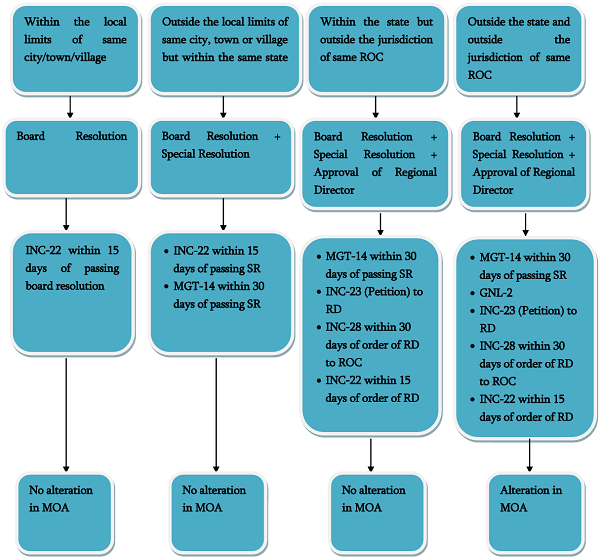
Company Law : This guide explains the complete legal procedure for shifting a company’s registered office within the same state but under a di...
Company Law : Section 56 of Companies Act, 2013 requires execution of a proper instrument of transfer for transfer of interest of a member in a ...
Corporate Law : The article explains how digital adjudication systems, virtual hearings, and online compliance platforms are reshaping India’s c...
Company Law : Provisional list of audit firms of listed companies yet to file NFRA-2 for 2023-24. Filing deadline was 30.11.2025; fines apply fo...
Company Law : ICSI recommended restoring public access to basic company master data without mandatory login requirements. The representation sta...
Company Law : NFRA introduced guidelines to evaluate audit firms’ compliance and quality control systems. The framework emphasizes governance,...
Company Law : The issue is ambiguity in filing authority during liquidation. ICSI has requested clarity to enable liquidators to maintain statut...
Company Law : The initiative addresses inefficiencies in the current filing system and proposes consolidation and automation. It highlights a sh...
Income Tax : In a commercial suit regarding specific performance, High Court had allowed a Civil Revision Petition by setting aside the order o...
Company Law : The Madras High Court permitted Nidhi companies to submit fresh replies against NDH-4 rejection orders and directed authorities to...
Company Law : Legal Analysis and Narrative Brief: Dale and Carrington Investment Pvt. Ltd. and Another v. P.K. Prathapan and Others (Supreme Cou...
Company Law : Bombay High Court held that writ petition cannot be entertained in the face of availability of alternative remedy of approaching t...
Company Law : The case examined whether Tribunal approval was required for extending preference share redemption. It was held that such extensio...
Company Law : ROC Pune held that procedural lapses in a private placement involving one investor formed part of a single integrated transaction ...
Company Law : ROC Pune penalized a start-up company and its officers for delayed filing of e-Form MGT-14 relating to a Special Resolution under ...
Company Law : ROC Pune penalized a company and its directors for delayed filing of e-Form PAS-3 relating to private placement allotment under Se...
Company Law : ROC Pune penalized a company and its directors for utilizing private placement funds before filing return of allotment under Secti...
Company Law : ROC Mumbai-II imposed penalty under Section 450 after a company incorrectly mentioned the AGM date in Form AOC-4 XBRL. The order h...
To run the business of a Private Limited Company, sufficient money /working capital is an essential component of a successful business. Lack of the fund is the main reason for the failure of many business in India. Section 2(68) of the companies Act defines private company” means a company as may be prescribed by its […]
The Registrar of Companies (ROC) of various states took an outrageous step and struck off many Companies who had not done their filing for a period of two financial years believing that such Companies are not doing any business in accordance with Section 248 (2) of the Companies Act, 2013 and consequently, disqualified their Directors […]
Appointment and Resignation of Auditor An Auditor is an independent professional person who is qualified to perform an audit; An Auditor is responsible for evaluating the validity and reliability of company’s financial statements. Section 138 to 148 of the Companies Act deal with accounts, audit and auditors, as companies are required to file financial reports […]
In this Article we will be discussing all relevant FAQs related to Filing of DIR-3 KYC. We will try to discuss all major doubts regarding filing of DIR-3 KYC. For more queries mail at Question: Who is Required to File DIR-3 KYC? Answer: Every Director who has been allotted DIN on or before the end of the financial […]
A company has to meet with numerous compliances apart from Annual Returns, but companies might not know the other mandatory and routine compliances applicable on them which could attract a good amount of penalties. Here is the list of few penalties for contravening the routine compliances/Provisions under Companies Act, 2013 which many of the Companies […]
E-FORM PAS 6 (Reconciliation of Share Capital Audit Report on half yearly basis) Objective: Reconciliation of Share capital Audit Report on half yearly basis by unlisted public Companies. Legal Provision: Ministry of Corporate Affairs (MCA) vide its notification dated 10th September 2018, inserted Rule 9A of Companies (Prospectus and Allotment of Securities), Rules, 2014, for […]
Directors are appointed since incorporation of company for the management of business and statutory auditor for auditing company’s books of accounts. But as the company grows based upon their turnover, paid up capital, outstanding loans or borrowings, outstanding deposits as well as based upon various specified criteria and for compliance of corporate governance. Specified companies […]
We know that a Company is a separate legal entity different from its members and its affairs are generally done by Board of Directors of the Company. It is Board of the Company who provides a road map within its limited power for the progress of a Company. Under the Companies Act, 2013 (‘the 2013 […]
Overview of Section 188 – Related party transactions No company shall enter into any contract or arrangement with a related partywith respect to: (a) sale, purchase or supply of any goods or materials; (b) selling or otherwise disposing of, or buying, property of any kind; (c) leasing of property of any kind; (d) availing or […]
Purpose of the E-Form IEPF-2: Statement of unclaimed or unpaid amounts and details of Nodal Officer. Earlier E-form INV-5 is filed for this purpose, however after introduction of Investor Education and Protection Fund Authority (Accounting, Audit, Transfer and Refund) Rules, 2016 , E Form INV-5 is being replaced by E- form IEPF-2 i.e. Statement of […]