The Companies Act 2013 is a crucial legislation in India governing the incorporation, functioning, and management of companies. Learn about the key provisions, compliance requirements, and legal framework under the Companies Act 2013.
Company Law : The Companies Act, 2013 and related rules now require most public and private companies to issue and transfer securities only in d...
Company Law : The Companies Law Amendment Bill, 2026 proposes major reforms in corporate governance, compliance, and digital regulation. This ar...
Company Law : This guide explains the complete legal procedure for shifting a company’s registered office within the same state but under a di...
Company Law : Section 56 of Companies Act, 2013 requires execution of a proper instrument of transfer for transfer of interest of a member in a ...
Corporate Law : The article explains how digital adjudication systems, virtual hearings, and online compliance platforms are reshaping India’s c...
Company Law : Provisional list of audit firms of listed companies yet to file NFRA-2 for 2023-24. Filing deadline was 30.11.2025; fines apply fo...
Company Law : ICSI recommended restoring public access to basic company master data without mandatory login requirements. The representation sta...
Company Law : NFRA introduced guidelines to evaluate audit firms’ compliance and quality control systems. The framework emphasizes governance,...
Company Law : The issue is ambiguity in filing authority during liquidation. ICSI has requested clarity to enable liquidators to maintain statut...
Company Law : The initiative addresses inefficiencies in the current filing system and proposes consolidation and automation. It highlights a sh...
Income Tax : In a commercial suit regarding specific performance, High Court had allowed a Civil Revision Petition by setting aside the order o...
Company Law : The Madras High Court permitted Nidhi companies to submit fresh replies against NDH-4 rejection orders and directed authorities to...
Company Law : Legal Analysis and Narrative Brief: Dale and Carrington Investment Pvt. Ltd. and Another v. P.K. Prathapan and Others (Supreme Cou...
Company Law : Bombay High Court held that writ petition cannot be entertained in the face of availability of alternative remedy of approaching t...
Company Law : The case examined whether Tribunal approval was required for extending preference share redemption. It was held that such extensio...
Company Law : ROC Pune held that procedural lapses in a private placement involving one investor formed part of a single integrated transaction ...
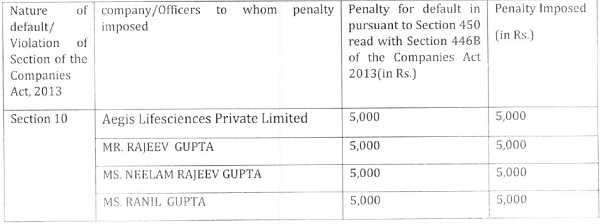
Company Law : ROC Pune penalized a start-up company and its officers for delayed filing of e-Form MGT-14 relating to a Special Resolution under ...
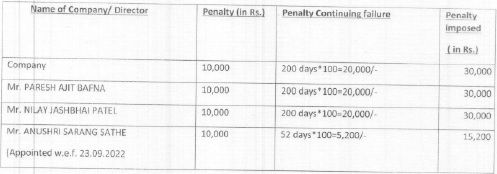
Company Law : ROC Pune penalized a company and its directors for delayed filing of e-Form PAS-3 relating to private placement allotment under Se...
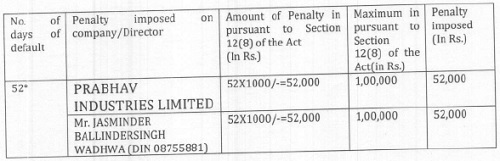
Company Law : ROC Pune penalized a company and its directors for utilizing private placement funds before filing return of allotment under Secti...
Company Law : ROC Mumbai-II imposed penalty under Section 450 after a company incorrectly mentioned the AGM date in Form AOC-4 XBRL. The order h...
Every listed company and every other public company having a paid-up share capital of Five crore rupees or more shall have whole-time key managerial personnel. And Further this Limit Increased to Ten Crore or More & Applicable in respect of FY Commencing on or after 01-04-2020.
CIN in relation to a Company stands for Company Identification Number. CIN is a 21-digit alphanumeric code assigned to a Company by Registrar Of Companies (ROC) to companies registered in India under Companies Act, 2013.
MCA order identifies that company failed to comply with Secretarial Standards, specifically regarding the mention of the number of board meetings held during the financial year in its reports. A show cause notice was issued to the company, and in response, they admitted the error. As a result, the penalty has been imposed on the company and its officers in default under Section 118(11) of the Companies Act, 2013.
This article aims to provide a comprehensive overview of ESG accounting and audit in India, covering the fundamentals, key considerations, and the role of professionals in this field.
Explore the liability of auditors under the Companies Act, 2013. This analysis examines recent court rulings and the impact of Section 140(5) on auditors’ resignation and fraudulent acts.
Understand procedural differences between private limited companies and public limited companies in terms of subscribers, directors, members, prospectus, securities, and more. Learn about the exemptions and their implications.
In present facts of the case, it was observed that deposit of 10% of the penalty shall have no effect on the order of ‘debarment’ passed against the Appellant(s) under Section 132(4)(c). Order of ‘debarment’ shall continue to operate unless an order is passed by the Appellate Tribunal.
Learn about Form DPT-3 filing requirements, applicable companies, deadlines, and consequences for non-compliance. Understand the rules and ensure timely submission to avoid penalties. Get expert guidance for hassle-free filing.
Learn about the concept of a company, its legal definition, types of companies, and the process of incorporating a company. Explore different classifications based on liability and incorporation and gain insights into the required documents.
Filing an application for DIN allotment is now a straightforward process. Learn about the implications of DIN for director appointments and the enigma of Section 156 in the Companies Act 2013.