Income Tax : Understand Section 194S of the Income Tax Act on 1% TDS for Virtual Digital Asset transfers, including deductor rules, compliance,...
Income Tax : ITAT Mumbai quashes reassessment (AY 13-14, 14-15) as AO missed the Rajeev Bansal-mandated "surviving limitation." S. 149 prevails...
Income Tax : Analysis of the Rajeev Bansal Supreme Court ruling on reassessment approvals, clarifying complexities in Section 151 and its impac...
Income Tax : Explore key court rulings on reassessment under Section 148 post-2021 amendments, covering procedural changes, taxpayer rights, an...
Company Law : Overview of Section 149 of the Companies Act, 2013: Board composition, women directors, resident and independent directors' roles,...
Income Tax : Learn about the new block assessment provisions for cases involving searches under section 132 and requisitions under section 132A...
Income Tax : Discover how Finance Act 2021 revamped assessment and reassessment procedures under Income-tax Act, impacting notices, time limits...
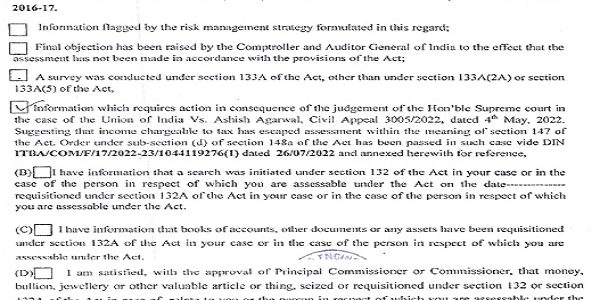
Income Tax : The Tribunal held that the reassessment notice issued on 26.07.2022 was beyond the permissible timeline under the surviving limita...
Income Tax : Mumbai ITAT held that reassessment notice issued under Section 148 for AY 2015-16 on 31.07.2022 was barred by limitation under Sec...
Income Tax : ITAT ruled that appellate powers under Section 251 are confined to assessment year under appeal. Directions to reopen completed as...
Income Tax : The Tribunal ruled that the Revenue must establish a direct connection between seized material and the assessee’s taxable income...
Income Tax : Hyderabad ITAT held that a notice issued under Section 148 after six years from the end of AY 2015-16 was invalid. The Tribunal ru...
Custom Duty : Learn how to file and process Bill of Entry amendments at Jawahar Lal Nehru Custom House. Get insights on self-approval and office...
With the reassessment proceedings held invalid, additions relating to property valuation and unexplained investment were not examined on merits. The appeal was allowed on legal grounds.
The Tribunal held that a notice issued under section 148 beyond the six-year limitation under the old law is invalid. It clarified that the first proviso to section 149 bars such reopening even under the amended regime.
The Tribunal held that reopening beyond three years requires escaped income in the form of an asset. Since bogus purchases are revenue items, the reassessment was declared invalid.
The tribunal held reopening invalid where actual escaped income was below ₹50 lakh. It clarified that jurisdiction depends on real income, not transaction value.
ITAT remanded the matter where the assessee claimed PAN misuse leading to additions under Sections 68 and 69. It directed AO to verify the police report, holding that relief must be granted if misuse is substantiated.
The Tribunal examined whether reassessment proceedings were valid when initiated beyond the statutory time limit. It held that the notice issued under Section 148 was barred by limitation and invalid. The ruling emphasizes strict adherence to limitation provisions in reassessment cases.
ITAT Mumbai held that reassessment initiated without approval from the correct authority under Section 151 is invalid. Since the reassessment itself was void, the revision order under Section 263 could not survive.
The Tribunal held that reopening beyond three years requires sanction from higher authorities under Section 151(ii). Since approval was obtained only from the PCIT, the reassessment notice was declared invalid.
The tribunal noted discrepancies in the dispatch register used to prove issuance of the notice. Because the records did not inspire confidence, the tribunal held the reassessment notice to be time-barred.
The Tribunal held that a notice under section 148 issued beyond three years requires sanction from PCCIT under section 151(ii). Approval from PCIT was held insufficient, leading to quashing of the reassessment.