The Companies Act 2013 is a crucial legislation in India governing the incorporation, functioning, and management of companies. Learn about the key provisions, compliance requirements, and legal framework under the Companies Act 2013.
Company Law : The Companies Act, 2013 and related rules now require most public and private companies to issue and transfer securities only in d...
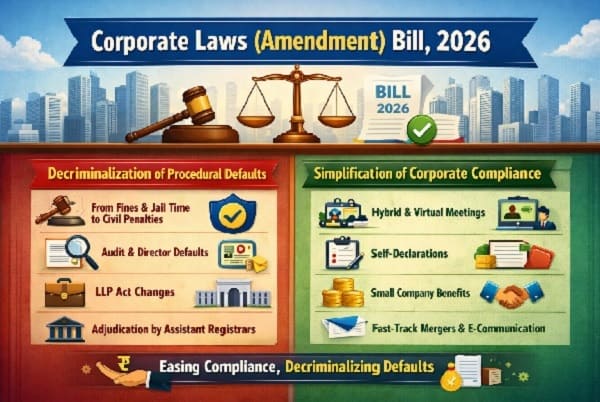
Company Law : The Companies Law Amendment Bill, 2026 proposes major reforms in corporate governance, compliance, and digital regulation. This ar...
Company Law : This guide explains the complete legal procedure for shifting a company’s registered office within the same state but under a di...
Company Law : Section 56 of Companies Act, 2013 requires execution of a proper instrument of transfer for transfer of interest of a member in a ...
Corporate Law : The article explains how digital adjudication systems, virtual hearings, and online compliance platforms are reshaping India’s c...
Company Law : Provisional list of audit firms of listed companies yet to file NFRA-2 for 2023-24. Filing deadline was 30.11.2025; fines apply fo...
Company Law : ICSI recommended restoring public access to basic company master data without mandatory login requirements. The representation sta...
Company Law : NFRA introduced guidelines to evaluate audit firms’ compliance and quality control systems. The framework emphasizes governance,...
Company Law : The issue is ambiguity in filing authority during liquidation. ICSI has requested clarity to enable liquidators to maintain statut...
Company Law : The initiative addresses inefficiencies in the current filing system and proposes consolidation and automation. It highlights a sh...
Income Tax : In a commercial suit regarding specific performance, High Court had allowed a Civil Revision Petition by setting aside the order o...
Company Law : The Madras High Court permitted Nidhi companies to submit fresh replies against NDH-4 rejection orders and directed authorities to...
Company Law : Legal Analysis and Narrative Brief: Dale and Carrington Investment Pvt. Ltd. and Another v. P.K. Prathapan and Others (Supreme Cou...
Company Law : Bombay High Court held that writ petition cannot be entertained in the face of availability of alternative remedy of approaching t...
Company Law : The case examined whether Tribunal approval was required for extending preference share redemption. It was held that such extensio...
Company Law : ROC Pune held that procedural lapses in a private placement involving one investor formed part of a single integrated transaction ...
Company Law : ROC Pune penalized a start-up company and its officers for delayed filing of e-Form MGT-14 relating to a Special Resolution under ...
Company Law : ROC Pune penalized a company and its directors for delayed filing of e-Form PAS-3 relating to private placement allotment under Se...
Company Law : ROC Pune penalized a company and its directors for utilizing private placement funds before filing return of allotment under Secti...
Company Law : ROC Mumbai-II imposed penalty under Section 450 after a company incorrectly mentioned the AGM date in Form AOC-4 XBRL. The order h...
NCLT Mumbai held that resolution plan for Latakisan Construction P. Ltd. as submitted by Successful Resolution Applicant stands approved as approved by 100% Committee of Creditors. Accordingly, resolution plan is allowed.
Interim dividend can be declared solely by the Board of Directors under the Companies Act. Shareholder consent is not required if statutory conditions are met.
This article explains the mandatory requirement that only a registered valuer can determine share pricing for preferential issues.
The government has approved new regional and company registries to streamline administration and improve access. The move aims to reduce jurisdictional load and strengthen regulatory facilitation.
Failure to appoint a whole-time Company Secretary within the statutory timeline led to substantial penalties on the company and its directors. The order reinforces strict adherence to Section 203 compliance requirements.
An incorrect statutory filing led to misclassification of the company on the MCA portal. The ruling clarifies that directors remain liable for accuracy of e-forms even when errors are voluntarily reported.
The article explains how complexity, ESG demands, and enforcement gaps are testing Indian company law and why governance quality must improve beyond checklist compliance.
The new framework mandates DIN KYC filing every third financial year instead of every year. Directors must still promptly report any change in personal information to avoid DIN deactivation.
Incorrect disclosure of promoter and public shareholding in a statutory return was penalised under the Companies Act. The key takeaway is that even clerical errors in MCA filings can trigger liability.
The regulator examined filing of statutory forms with incorrect financial figures. It held that later correction does not erase liability for filing defective information.