Corporate Law : The Supreme Court held that liabilities arising from corporate guarantees qualify as financial debt under Section 5(8) of the Inso...
Corporate Law : The Supreme Court ruled that a shortfall payment clause in a Deed of Hypothecation can qualify as a contract of guarantee under th...
Corporate Law : The article examines how conflicting Supreme Court judgments in Rainbow Papers and Raman Ispat created uncertainty regarding the s...
Corporate Law : The IBC (Amendment) Act, 2026 introduces CIIRP as a faster and proactive insolvency mechanism for early-stage financial stress. Th...
Corporate Law : Explains how the Court held that insolvency proceedings cannot be used as a pressure tactic for debt recovery. Even if default is ...
Corporate Law : The Supreme Court upheld joint insolvency proceedings against two interconnected real estate companies due to common management an...
Corporate Law : 2026 Guidelines streamline selection of Insolvency Professionals for IRP, RP, Liquidator, and Bankruptcy Trustee roles, ensuring t...
Corporate Law : The amendments replace the consultation committee with CoC oversight, giving creditors greater control over liquidation decisions....
Corporate Law : The proposal focuses on enabling creditors to initiate resolution while retaining debtor management under supervision. It sets out...
Corporate Law : The amendments arise from the inclusion of a unified “service provider” definition under the Code. The move expands regulatory...
Corporate Law : NCLT Indore held that dissolution under Section 54 of the IBC was justified after all assets of the corporate debtor were liquidat...
Corporate Law : NCLT Mumbai held that ongoing One-Time Settlement discussions cannot defeat insolvency proceedings when debt and default are admit...
Corporate Law : NCLAT held that foreign oil and gas assets owned through Videocon subsidiaries could not be included in the CIRP of Videocon Indus...
Corporate Law : Tribunal noted that the CIRP period, including all extensions, had reached 741 days and expired on 20 November 2025. Since no plan...
Corporate Law : The NCLT Mumbai held that liquidation became mandatory under Section 33(2) of the IBC after the Committee of Creditors rejected al...
Corporate Law : The amendment bars related parties, recent auditors, and connected persons from acting as registered valuers in pre-pack insolvenc...
Corporate Law : The IBBI amended the Liquidation Process Regulations, 2016 to allow appointment of one registered valuer for each asset class in M...
Corporate Law : The IBBI amended the CIRP Regulations, 2016 to permit appointment of one set of registered valuers for MSME corporate debtors. The...
Corporate Law : The IBBI Amendment Regulations, 2026 introduce nominee directors on IPA governing boards and strengthen oversight mechanisms. The ...
Corporate Law : The order highlights that delayed applications, late progress reports, and non-compliance with filing requirements amounted to ser...
NCLAT held that The Resolution Professional has calculated the claim of the Appellant as per the award dated 19.01.2018. Appellant who has himself initiated the Arbitration Proceeding cannot deny that he is bound by the award which was delivered in his favour.
IBBI has perused the contraventions alleged in the SCN and the reply of the RV on the SCN. It is observed that the RV has neither countered the allegations made in the SCN nor provided any justification as to how his valuation report is in compliance with the applicable provisions of Valuation Rules. A valuation […]
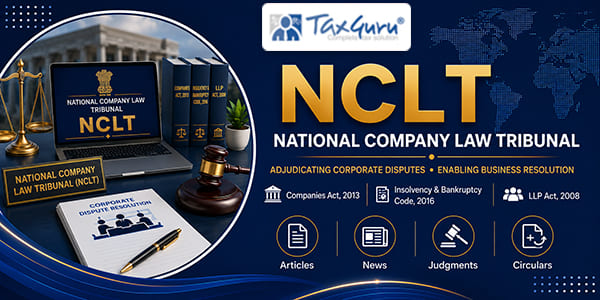
Uncover the multifaceted role of the National Company Law Tribunal (NCLT) beyond debt recovery, exploring its significance in fair and efficient resolution of corporate disputes under the Insolvency and Bankruptcy Code (IBC). Delve into key provisions, court interpretations, and the NCLTs crucial role in promoting resolution over liquidation for distressed corporate debtors. Stay informed on the evolving landscape of insolvency laws in India.
NCLT Mumbai held that as date of default is beyond 25th March 2020, the default as alleged by Operational Creditor falls under the purview of Section 10A of the IBC, 2016 and hence application seeking initiation of CIRP rejected.
IBBI warns RV to be cautious & transparent while conducting valuation under IBC, 2016 & Companies (Registered Valuers and Valuation) Rules, 2017
Section 7 of the Insolvency and Bankruptcy Code, 2016, addresses the initiation of the corporate insolvency resolution process by the financial creditor.
Provisions of Section 9 of IBC mandates Operational creditor to file CIRP application against Corporate Debtor after expiry of 10 days from date of receipt of demand notice by Corporate Debtor,
Under section 18(f) of IBC Code, Mr. S. Muthuraju being IRP of the CD from 14.06.2017 to 20.09.2017 was required to take control and custody of any asset over which the CD has ownership rights, as recorded in the balance sheet of the CD.
Explore the necessity of Committee of Creditors approval for the appointment of Transaction/Forensic Auditor under Section 18 of the Insolvency and Bankruptcy Code, 2016. Understand the role of Forensic Auditors in identifying PUFE Transactions and ensuring compliance with IBC regulations.
Discover the overriding effect of IBC (Insolvency and Bankruptcy Code) over Income Tax and GST Acts. Supreme Court rulings and legal provisions explained. Stay informed on the legal landscape for corporate debtors.