Corporate Law : The Supreme Court held that liabilities arising from corporate guarantees qualify as financial debt under Section 5(8) of the Inso...
Corporate Law : The Supreme Court ruled that a shortfall payment clause in a Deed of Hypothecation can qualify as a contract of guarantee under th...
Corporate Law : The article examines how conflicting Supreme Court judgments in Rainbow Papers and Raman Ispat created uncertainty regarding the s...
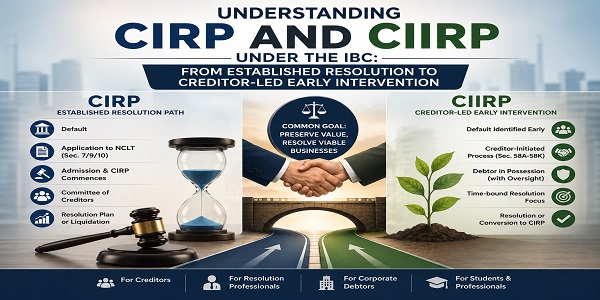
Corporate Law : The IBC (Amendment) Act, 2026 introduces CIIRP as a faster and proactive insolvency mechanism for early-stage financial stress. Th...
Corporate Law : Explains how the Court held that insolvency proceedings cannot be used as a pressure tactic for debt recovery. Even if default is ...
Corporate Law : The Supreme Court upheld joint insolvency proceedings against two interconnected real estate companies due to common management an...
Corporate Law : 2026 Guidelines streamline selection of Insolvency Professionals for IRP, RP, Liquidator, and Bankruptcy Trustee roles, ensuring t...
Corporate Law : The amendments replace the consultation committee with CoC oversight, giving creditors greater control over liquidation decisions....
Corporate Law : The proposal focuses on enabling creditors to initiate resolution while retaining debtor management under supervision. It sets out...
Corporate Law : The amendments arise from the inclusion of a unified “service provider” definition under the Code. The move expands regulatory...
Corporate Law : NCLT Indore held that dissolution under Section 54 of the IBC was justified after all assets of the corporate debtor were liquidat...
Corporate Law : NCLT Mumbai held that ongoing One-Time Settlement discussions cannot defeat insolvency proceedings when debt and default are admit...
Corporate Law : NCLAT held that foreign oil and gas assets owned through Videocon subsidiaries could not be included in the CIRP of Videocon Indus...
Corporate Law : Tribunal noted that the CIRP period, including all extensions, had reached 741 days and expired on 20 November 2025. Since no plan...
Corporate Law : The NCLT Mumbai held that liquidation became mandatory under Section 33(2) of the IBC after the Committee of Creditors rejected al...
Corporate Law : The amendment bars related parties, recent auditors, and connected persons from acting as registered valuers in pre-pack insolvenc...
Corporate Law : The IBBI amended the Liquidation Process Regulations, 2016 to allow appointment of one registered valuer for each asset class in M...
Corporate Law : The IBBI amended the CIRP Regulations, 2016 to permit appointment of one set of registered valuers for MSME corporate debtors. The...
Corporate Law : The IBBI Amendment Regulations, 2026 introduce nominee directors on IPA governing boards and strengthen oversight mechanisms. The ...
Corporate Law : The order highlights that delayed applications, late progress reports, and non-compliance with filing requirements amounted to ser...
The court examined whether delay in filing returns during insolvency proceedings constituted genuine hardship. It held that delay caused due to CIRP and management transition must be condoned to avoid unjust denial of tax benefits.
The Tribunal held that appeals against liquidator decisions must be filed within 14 days. It ruled that delays beyond this period cannot be condoned.
The Tribunal held that all resolution plans were rightly rejected as they offered values below liquidation value. It emphasized that the CoC’s commercial judgment, based on financial viability, cannot be interfered with unless statutory provisions are violated. The ruling reinforces that business decisions of the CoC are paramount in insolvency proceedings.
The issue involved whether a guarantee cap covered both principal and interest. The Tribunal held that default interest is a separate liability. The takeaway is that interest obligations can extend beyond capped principal liability.
The Government confirmed that tribunals allowed flat registration where buyers had paid dues and taken possession. The ruling emphasizes protection of homebuyers despite developer insolvency.
The Court examined whether claims not filed during CIRP can be pursued later. It held that such claims stand extinguished upon approval of the resolution plan. The key takeaway is that only claims included in the plan survive.
The Tribunal held that a successful bidder cannot claim wide-ranging exemptions from statutory compliances. The key takeaway is that reliefs must be reasonable and legally permissible.
The case addresses failure to place a mandatory replacement agenda despite requisite voting share. The ruling emphasizes that statutory obligations under CIRP regulations are non-discretionary and must be strictly followed.
The Court held that insolvency proceedings cannot be invoked after completion of SARFAESI auction to stall recovery. It clarified that Section 96 moratorium cannot undo concluded transactions.
The tribunal held that default arose after valid invocation of the corporate guarantee and non-payment within the notice period. It ruled that the Section 7 petition was within limitation and debt and default were established.