Goods and Services Tax : Supreme Court upheld Section 69 GST arrest powers, requiring recorded reasons, CrPC safeguards, CBIC instructions and limiting arr...
Income Tax : The Supreme Court held excise duty paid by buyers formed part of turnover, discussed colourable devices, and distinguished legitim...
Corporate Law : A non-speaking dismissal of an SLP does not affirm the High Court's reasoning or constitute law under Article 141. The doctrine of...
Corporate Law : The Supreme Court ruled that summoning hotel booking records and call detail records to prove adultery does not violate privacy, a...
Corporate Law : The Supreme Court agreed to examine allegations that bank dues were settled at steep discounts through ARCs, while clarifying that...
Corporate Law : The Supreme Court upheld joint insolvency proceedings against two interconnected real estate companies due to common management an...
Corporate Law : Supreme Court ruled that CoC and RP can surrender financially burdensome assets voluntarily, clarifying moratorium under section 1...
Corporate Law : SC clarifies limits of High Court's writ powers in IBC cases and recognises Indian CIRP as foreign main proceeding in cross-border...
Corporate Law : Justice BR Gavai sworn in as India's 52nd Chief Justice. Focus areas include addressing case pendency and improving court infrastr...
Corporate Law : Key IBC case law updates from Oct-Dec 2024, covering Supreme Court and High Court decisions on CoC powers, resolution plans, relat...
Corporate Law : SC held a Ministers statement binds the Government only if it reflects the Governments view and declined to issue speech guideline...
Corporate Law : Supreme Court granted bail under the PMLA, noting prolonged custody, documentary evidence, delayed trial, parity with co-accused, ...
Corporate Law : Supreme Court set aside the High Court's PMLA bail order for failure to apply Section 45 twin conditions and remanded the matter f...
Corporate Law : Supreme Court declined to refer the Article 370 challenge to a larger Bench, holding there was no conflict between earlier Constit...
Corporate Law : Supreme Court upheld termination of a slum redevelopment developer for prolonged delay and reaffirmed the statutory duty and accou...
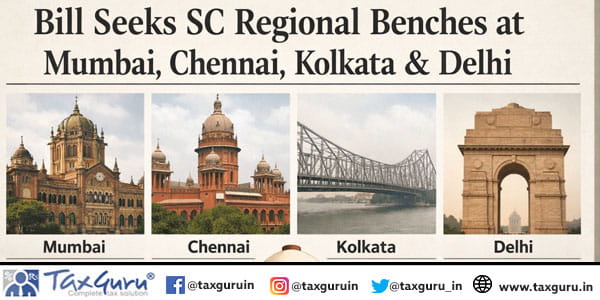
Corporate Law : The Bill seeks to amend Articles 15 and 16 to allow reservation for backward classes proportionate to their population identified ...
Fema / RBI : RBI directs banks, NBFCs, and other entities to implement Supreme Court’s accessibility guidelines for digital KYC, ensuring inc...
Income Tax : CBDT raises monetary limits for tax appeals: Rs. 60 lakh for ITAT, Rs. 2 crore for High Court, and Rs. 5 crore for Supreme Court, ...
Corporate Law : No restrictions on joint bank accounts or nominations for the queer community, as clarified by the Supreme Court and RBI in August...
Corporate Law : Supreme Court of India introduces new procedures for case adjournments effective 14th February 2024, detailing strict guidelines a...
The Court held that both salary and farm income must be considered, increasing the deceased’s monthly income to ₹8,000. ignoring legitimate income sources leads to undervalued compensation.
The Court held that strict documentary proof of salary is not mandatory and adopted a reasonable income figure. liberal standards apply when determining earnings for young accident victims.
The Court held that the deceased’s income had been wrongly computed at ₹84,000 and reassessed it at ₹1,00,000 based on available evidence. The ruling increased the compensation and reaffirmed principles for fair assessment in motor accident claims.
Courts held that allegations of large-scale fraudulent ITC require factual adjudication and are unsuitable for writ jurisdiction, directing the petitioner to pursue the statutory appeal. The Supreme Court refused intervention but extended time to file the appeal.
State Bank of India Vs Pallabh Bhowmick & Ors (Supreme Court of India) In this case, the Supreme Court upheld the High Court’s finding that a series of online transactions carried out on 18.10.2021 from the customer’s bank account were entirely unauthorized and fraudulent, and that no negligence on the part of the account holder […]
The Court ruled that Section 148 notices issued by the local Assessing Officer, following orders under Section 148A(d), are legally valid. It rejected arguments that such notices must be issued facelessly under the 2022 Scheme. This establishes that notice issuance and faceless assessment are distinct processes.
The Court held that intercepted calls and investigation records did not establish demand or acceptance of illegal gratification. It affirmed that no material linked the accused to the alleged conspiracy, upholding the quashing of charges.
The Court ruled that the High Court erred in terminating the case at the pre-trial stage. It held that allegations of disproportionate assets require examination at trial and restored the prosecution.
The Court upheld the refusal to discharge the accused, citing material suggesting grave suspicion of involvement in a conspiracy. It held that the allegations warranted full trial scrutiny.
The Court held that prosecution cannot continue when no recovery is made and the only material is statements of co-accused. It ruled that such statements alone cannot justify a trial under Sections 489B and 489C.