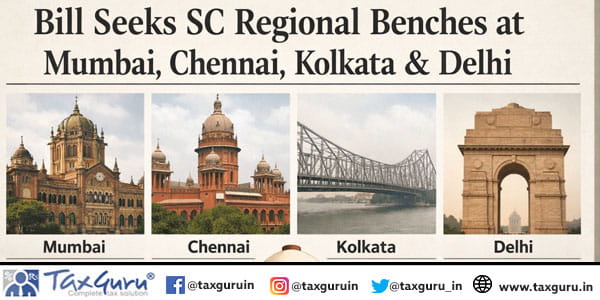
Constitutional Amendment Bill Proposes 4 Permanent Regional Benches of SC at Mumbai, Chennai, Kolkata & Delhi
Bill No. XV of 2026 proposes amendments to several provisions of the Constitution of India relating to reservation policies, judicial appointments, and the structure of the Supreme Court of India and High Courts. The Bill seeks to amend Articles 15 and 16 to permit the State to provide reservation for socially and educationally backward classes proportionate to their population based on caste census data, and to extend reservation in appointments and promotions for Scheduled Castes, Scheduled Tribes, and Other Backward Classes where representation is inadequate. It also proposes provisions for representation of Scheduled Castes, Scheduled Tribes, Other Backward Classes, minorities, and women in judicial appointments. The Bill further introduces permanent regional benches of the Supreme Court at Chennai, Kolkata, and Mumbai while retaining a Constitution Bench at New Delhi for constitutional matters. Additionally, it proposes increasing the retirement age of High Court judges from 62 to 65 years and introduces procedural timelines for judicial appointments. The Bill also proposes transferring “Census” to the Concurrent List in the Seventh Schedule.
Gazette Of India Extraordinary
Bill No. XV of 2026
A Bill further to amend the Constitution of India.
BE it enacted by Parliament in the Seventy-seventh Year of the Republic of India as follows: —
1. Short title and commencement.
(1) This Act may be called the Constitution (Amendment) Act, 2026.
(2) It shall come into force on such date as the Central Government may, by notification in the Official Gazette, appoint.
2. Amendment of article15.
In article 15 of the Constitution, for clause (4), the following new clause shall be substituted:—
“(4) Nothing in this article or in clause (2) of article 29 shall prevent the State from making any special provision for the advancement of any socially and educationally backward classes of citizens proportionate to their population in the caste census or for the Scheduled Castes and the Scheduled Tribes.”
3. Amendment of article 16.
In article 16 of the Constitution, for clauses (4) & (4A), the following new clauses shall be substituted, namely:-
“(4) Nothing in this article shall prevent the State from making any provision for the reservation of appointments or posts in favour of any backward class of citizens which, in the opinion of State, is not adequately represented in the services under the State proportionate to their population in the caste census.
(4A) Nothing in this article shall prevent the State from making any provision for reservation in matters of promotion, with consequential seniority, to any class or classes of posts in the services under the State in favour of the Scheduled Castes, the Scheduled Tribes and Other Backward Classes which, in the opinion of the State, are not adequately represented in the services under the State.”
4. Amendment of article 124.
In article 124 of the Constitution, after clause (2A), the following new clauses shall be inserted, namely:—
“(2B) Notwithstanding anything in this Constitution, the appointment of Judges to the Supreme Court shall be made by giving due representation to members of the Scheduled Castes, Scheduled Tribes, Other Backward Classes, religious minorities and women, in proportion to their population in the country:
Provided that the provisions of this clause shall not apply to such categories which are already represented in the total strength of Judges of the Supreme Court in proportion to their population in the country.
2C. Subject to the provisions of clause (2B), the Central Government shall frame a Memorandum of Procedure for appointment of Judges of the Supreme Court in consultation with the Chief Justice of India, setting out the timelines and procedure including identifying, assessing, recommending, and appointing suitable candidates as Judges of the Supreme Court.
2D. If the Chief Justice or Judge of any High Court is being considered for appointment as a Judge of the Supreme Court, the Central Government shall consult the Government of that State before making such appointment.
2E. The Central Government shall either return or notify any recommendation of the collegium of the Supreme Court for appointment of Judges of the Supreme Court within sixty days of receipt of the recommendation:
Provided that if any recommendation is returned by the Central Government and the same is re-iterated by the collegium of the Supreme Court, the Central Government shall notify the same within a period of thirty days of receipt of the reiteration.
Explanation— For the purpose of this clause, ‘collegium of the Supreme Court’ shall mean a Committee comprising of five senior-most Judges of the Supreme Court including the Chief Justice of India.”
5. Substitution of article 130
Constitution Bench and Permanent Regional Benches of the Supreme Court.
For article 130 of the Constitution, the following article shall be substituted, namely:—
“130. (1) The Supreme Court established under Clause (1) of article 124 shall comprise of a Constitution Bench sitting at New Delhi and four Permanent Regional Benches for the northern, southern, eastern and western regions, which shall sit at New Delhi, Chennai, Kolkata and Mumbai respectively.
(2) The Constitution Bench at New Delhi shall hear only cases which are of constitutional importance.
Explanation— The Chief Justice of India shall have exclusive power to determine which case is to be classified as a case of constitutional importance.
(3) The four Permanent Regional Benches of the Supreme Court shall exercise the full jurisdiction of the Supreme Court of India, except over cases to be heard by the Constitution Bench.
(4) The territorial jurisdiction of the Permanent Regional Benches of the Supreme Court shall be as follows:—
a. the northern Regional Bench of the Supreme Court at New Delhi shall deal with all cases, except cases to be heard by the Constitution Bench, arising out of the States of Uttar Pradesh, Uttarakhand, Rajasthan, Punjab, Haryana, Himachal Pradesh and the Union territories of Jammu and Kashmir, Ladakh, Delhi and Chandigarh;
b. the southern Regional Bench of the Supreme Court at Chennai shall deal with all cases, except cases to be heard by the Constitution Bench, arising out of the States of Tamil Nadu, Kerala, Karnataka, Andhra Pradesh, Telangana and the Union territories of Puducherry and Lakshadweep;
c. the eastern Regional Bench of the Supreme Court at Kolkata shall deal with all cases, except cases to be heard by the Constitution Bench, arising out of the States of West Bengal, Bihar, Odisha, Jharkhand, Assam, Sikkim, Arunachal Pradesh, Nagaland, Meghalaya, Manipur, Tripura, Mizoram and Union territory of Andaman and Nicobar Islands; and
d. the western Regional Bench of the Supreme Court at Mumbai shall deal with all cases, except cases to be heard by the Constitution Bench, arising out of the States of Maharashtra, Madhya Pradesh, Chhattisgarh, Gujarat, Goa and Union territory of Dadra and Nagar Haveli and Daman and Diu:
Provided that the Chief Justice of India may, if in the interest of administration of justice, transfer any case pending before any Permanent Regional Bench to any other Permanent Regional Bench or the Constitution Bench:
Provided further that when cases involving the same substantial question of law or the same subject matter are pending before two or more Regional Benches, the Chief Justice of India may direct that all such cases be heard by any one of the Regional Benches.
(5) The Chief Justice of India shall nominate Judges of the Supreme Court to sit at the Constitution Bench and the Permanent Regional Benches:
Provided that Chief Justice of India shall nominate not less than six Judges of Supreme Court in each of the Permanent Regional Benches:
Provided further that while nominating Judges to the Permanent Regional Benches, the Chief Justice shall give preference to Judges whose parent High Court or erstwhile place of practice or residence prior to appointment as Judge, is within the territorial jurisdiction of that Permanent Regional Bench:
Provided also that nothing contained herein shall prevent the Chief Justice from nominating any Judge of the Supreme Court to the Constitution Bench or any of the Permanent Regional Benches on the basis of seniority, or if it is otherwise necessary to do so in the interest of administration of justice.”
6. Amendment of article 217.
In article 217 of the Constitution—
(1) in clause (1), for the words “sixty-two years”, the words “sixty-five years” shall be substituted.
(2) after clause (2), the following new clauses shall be inserted, namely :—
“(2A) Notwithstanding anything contained in this Constitution, the appointment of Judges to the High Court of a State shall be made by giving due representation to members of the Scheduled Castes, Scheduled Tribes, Other Backward Classes, religious minorities and women, in proportion to their population within that State:
Provided that the provisions of this clause shall not apply to such categories which are already represented in the total strength of Judges of a High Court in proportion to their population within that State.
2B. In all cases of appointments to a High Court of a State, the Central Government, the collegium of the Supreme Court and the collegium of that High Court shall take into consideration the opinion of the Government of that State before making the appointment.
Explanation— For the purpose of this clause, ‘State’ includes all
States and Union Territories that share a common High Court.
2C. Subject to the provisions of clause (2A), the Central Government shall frame a Memorandum of Procedure for appointment of Judges of High Courts in consultation with all the State Governments, Governments of Union Territories, the Chief Justice of India and Chief Justices of all High Courts, setting out the timelines and procedure including identifying, assessing, recommending, and appointing suitable candidates as Judges of High Courts.
2D. The Central Government shall either return or notify any recommendation of the collegium of the Supreme Court for appointment of Judges of the High Court within sixty days of receipt of the recommendation:
Provided that if any recommendation is returned by the Central Government and the same is reiterated by the Supreme Court, the Central Government shall notify the same within a period of thirty days of receipt of the reiteration.
Explanation— For the purpose of article 217, ‘collegium of Supreme Court’ shall mean a Committee comprising the five senior most Judges of the Supreme Court including the Chief Justice of India and ‘collegium of High Court’ shall mean a Committee comprising the three senior most Judges of that High Court including the Chief Justice of that High Court.”
7. Amendment of article 224.
In article 224 of the Constitution—
1A. after clause (1), the following new clause shall be inserted, namely :—
“(1A) Notwithstanding anything contained in this Constitution, the appointment of additional Judges to the High Court of a State shall be made, by giving due representation to members of the Scheduled Castes, Scheduled Tribes, Other Backward Classes, religious minorities and women, in proportion to their population within that State:
Provided that the provisions of this clause shall not apply to such categories which are already represented in the total strength of Judges and additional Judges of a High Court in proportion to their population within that State.”
(2) in clause (3), for the words “sixty-two years”, the words “sixty-five years” shall be substituted.
8. Amendment of the Seventh Schedule.
In the Seventh Schedule to the Constitution: —
(a) In List I – Union List, Entry 69 shall be omitted;
(b) In List III – Concurrent List, after Entry 47, the following entry shall be inserted, namely: —
“48. Census”