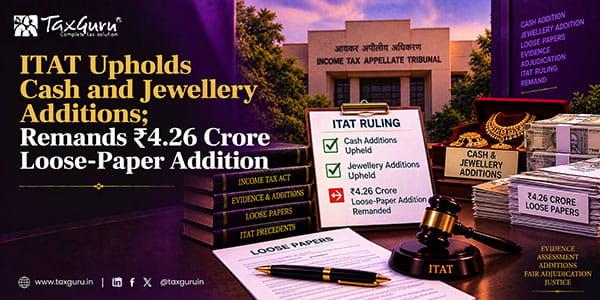
Income Tax : Smt. Ranjana Kumari/Kalta Vs DCIT/ACIT (Central) (ITAT Chandigarh) The appeals involved three assessees belonging to the Kalta Gro...
Income Tax : Understand the statutory time limits for issuing income-tax notices and completing assessments under the Income-tax Act. The guide...
Income Tax : Learn the updated provisions governing rectification, assessments, reassessments, and appeals under the Income-tax Act. This guide...
Income Tax : Learn how different types of income tax assessments are conducted under the Income-tax Act. The FAQs explain assessment procedures...
Income Tax : Section 154 permits rectification of mistakes apparent from the record in assessment orders, intimations, and TDS/TCS processing s...
Income Tax : Delhi ITAT allows Sanco Holding, a Norwegian company, to compute income from bareboat charter of seismic vessels under Article 21(...
Income Tax : It has been observed that in many cases an assessee may wish to make a claim which was not made in the return of income filed unde...
Income Tax : We have attached a file in excel format. The file contains the format of various details which normally assessing officer asks As...
Income Tax : ITAT Delhi held legal services are not FTS under Section 9(1)(vii) and directed partner-wise DTAA examination. FTS addition was de...
Income Tax : ITAT Mumbai deleted a Section 69 addition after finding documentary evidence established joint ownership, source of funds, and ear...
Income Tax : ITAT Mumbai quashed reassessment after finding no Section 143(2) notice and that the AO issued a final order disguised as a draft ...
Income Tax : ITAT Surat held that delayed filing of Form 10B is a procedural lapse and remanded the matter after directing the AO to consider t...
Income Tax : ITAT Delhi held that interest and dividend earned from co-operative banks qualify for deduction under Section 80P(2)(d). Totgar's ...
Income Tax : Instruction No.1/2015 Clarification regarding applicability of section 143(1D) of the Income-tax Act, 1961- Vide Finance Act, 2012...
The Tribunal held that the Assessing Officer exceeded the scope of limited scrutiny by treating capital gains as business income without obtaining mandatory approval for complete scrutiny. The appeal was partly allowed on this technical ground, and the merits were not examined.
The ITAT Delhi held that a notice under Section 143(2) issued by an Assessing Officer lacking jurisdiction cannot confer valid authority to complete an assessment. It quashed the assessment after finding that the jurisdictional officer also failed to issue a fresh statutory notice.
The ITAT held that a scrutiny assessment cannot survive where the jurisdictional Assessing Officer failed to issue the mandatory notice under Section 143(2). It ruled that the defect rendered the entire assessment void ab initio despite transfer of the case.
The ITAT Delhi held that an assessment order passed through e-Proceedings must be digitally signed as required by CBDT Instruction No. 1/2018. Since the order was manually signed without any prescribed exception, it was quashed.
The ITAT Mumbai held that the final assessment order was passed beyond the mandatory timeline prescribed under Section 144C(13) after receipt of the DRP’s directions. It declared the assessment void ab initio and allowed the assessee’s appeal.
The ITAT Delhi held that the final assessment order was time-barred as it was passed beyond the mandatory period prescribed under Section 144C(13). The Tribunal ruled that internal departmental communications could not extend the statutory limitation and quashed the assessment.
The ITAT held that payments made to directors represented arranger fees and not prohibited sub-brokerage under SEBI Regulations. It deleted the entire disallowance under Section 37(1), finding no violation of law.
The ITAT observed that registration undertaken solely to satisfy a banks mortgage requirement cannot automatically attract tax under Section 56(2)(x). It restored the matter for fresh examination of the true nature of the transaction.
The Pune ITAT deleted a ₹10 lakh addition after finding no reliable evidence that the assessee paid cash while purchasing a flat. It held that payments made through banking channels cannot be disregarded merely on the basis of unsubstantiated allegations.
The Tribunal distinguished between lack of enquiry and inadequate enquiry, holding that Section 263 cannot be invoked merely because the PCIT desired further verification. Since the AO had examined the evidence, the revisionary order was quashed.