The Companies Act is a legislation that governs the formation, functioning, and management of companies. Explore the key provisions, compliance requirements, and legal framework under the Companies Act.
Company Law : The Companies Act, 2013 and related rules now require most public and private companies to issue and transfer securities only in d...
Company Law : The Companies Law Amendment Bill, 2026 proposes major reforms in corporate governance, compliance, and digital regulation. This ar...
Company Law : This guide explains the complete legal procedure for shifting a company’s registered office within the same state but under a di...
Company Law : Section 56 of Companies Act, 2013 requires execution of a proper instrument of transfer for transfer of interest of a member in a ...
Corporate Law : The article explains how digital adjudication systems, virtual hearings, and online compliance platforms are reshaping India’s c...
Company Law : Provisional list of audit firms of listed companies yet to file NFRA-2 for 2023-24. Filing deadline was 30.11.2025; fines apply fo...
Company Law : ICSI recommended restoring public access to basic company master data without mandatory login requirements. The representation sta...
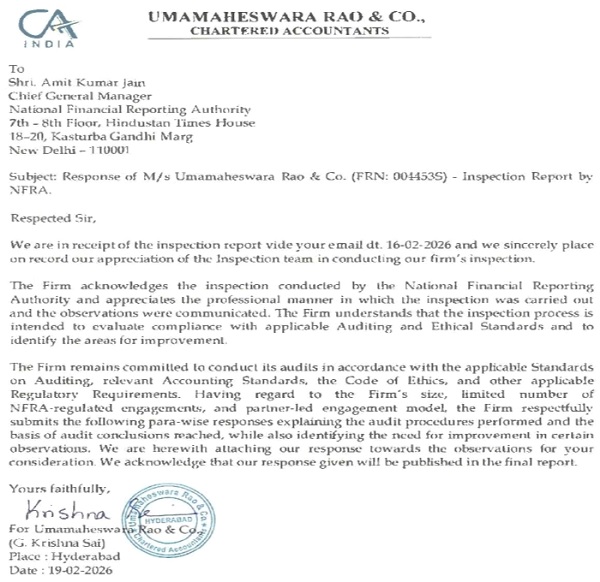
Company Law : NFRA introduced guidelines to evaluate audit firms’ compliance and quality control systems. The framework emphasizes governance,...
Company Law : ICSI highlights delays in marking defective forms by RoCs under CCFS 2026. It urges MCA to mandate time-bound processing or allow ...
Company Law : The issue is ambiguity in filing authority during liquidation. ICSI has requested clarity to enable liquidators to maintain statut...
Company Law : The Madras High Court permitted Nidhi companies to submit fresh replies against NDH-4 rejection orders and directed authorities to...
Company Law : Legal Analysis and Narrative Brief: Dale and Carrington Investment Pvt. Ltd. and Another v. P.K. Prathapan and Others (Supreme Cou...
Company Law : The case examined whether Tribunal approval was required for extending preference share redemption. It was held that such extensio...
Company Law : The Tribunal held that allegations of siphoning ₹30 lakh were not supported by any evidence tracing funds to the respondent. Mer...
Company Law : The Court held that a separate meeting of sub-class shareholders is not required when identical terms are offered to the entire cl...
Company Law : ROC Pune held that procedural lapses in a private placement involving one investor formed part of a single integrated transaction ...
Company Law : ROC Pune penalized a start-up company and its officers for delayed filing of e-Form MGT-14 relating to a Special Resolution under ...
Company Law : ROC Pune penalized a company and its directors for delayed filing of e-Form PAS-3 relating to private placement allotment under Se...
Company Law : ROC Pune penalized a company and its directors for utilizing private placement funds before filing return of allotment under Secti...
Company Law : ROC Mumbai-II imposed penalty under Section 450 after a company incorrectly mentioned the AGM date in Form AOC-4 XBRL. The order h...
The issue concerned late filing of Form MGT-14 for a special resolution. The authority held the delay violated Section 117(2) and imposed penalties on the company and its officers.
The notification updates the IEPF Authority’s composition by appointing an RBI Executive Director as an ex-officio member. The key takeaway is the revised institutional representation within the Authority.
The issue was failure to provide full allottee particulars in PAS-3. The key takeaway is that missing PAN or email details can trigger penalties under Section 450.
The issue involved prolonged delay in filing Form MGT-14 for approval of annual accounts. The authority held that such delay attracts residuary penalty despite subsequent compliance.
This matter examined consequences of not filing a mandatory Board Resolution. The authority held that later compliance does not erase liability for earlier default.
The adjudicating authority held that failure to maintain the required number of directors liable to retire by rotation violates Section 152(6)(a). A monetary penalty was imposed on the officer in default despite suo motu disclosure.
The case addressed failure to appoint a woman director within the statutory timeline. The authority held the company and its officers liable under the residuary penalty provision.
The issue was failure to appoint a CFO after crossing the capital threshold. The takeaway is that delays in KMP appointments attract steep statutory penalties.
Missing mandatory allottee particulars in PAS-3 were held to violate Rule 14(6). The company and director were penalised under Section 450 despite prior rejection of NDH-4.
The issue involved prolonged delay in filing Form MGT-14 for approval of accounts. The key takeaway is that misunderstanding compliance requirements does not absolve liability under Section 450.