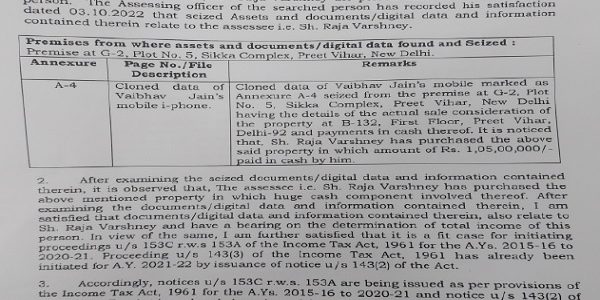
Income Tax : Smt. Ranjana Kumari/Kalta Vs DCIT/ACIT (Central) (ITAT Chandigarh) The appeals involved three assessees belonging to the Kalta Gro...
Income Tax : Understand the statutory time limits for issuing income-tax notices and completing assessments under the Income-tax Act. The guide...
Income Tax : Learn the updated provisions governing rectification, assessments, reassessments, and appeals under the Income-tax Act. This guide...
Income Tax : Learn how different types of income tax assessments are conducted under the Income-tax Act. The FAQs explain assessment procedures...
Income Tax : Section 154 permits rectification of mistakes apparent from the record in assessment orders, intimations, and TDS/TCS processing s...
Income Tax : Delhi ITAT allows Sanco Holding, a Norwegian company, to compute income from bareboat charter of seismic vessels under Article 21(...
Income Tax : It has been observed that in many cases an assessee may wish to make a claim which was not made in the return of income filed unde...
Income Tax : We have attached a file in excel format. The file contains the format of various details which normally assessing officer asks As...
Income Tax : ITAT Delhi held legal services are not FTS under Section 9(1)(vii) and directed partner-wise DTAA examination. FTS addition was de...
Income Tax : ITAT Mumbai deleted a Section 69 addition after finding documentary evidence established joint ownership, source of funds, and ear...
Income Tax : ITAT Mumbai quashed reassessment after finding no Section 143(2) notice and that the AO issued a final order disguised as a draft ...
Income Tax : ITAT Surat held that delayed filing of Form 10B is a procedural lapse and remanded the matter after directing the AO to consider t...
Income Tax : ITAT Delhi held that interest and dividend earned from co-operative banks qualify for deduction under Section 80P(2)(d). Totgar's ...
Income Tax : Instruction No.1/2015 Clarification regarding applicability of section 143(1D) of the Income-tax Act, 1961- Vide Finance Act, 2012...
PCIT had erroneously mixed up the scope of renewal proceedings with cancellation proceedings under Section 12AB(4). Further, Settlement Commission itself had accepted the charitable nature and genuineness of the assessee’s activities and PCIT (Central) was found to lack jurisdiction to adjudicate the issue of renewal/cancellation of registration.
The Bangalore ITAT held that once a notice under Section 143(2) initiates regular scrutiny assessment, the Department cannot subsequently resort to summary processing under Section 143(1). The Tribunal quashed massive GST-related adjustments as being without jurisdiction.
ITAT Delhi upheld deletion of disallowance under Section 40A(3) after finding that payments were made to multiple labourers and no individual payment exceeded statutory limit. Tribunal accepted that bulk transfers were only administrative in nature.
The High Court held that adjustment of refunds beyond 20% of disputed tax demand during pendency of appeal was unsustainable without proper justification. It directed refund of the excess amount adjusted under Section 245 of the Income Tax Act.
The ITAT Ahmedabad held that a demolished and uninhabitable structure could not be treated as a residential house for Section 54F purposes. The Tribunal upheld the assessee’s eligibility for capital gains exemption.
The ITAT Mumbai ruled that income earned by a securitisation trust created under the SARFAESI Act was taxable in the hands of Security Receipt holders because the trust qualified as a revocable trust under Sections 61 to 63 of the Income Tax Act.
The ITAT Indore held that Section 50C could not be invoked where the difference between actual sale consideration and stamp duty valuation was only 1.19%. The Tribunal directed adoption of actual sale consideration as the full value for capital gains computation.
The ITAT Ahmedabad held that Form 10-IE filed along with the return could not be ignored merely because it was not filed within the due date under Section 139(1). The Tribunal directed CPC to recompute tax under the new tax regime.
The ITAT Rajkot held that mere disallowance of expenditure during assessment proceedings does not automatically justify penalty under Section 271(1)(c). The Tribunal found no concealment or furnishing of inaccurate particulars by the assessee.
The Tribunal held that rental income earned from immovable property held under trust could not automatically be treated as business income. It ruled that the proviso to Section 2(15) was wrongly invoked where the trust’s dominant object remained charitable.