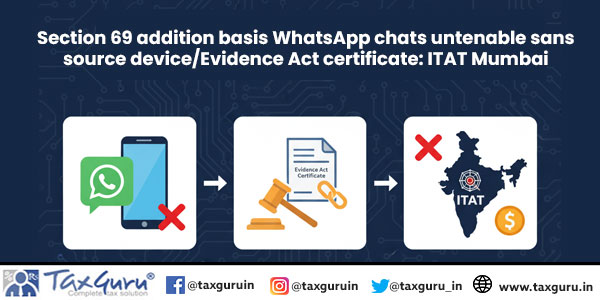
Income Tax : ITAT held that additions based solely on third-party search material without independent evidence or cross-examination are invalid...
Income Tax : Income without satisfactory explanation is taxed at a special high rate under Section 115BBE. The provisions place strict liabilit...
Income Tax : A doctrinal analysis of unexplained cash credits, investments, and expenditure under Sections 68–69D. Explains burden of proof a...
Income Tax : This covers how unexplained credits and investments are taxed under Sections 68 to 69D. The key takeaway is that additions require...
Income Tax : ITAT held that section 69 cannot be invoked where purchases are duly recorded in books and paid through banking channels, making t...
Income Tax : The ITAT Amritsar held that a valuation report by itself cannot justify addition under Section 69 without evidence of extra paymen...
Income Tax : The ITAT held that stamp duty valuation could not be blindly adopted where the property was affected by BBMP demolition proceeding...
Income Tax : The ITAT Delhi upheld deletion of a Rs.6 crore addition under Section 68 after finding that the share sale transactions were prope...
Income Tax : Delhi ITAT held that investments in immovable properties cannot be treated as unexplained once payments are made through disclosed...
Income Tax : The Tribunal held that entries found in third-party ERP software during a search cannot alone justify unexplained investment addit...
The ITAT deleted an addition under Section 69 for unexplained investment in property. The tribunal held that authorities couldn’t ignore the sale deed and bank statements proving the co-owner (husband) made the payments in a preceding year, even in ex-parte proceedings.
ITAT Indore deleted a ₹2 lakh addition for cash deposited during demonetisation, citing CBDT Instruction No. 3/2017 which bars verification for deposits up to ₹2.5 lakhs by individuals.
Detailed overview of penalties under various sections of the Income Tax Act, covering defaults in tax payment, reporting, documentation, and TDS/TCS compliance with prescribed penalty amounts.
ITAT Jaipur held that gain not realized during the year under consideration cannot be taxed under the head capital gain or as income under the head profit and gains of business or profession by valuing unsold scrips at market value.
ITAT Lucknow held that cash deposits during demonetization period cannot be treated as unexplained credit since the same is made out of cash sales. Accordingly, addition merely on suspicion, doubt, conjecture and guess work cannot be sustained.
GST arrest power under Section 69 is limited to grave offenses (evasion > ₹2 crore, or repeat fraud), requiring reasons to believe and adherence to Article 22 safeguards, with most offenses being non-cognizable and bailable.
The ITAT Delhi partly allowed an appeal, restricting a Rs. 10 lakh cash deposit addition to 1 lakh after the assessee, a salaried individual, explained the source as family savings from disclosed income. The Tribunal used a reasonable estimate approach, finding neither the assessee’s full explanation nor the Revenue’s complete rejection of evidence to be fully warranted, granting Rs. 9 lakh relief.
ITAT Mumbai set aside a ₹74 lakh unexplained investment addition, remanding the case to the AO after finding the AO ignored evidence and based the addition on an incorrect loan amount.
The Tribunal set aside the PCIT’s revision of a scrutiny assessment, ruling the action invalid because the Assessing Officer’s view on critical items like creditors and PF/ESI payments was already plausible and reasoned. Introducing new issues not covered in the show-cause notice constituted an exercise of jurisdiction beyond the permissible scope of Section 263.
The ITAT restored the assessee’s appeal, condoning the delay because the NFAC sent crucial communications to a wrong email, thus depriving the taxpayer of an opportunity to be heard. The ruling confirms that the entire appellate proceeding becomes non-est if service of notice is flawed, and the matter must be decided afresh on its merits.