Income Tax : This guide explains when penalties can be imposed under various provisions of the Income-tax Act, 1961. It also outlines the appli...
Income Tax : This guide explains how unexplained cash credits under Section 68 and related provisions can attract steep taxation under Section ...
Income Tax : The Tribunal held that cash deposits during demonetisation cannot be treated as unexplained when backed by audited books, invoices...
Income Tax : ITAT Bangalore held that profit cannot be estimated arbitrarily when regular books of account are maintained and not rejected unde...
Income Tax : A large spousal gift exemption was denied due to failure in proving genuineness, creditworthiness, and source of funds. The ruling...
Income Tax : ITAT Kolkata deleted the Section 68 addition, holding that share application money already assessed in subscribers' hands cannot b...
Income Tax : Calcutta HC dismissed the Revenue's appeal after the remand report confirmed the disputed receipt was sale proceeds of investments...
Income Tax : ITAT Delhi held Section 68 cannot apply to sale proceeds of disclosed investments already recorded in books. Revenue's appeals wer...
Income Tax : ITAT Delhi held Section 68 inapplicable where shares were disclosed in an earlier year and sale proceeds were already offered as i...
Income Tax : ITAT Agra held Section 44AD could not apply where turnover exceeded the limit, adopted past profit history, allowed telescoping an...
Income Tax : CBDT has instructed tax officers to uniformly apply Sections 68 to 69D and Section 115BBE after a C&AG audit found inconsistencies...
Income Tax : Assessing Officers should follow the sequence as noted below for applying provisions of section 68 of the Act: Step 1: Whether the...
Ahmedabad ITAT held that the Assessing Officer wrongly treated entire business liabilities and receipts as unexplained income. The addition was drastically reduced to estimated profit at 15% of disputed turnover.
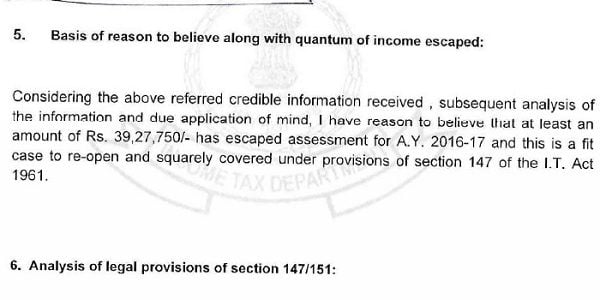
The ITAT Ahmedabad held that reassessment under Section 147 was invalid because the Assessing Officer reopened the case for fictitious loan entries but made additions for alleged bogus LTCG from penny stock transactions. The Tribunal ruled that changing the basis of reopening is not permissible in law.
ITAT Delhi held that an appeal dismissed ex-parte by NFAC should still be decided on merits under Section 250 of the Income Tax Act. The Tribunal restored the matter for fresh adjudication after granting one final opportunity to the assessee.
ITAT Delhi held that penalty under Section 271AAC cannot survive once the underlying Section 153C assessment is quashed. The Tribunal deleted the penalty after noting that the quantum assessment itself no longer existed.
ITAT Mumbai deleted additions exceeding ₹10.57 crore made under section 56(2)(vii)(c) after finding that the Assessing Officer wrongly adopted an amended valuation approach retrospectively. The Tribunal upheld the CIT(A)’s deletion in entirety.
ITAT Mumbai held that additions under section 68 cannot survive where the Assessing Officer failed to conduct independent verification of alleged accommodation entries. Reliance solely on third-party investigation reports was rejected.
ITAT Chandigarh held that cash deposits during demonetization could not be treated as unexplained income since the amounts were recorded as sales turnover in the books and supported by VAT returns.
ITAT Delhi deleted a ₹45 lakh addition under Section 68 after finding that the assessee had furnished complete details of investor companies and share allotment. The Tribunal held that verified share application money could not be treated as unexplained cash credit.
ITAT Delhi held that addition under Section 41(1) cannot be made without proving cessation of liability. The Tribunal found that family loans continued to remain payable and were merely reclassified in the capital account.
The ITAT Surat held that abnormal price rise in a penny stock and surrounding circumstances justified treating claimed LTCG as unexplained income under Section 68. The Tribunal found the transactions to be part of a pre-arranged accommodation entry scheme.