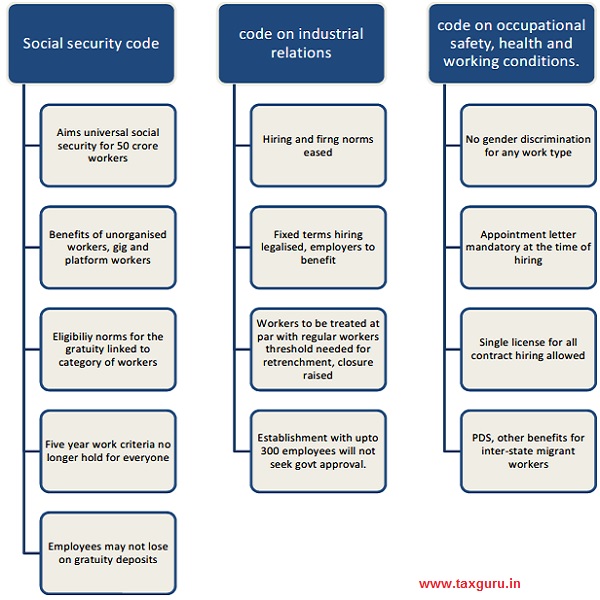
Corporate Law : India’s Social Security Code consolidates multiple labour welfare laws into a unified framework covering organised, unorganised,...
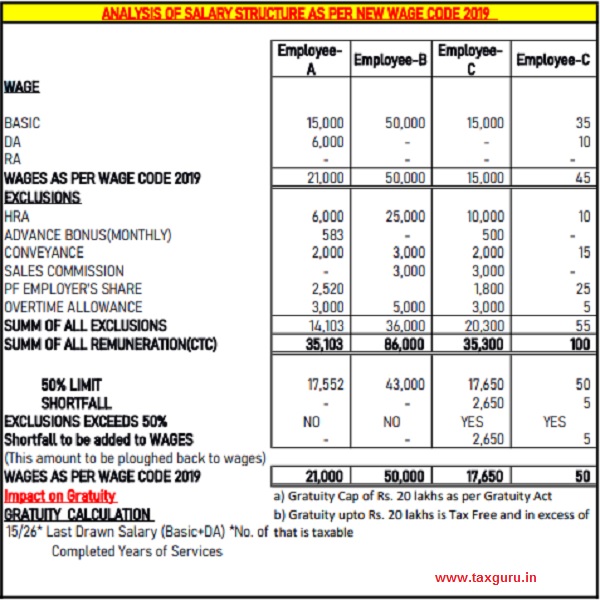
Corporate Law : The Code on Wages and the 2026 Rules introduce a uniform wage definition and cap exclusions at 50% of total remuneration. Employer...
Corporate Law : India’s new Labour Codes introduce a uniform wage definition and 50% cap on exclusions, affecting PF, gratuity, bonus, and salar...
Corporate Law : The paper examines whether recent labour law reforms deliver real gender equality or merely formal compliance. It concludes that d...
Corporate Law : Dhara Verma Abstract The labour welfare laws in India provide essential maternity and paternity benefits to workers which demonstr...
Corporate Law : The ruling clarifies that digital processes are encouraged but not mandatory, ensuring workers rights are protected even through p...
Company Law : The law removes sector-based exclusions and extends minimum wage protection to all employees. It confirms universal coverage acros...
Corporate Law : The FAQs explain the uniform wage definition and the 50% allowance cap across all Codes. Gratuity applies prospectively from 21 No...
Corporate Law : The Code retains trade union rights, collective bargaining, and strike provisions with notice requirements. It confirms continued ...
Corporate Law : Raising factory and licensing thresholds does not remove safety and welfare protections. All establishments with 10 or more worker...
Corporate Law : The Supreme Court held that compensatory allowances form part of “ordinary wages” for overtime calculation. Executive circular...
Corporate Law : The Karnataka High Court has set aside a prosecution order against Natural Remedies Private Limited. The court found that the Comm...
Corporate Law : Punjab & Haryana High Court directs that temporary employees cannot be replaced by another set of temporary staff but can be repla...
Corporate Law : The Telangana High Court addressed jurisdiction and employment status in Godrej Agrovet Ltd. Vs Presiding Officer. Key aspects of ...
Corporate Law : The Bombay High Court sets aside the Industrial Court's interim relief, reinstating employer rights to transfer and discipline emp...
Corporate Law : The Industrial Relations Code (Amendment) Bill, 2026 (Bill No. 33 of 2026), introduced in the Lok Sabha, seeks to amend section 10...
Corporate Law : The government has notified a clear wage ceiling for supervisory roles. Earnings above this limit remove such employees from worke...
Corporate Law : The Government has issued draft Coal Mines Safety Regulations, 2026 under the OSHWC Code, detailing safety standards, certificatio...
Corporate Law : The draft Central Rules lay down detailed procedures to operationalised the Industrial Relations Code, replacing older dispute and...
Corporate Law : The notification introduces draft rules under the OSH Code to unify and modernise labour regulation. The key takeaway is a shift t...
Where a worker works in a factory for more than nine hours in any day or for more than forty-eight hours in any week, he shall, in respect of overtime work, be entitled to wages at the rate of twice his ordinary rate of wages
Alternative Dispute Resolution (ADR) mechanisms are gaining momentum in India’s labour law enforcement system. It has become an essential tool to resolve conflicts and disputes in the workplace. The traditional court system is seen as time-consuming, expensive, and complicated, leading to a backlog of cases.
As work-from-home and hybrid working have become more common, employees have found that they are more comfortable managing and engaging in activities besides the specified work obligations that serve as their primary source of revenue.
Industrial Dispute Act is enacted in year 1947 by the parliament of India in order to make the provisions for the investigation and settlement of industrial disputes, and for certain other purposes. It is labour legislation to protect the workmen against victimization by employers and to ensure social justice to both employers and employees. It lays down the provisions related to lay offs in India.
A contractual employee is defined under Section 2(b) of The Contract Labor (Regulation and Abolition) Act, 1970 which states that a contractual employee is employed by a principal employer in connection with the work of an establishment through a contractor.
Given the obstacles they encounter at work, women’s well-being has long been an issue in India. These challenges tend to have a connection to social, economic, and legal aspects. Although there are legislation and processes in place to protect the rights of women workers, they are not always adhered to by numerous corporations.
The unorganized sector, also known as the informal sector, is a term used to describe employment that is not regulated by the government or formal institutions. It includes various types of self-employment and small-scale enterprises, which operate outside the purview of labor laws and regulations.
Understand the recent layoffs in companies like Accenture and the rights available to workers in India. Explore provisions under the Industrial Disputes Act, 1947, and the Industrial Employment (Standing Orders) Act, 1946. Learn about compensation, notice periods, and employees’ rights to challenge layoffs. Stay informed about labour laws and safeguard the rights of employees during layoffs.
In India, trade unions are essential for protecting workers’ rights. These groups push for greater pay, benefits, and working conditions while representing workers in agreements with employers. In this blog, we will look at how trade unions in India struggle to uphold workers’ rights.
The Industrial Disputes Act, 1947, was enacted to regulate employment relations and resolve disputes between employers and employees in India. One of the most contentious issues covered under the Act is the termination of employment, including lay-offs and retrenchment.