Dhara Verma
Abstract
The labour welfare laws in India provide essential maternity and paternity benefits to workers which demonstrate the country’s commitment to achieving gender equity and supporting families while fostering social and economic development. The maternity protection system in India has experienced legislative and judicial improvements but its paternity benefits system remains underdeveloped because necessary policy decisions have not created legal rights. The research paper evaluates the maternity and paternity benefit laws in India through critical assessment while examining constitutional and judicial changes and international standards. The existing maternal-centric system perpetuates gender discrimination because it creates unfair financial burdens for companies which lead to indirect discrimination against women who work. The paper supports a shift to gender-neutral parental leave systems which require government backing and comprehensive coverage for informal workers.
1. Introduction
The evolution of labour law began with its original system based on contracts and evolved into a modern welfare system which safeguards workers from severe occupational hazards.’ The laws which govern maternity and paternity benefits establish their unique position because their enforcement interrupts both gender equality rights and social security systems and reproductive rights.
India provides maternity protection through its established legal framework but does not yet have complete paternity benefits.’ The existing situation demonstrates a structural problem because society continues to hold biased views about who should perform caregiving duties. The law recognizes women as primary caregivers who require legal protection but it does not extend the same rights to men.
The research paper evaluates whether existing legal systems maintain constitutional standards of equality and dignity while measuring their success in meeting present economic and social demands.
2. The research focuses on Labour Welfare and Gender Justice which serves as the main research area for Theoretical Framework.
2.1 Welfare State and Labour Rights.
Maternity benefits exist because welfare state principles deliver essential social security protection and basic living standard requirements. The economic safeguards that labour welfare measures provide to workers create social justice through their function as protection for working people.
2.2 Feminist legal perspective
The maternity benefits system has two functions according to feminist analysis because it provides protective benefits through its system while creating a restriction of existing gender roles. The laws that provide maternity rights to women create a system that maintains gender discrimination by preventing men from taking on family care duties.
2.3 Substantive Equality
The Indian Constitution guarantees equality under Articles 14, 15, and 16.3 The concept of formal equality which treats all people equally does not provide enough protection. Labour laws must create equal rights for all workers because they need to protect women’s rights and promote shared responsibilities between men and women.
3. Maternity Benefits in India: A Critical Study
3.1 statutory Framework
The Maternity Benefit Act, 1961 provides comprehensive protection to women employees.4 The law guarantees three essential benefits to workers which include paid leave and job security as
well as medical benefits. The 2017 amendment together with subsequent reforms has resulted in better protection for workers.
The law establishes a framework which only offers protection to women through its maternal- focused approach.
3.2 progressive Development
- The government will extend maternity leave time period to 26 weeks.
- The updated policy will recognize both adoptive mothers and mothers who choose surrogate motherhood.
- The new system will start its crèche service operations through its established process.
The new parental rights reforms show how society better understands what parents require to care for their children.
3.3 Judicial Activism
The Supreme Court established maternity rights for casual workers in the case Municipal Corporation of Delhi v. Female Workers (Muster Roll) because the court recognized these rights as essential human rights.5 The courts have established that maternity benefits function as a constitutional right because they derive from Article 21 which protects the fundamental right to life and dignity of every person.
3.4 Critical Issues
i. Employer-Centric Cost Model
Employers bear all financial expenses which arise from maternity benefits. This creates:
- Hiring bias against women
- Wage disparities
- Reduced employment opportunities
ii. Exclusion of Informal Sector
India has a large workforce which operates in its informal sector because workers do not receive proper statutory protections.
iii. Reinforcement of Gender Roles
The law enforces the belief which exists that women alone bear responsibility for childcare through its exclusive focus on women.
4. Paternity Benefits: The Missing Link
4.1 Legal Vacuum
The country of India does not possess an all-encompassing legal framework which provides paternity leave benefits. The current rules only apply to government workers who are covered by specific service regulations.
The situation demonstrates a societal bias which fails to acknowledge men as the main caregivers.
4.2 Implications
The absence of paternity leave creates multiple negative impacts which include:
- Unequal distribution of caregiving responsibilities
- Increased burden on working mothers
- Limited father-child bonding
- Reinforcement of patriarchal norms
4.3 Legislative Inertia
The Paternity Benefit Bill, 2018,6 represents a step towards reform but remains unenacted. The government demonstrates its lack of political commitment to gender-neutral parenting policies through its failure to enact this legislation.
5. Comparative International Perspective
5.1 Nordic Model
The shared parental leave system of Sweden and Norway provides both parents with paid parental leave benefits. The leave includes a special part which must be used by fathers to guarantee their involvement in child care activities.
5.2 Role of International Labour Organization
The ILO Advocates:
- Maternity Protection
- Paternity and Parental Leave
- Work- Life Balance
International conventions emphasize that parental benefits should not reinforce gender inequality. 5.3 Lessons for India
Paternity leave rights need to expand by including social security benefits which allow workers to take paternity leave while accessing social insurance benefits.
6. Constitutional Perspective
There are constitutional queries about the present setup:
6.1 Equality Before Law (Article 14)
Failure to pay paternity benefits may also be an instance of treating parents unequally as equals.
6.2 Non-Discrimination (Article 15)
The law permits special provisions for women but their implementation with exclusion of men will create a situation that maintains existing stereotypes. The law permits special provisions for women but their implementation with exclusion of men will create a situation that maintains existing stereotypes.
6.3 Right to Life and Dignity (Article 21)
The prompt arises from Article Eighteen’s principles.
7. Economic and Social Implication
7.1 Impact on Women’s Employment
High maternity costs discourage employers from hiring women which results in two effects. The first effect creates a gender wage gap while the second effect results in occupational segregation.
7.2 Productivity and Economic Growth
The implementation of inclusive parental policies leads to:
- Increased employee contentment
- Higher employee retention rates
- Improved workforce participation rates
7.3 Social Transformation
Paternity leave assists in:
- Gender equality
- Balanced family structures
- Physical and neurological development of children
8. Towards a Gender-Neutral Parental Leave Framework
8.1 Key Features of Reform
- Given equal time off for both parents
- Ensures offering paternity leave and does not allow transfers
- Keeps the scope of state-financed benefits to include informal worker as well
8.2 Policy Recommendation
(i) Enact Comprehensive Legislation
The current combination of existing parental benefit laws should be replaced by a single unified Parental Benefit Act.
(ii) Social Insurance Model
Government-funded programs enable companies to decrease their financial obligations toward employee health benefits.
(iii) Awareness and Cultural Change
The implementation of legal reform requires the establishment of social awareness programs.
9. Empirical Data, Graphs, and Comparative analysis
9.1 Global Gender Gap in Parental Level (Graph Analysis)
The International Labour Organization (ILO) discovered one of its most important research results when it found that:
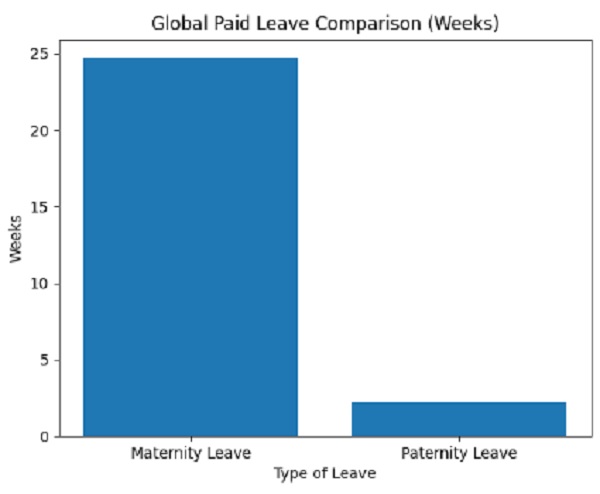
- Average maternity leave worldwide lasts for 24.7 weeks.
- Average paternity leave throughout the world extends for 2.2 weeks.
- The time difference between them exceeds five months.
Graph 1: Global Paid Leave Comparison
Critical Insight
The graph displays a structural imbalance:
- women serve as primary caregivers
- men function as secondary or optional caregivers.
> This imbalance creates a situation which results in men receiving preferential treatment through their ability to choose between work and home responsibilities while women must take on both roles.
12.2 Access to Maternity Leave (Global V. India)
Graph 2: Access to Paid Maternity Leave
- Global Average:58% Workers have Access
- India: (Urban) 82%
- India: (Rural) 58%
- Informal Sector: (Global) 60% Lack Access
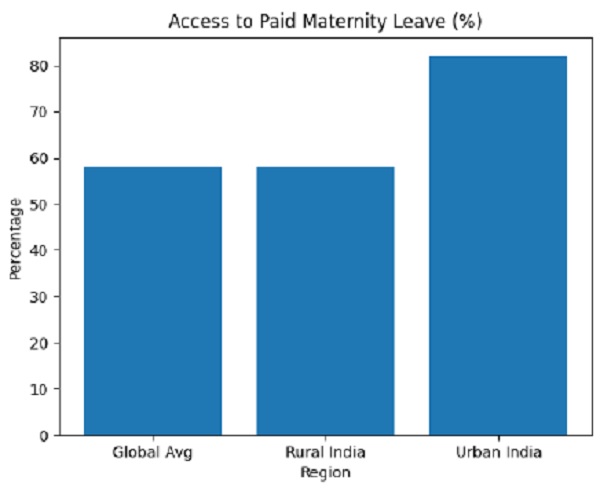
Formal employment provides better job opportunities in urban areas which enables them to achieve higher development results. The rural population together with informal workers continues to face severe social exclusion from society.
The situation demonstrates that India experiences two distinct problems which operate as a dual labor market system.
12.3 Impact of Maternity Leave on Social Outcome
Table 1: Effect of Maternity Leave (Empirical Data)
| Indicator | Impact |
|---|---|
| Infant Mortality | ↓4.3% per Additional 4 Weeks |
| Maternal Depression | ↓18% |
| Women’s Employment Retention | ↑31% |
| Workforce Participation | ↑9% |
| Child Education Outcome | ↑12% |
Critical Insight
Maternity leave is both one step towards providing welfare and a highly essential investment in human capital.
12.4 Women’s Workforce Participation in India
Graph 3: Female Labour Force Participation (India)
- Increased From 27.8%-41.7% (2024-2025)
- Still far Below Global Standards
Key Insight
- The economy experiences slow growth which occurs in an irregular pattern.
- Most women work in positions that are either informal or which pay low wages.
12.5 Motherhood Penalty and Employment Loss
Table 2: Post-Maternity Employment Challenges (India)
| Issue | Data |
|---|---|
| Women Leaving Workforce After Childbirth | ~48% |
| Difficulty Returning to Work | ~40% |
| Formal Employment among Mothers | ~11% |
| Hiring Discrimination (Callback drop) | ~22% |
The evidence demonstrates that:
- The existing fatherhood penalty creates disadvantages for men at work.
- Women face job loss while their career development becomes slower and wage differences between men and women keep growing.
12.6 Comparative Table: India vs. Global Best Practices
Table 3: Comparative Parental Leave Framework
| Feature | India | Sweden/Norway (Model Countries |
|---|---|---|
| Maternal Leave | 26 Weeks | ~12-14 Months Shared |
| Paternal Leave | Limited (15 Days govt. only) | Mandatory Father quota |
| Funding | Employer based | State-Funded |
| Gender Neutrality | Low | High |
| Informal Sector Coverage | Weak | Strong |
12.7 Economic Impact of Parental Leave
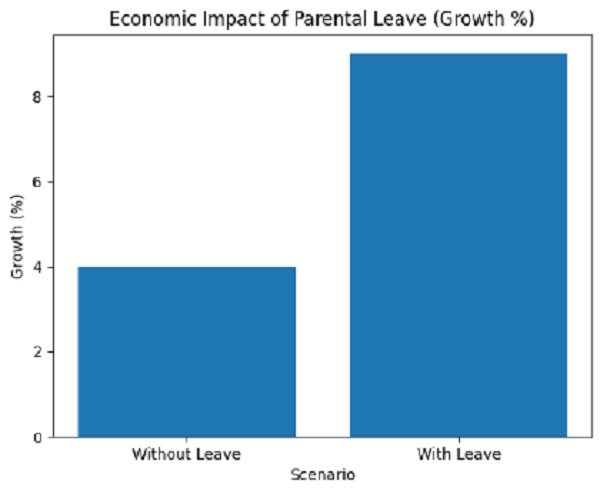
Graph 4: Economic Effect
- The implementation of paid leave results in a 9 percent increase in women’s participation within the workforce.
- The economic growth potential of a country improves when both genders are included in its workforce.
 Creative Insight
Parental leave is not a cost; it increases the economy.
14. Critical Evaluation
Woman protection through the Indian maternity benefit system fails to achieve its goals because it does not provide complete rights protection while it ignores gender-based discrimination which arises from caregiving duties. Modern economies require maternal-centric systems but they also need additional solutions because their dual-income family structure and changing gender roles create new requirements.
The absence of paternity benefits in legislation proves that society discriminates against men through its fundamental practices which exist at a deeper level. The legal system will remain ineffective until society achieves complete resolution of its existing biases.
15. Conclusion
The implementation of maternity and paternity benefits serves as vital resources which help to create gender equality and social equality between men and women. India needs to improve its maternity protection system because it has developed successful programs but still needs to acknowledge the significance of paternity rights.
The current parental leave systems need to be replaced with a gender-neutral system which will enable labour regulations to meet both constitutional rights and international labour standards and practices. The proposed changes will create advantages for households while driving forward economic development and social progress.
References
1. Maternity Benefit Act, 1961
2. Maternity Benefit (Amendment) Act, 2017
3. Code on Social Security, 2020
4. Municipal Corporation of Delhi v Female Workers (Muster Roll) (2000) 3 SCC 224
5. B Shah v Presiding Officer, Labour Court, Coimbatore (1977) 4 SCC 384
6. Air India v Nergesh Meerza (1981) 4 SCC 335
7. Neera Mathur v LIC of India (1992) 1 SCC 286
8. United Nations, Convention on the Elimination of All Forms of Discrimination Against Women (CEDAW), 1979
9. P L Malik, Industrial Law (Eastern Book Company, latest edn)
10. V G Goswami, Labour and Industrial Law (Central Law Agency, latest edn)
11. OECD, Parental Leave Systems and Economic Outcomes (2021)
12. UNICEF, Early Childhood Development Report (2020)