The Companies Act is a legislation that governs the formation, functioning, and management of companies. Explore the key provisions, compliance requirements, and legal framework under the Companies Act.
Company Law : The Companies Act, 2013 and related rules now require most public and private companies to issue and transfer securities only in d...
Company Law : The Companies Law Amendment Bill, 2026 proposes major reforms in corporate governance, compliance, and digital regulation. This ar...
Company Law : This guide explains the complete legal procedure for shifting a company’s registered office within the same state but under a di...
Company Law : Section 56 of Companies Act, 2013 requires execution of a proper instrument of transfer for transfer of interest of a member in a ...
Corporate Law : The article explains how digital adjudication systems, virtual hearings, and online compliance platforms are reshaping India’s c...
Company Law : Provisional list of audit firms of listed companies yet to file NFRA-2 for 2023-24. Filing deadline was 30.11.2025; fines apply fo...
Company Law : ICSI recommended restoring public access to basic company master data without mandatory login requirements. The representation sta...
Company Law : NFRA introduced guidelines to evaluate audit firms’ compliance and quality control systems. The framework emphasizes governance,...
Company Law : ICSI highlights delays in marking defective forms by RoCs under CCFS 2026. It urges MCA to mandate time-bound processing or allow ...
Company Law : The issue is ambiguity in filing authority during liquidation. ICSI has requested clarity to enable liquidators to maintain statut...
Company Law : The Madras High Court permitted Nidhi companies to submit fresh replies against NDH-4 rejection orders and directed authorities to...
Company Law : Legal Analysis and Narrative Brief: Dale and Carrington Investment Pvt. Ltd. and Another v. P.K. Prathapan and Others (Supreme Cou...
Company Law : The case examined whether Tribunal approval was required for extending preference share redemption. It was held that such extensio...
Company Law : The Tribunal held that allegations of siphoning ₹30 lakh were not supported by any evidence tracing funds to the respondent. Mer...
Company Law : The Court held that a separate meeting of sub-class shareholders is not required when identical terms are offered to the entire cl...
Company Law : ROC Pune held that procedural lapses in a private placement involving one investor formed part of a single integrated transaction ...
Company Law : ROC Pune penalized a start-up company and its officers for delayed filing of e-Form MGT-14 relating to a Special Resolution under ...
Company Law : ROC Pune penalized a company and its directors for delayed filing of e-Form PAS-3 relating to private placement allotment under Se...
Company Law : ROC Pune penalized a company and its directors for utilizing private placement funds before filing return of allotment under Secti...
Company Law : ROC Mumbai-II imposed penalty under Section 450 after a company incorrectly mentioned the AGM date in Form AOC-4 XBRL. The order h...
Article explains Provisions of Section 186 of Companies Act, 2013 related to Inter-Corporate Loans & Investments. Section 186 is NOT Applicable to Loan Made, guarantee given or security provided or investment made by Banking Company, or Insurance Company or Housing Finance Company in the ordinary course of its business or whose principal business is of […]
Investor Education and Protection Fund (IEPF) is a fund that is created by Central Government under section 125 of Companies Act, 2013 for promotion of investors’ awareness and protection of interests of investors.
The Supreme Court on 6 th July 2020 in the case of Aruna Oswalvs Pankaj Oswal has categorically held that dispute about inheritance of shares is a civil dispute and the same cannot be decided in proceedings under Section 241/ 242 of Companies Act, 2013. The brief facts of the case are that Late Abhey […]
Fast Track Mergers The introduction of the concept of fast track mergers or FTMs has led to a significant change in the M&A landscape. Prior to the introduction of FTM vide section 233 and Rule 25 of Companies (Compromises, Arrangements and Amalgamations) Rules, 2016 there was one unified merger process for all companies. This process […]
As per section 71 (Debentures) read with rule 18 of the Companies (Share Capital and Debentures) Rules 2014 provides the condition for issue of debentures. A debenture is a legal document that represents a secure means by which a creditor can lend money to the debtor. As per section 2 (30) of the Companies Act, […]
Article explain Provision of Section 29(1) & Section 29(IA), Issue of securities by Unlisted public company in demat form, Demat of all existing securities of Promoters and KMPs by Unlisted public Company, Action to be taken by Holder of securities of unlisted company, Obtaining of ISIN by Unlisted Public Company, Obligations of the Unlisted Public […]
E-form Active (INC-22A) and Companies Fresh Start Scheme, 2020 (‘CFSS-2020’) On November 2, 2018, the Government of India has announced various new amendments to the Companies Act, 2013 (‘Principal Act’). These amendments were a continuation of a number of steps the Government of India has taken in the past couple of years, to strengthen the […]
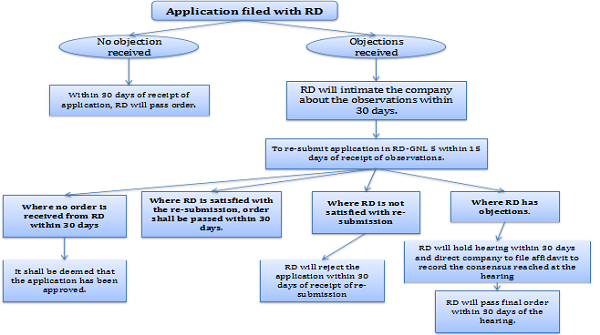
All about Financial Year of a Company/Body Corporate Under Companies Act, 2013 Article explains Definition of Financial Year as provided in Section 2(41) of the Companies Act, 2013. It further explains how to make Application for change of Financial Year to Regional Director in Form RD-1 for approval under section 2(41) along with prescribed fees. […]
Due to this pandemic situation every person is limited with resources either in the terms of funds or in terms of compliance, so in this pandemic situation, to boost the entrepreneur and to encourage him the government comes forward and introduce an one time late fees waiver for all the previous returns in which Company […]
1. Section 149 (4) and rule 4 of Companies (Appointment & Qualification of Director) Rule, 2014 1. Every listed company shall have at least 1/3rdof total No. of directors as Independent Director, and 2. Following classes of companies shall have at least 2 Directors as Independent Director- In case of Public Company having – i. […]