
Introduction
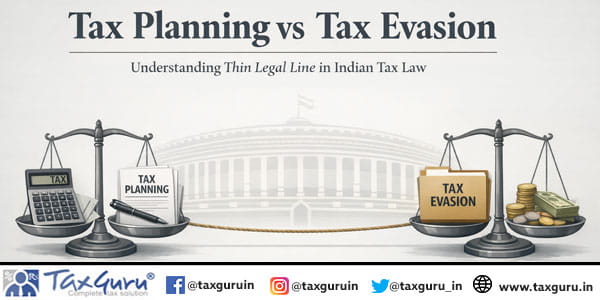
One of the main ways the government raises money is through taxes, which also have a big impact on a nation’s economic growth. In India, public welfare initiatives including infrastructure development, healthcare, education, and social security programs are funded by taxes paid by both individuals and corporations. In addition, people frequently search for methods to lower their tax liability. This causes misunderstandings between tax planning and tax evasion, two key ideas in tax law despite the fact that they both seek to lower tax obligations, they are essentially distinct. By utilising the deductions, exemptions, and incentives offered by tax legislation, tax planning is a legitimate way to reduce tax obligations. Contrarily, tax evasion entails unlawful actions like hiding income or giving false information in order to evade paying taxes. Taxpayers must comprehend this distinction in order to stay in compliance with the law and stay out of trouble. In clear and understandable terms, this article describes the definition, distinctions, legal status, and real-world applications of tax planning and tax evasion.
Meaning of Tax Planning
These provisions are intentionally introduced by the government to promote financial The structuring of financial affairs in a way that lawfully lowers tax liabilities is referred to as tax planning. In order to achieve tax efficiency while staying within the bounds of the law, it entails utilising the provisions offered by taxation legislation. Tax planning helps people properly manage their finances by promoting investments and savings. For instance, investments made in securities like Public Provident Funds (PPF), life insurance policies, and Equity Linked Saving Schemes (ELSS) are eligible for deductions under Section 80C of the Income Tax Act, 1961. Likewise, health insurance premiums can be deducted under Section 80D. social welfare and security. Because tax planning complies with the law and promotes economic growth through investment and compliance, it is consequently regarded as a valid and acceptable strategy.
Meaning of Tax Evasion
The unlawful practice of purposefully avoiding paying taxes by concealing income or falsifying financial data is known as tax evasion. It entails breaking tax regulations and is punishable by fines, interest, and in extreme situations, prosecution. Tax evasion is frequently demonstrated by failing to report real income, keeping fictitious accounts, fabricating invoices, or carrying out cash transactions that are not documented in order to avoid paying taxes. Such actions lead to inequity among law-abiding taxpayers and have a detrimental impact on government revenue. Tax evasion is strictly prohibited under the Income Tax Act of 1961, and its identification has improved with the growing use of digital surveillance, data analytics, and required reporting systems. Taxpayers must thus be fully aware that unlawful tax evasion might have serious legal repercussions.
Difference Between Tax Planning and Tax Evasion
The following principles, which provide a full explanation of their nature, legality, aim, and impact, help to clarify the difference between tax planning and tax evasion:• Nature and Legality: Within the parameters of tax legislation, tax planning is a legitimate and acceptable practice. Using measures that are particularly permitted by law, it entails structuring financial affairs to minimise tax obligations. Contrarily, tax evasion is unlawful and entails wilfully breaking tax regulations by hiding income, falsifying accounts, or providing misleading information to tax officials.
- Goal and Intention: Tax planning aims to reduce tax obligations through legal methods while maintaining adherence to legal mandates. It displays sound financial judgement and conscientious tax administration. However, the goal of tax evasion is to completely avoid paying taxes by using dishonest or illegal means, which negates the purpose of taxes.
- Approach Used: Tax planning utilises the deductions, exemptions, refunds, and incentives offered by the Income Tax Act of 1961, including health insurance deductions and investments under Section 80C. Underreporting income, keeping fictitious accounts, making cash transactions that aren’t documented, or fabricating invoices in order to lower taxable income are all examples of tax evasion.
- Legal Repercussions: Since tax planning is accepted and promoted by law, it is not punishable by law when done honestly. However, under applicable tax rules, tax evasion carries severe legal repercussions, such as fines, interest payments, prosecution, and in extreme situations, incarceration.
- Effect on Economy and Society: By encouraging investments, savings, and voluntary compliance among taxpayers, tax planning supports economic growth. Because it lowers government revenue, increases inequality among taxpayers, and erodes public confidence in the tax system, tax evasion has a negative impact on the economy.
- Compliance and Transparency: Tax planning entails precise returns and paperwork that appropriately reveal financial transactions to tax authorities. Tax evasion lacks transparency and typically entails transactions that are concealed or undeclared in order to deceive authorities.
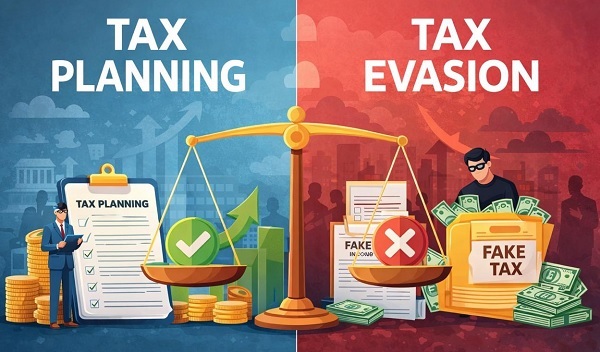
These distinctions make it abundantly evident that, even while lowering tax obligations is not criminal in and of itself, the act’s legality depends on whether the taxpayer uses honest and lawful procedures or engages in illicit ones.
Judicial Approach and Important Case Laws
Through a number of court rulings, Indian courts have made it clearer what constitutes legal tax planning and illegal tax evasion. In McDowell & Co. Ltd. v. Commercial Tax Officer (1985), the Supreme Court emphasised that taxpayers should not abuse legal provisions to avoid tax duty and noted that tax avoidance using artificial or colourable techniques should not be encouraged. Nonetheless, the Supreme Court ruled in Union of India v. Azadi Bachao Andolan (2003) that legal tax planning is acceptable as long as it follows the law. The Court acknowledged that, as long as the transactions are legitimate and not fraudulent, taxpayers have the right to set up their financial affairs in a way that legally lowers their tax obligation. These rulings demonstrate that while legal tax planning is permissible, arrangements created purely for tax evasion are not legally protected.
Real-World Examples
Because the law expressly permits such benefits, a paid person who invests in tax-saving products like PPF or takes health insurance deductions is participating in tax planning. Businesses that claim depreciation or allowable business expenses are also abiding by the law. On the other hand, tax evasion occurs when a business owner purposefully underreports sales or keeps undeclared income in order to lower their tax obligation. The distinction is whether the approach taken conforms with legal requirements rather than if the goal is to lower taxes. Ordinary taxpayers can better grasp the practical distinctions between legitimate tax planning and unlawful tax evasion by using these examples.
Challenges in the Indian Tax System
The Indian tax system still faces a number of issues that impact both taxpayers and tax officials, even in the face of several changes and technological developments. The intricacy of tax regulations and their regular revisions are among the main obstacles. Ordinary taxpayers find it challenging to completely comprehend and abide by the law because tax regulations are frequently technical in nature and are frequently changed through notifications and budget revisions. This intricacy sometimes results in inadvertent mistakes while filing taxes and encourages reliance on tax experts. The ignorance and lack of financial literacy among taxpayers is another major issue. Many people are not completely aware of the available deductions, exemptions, or correct filing procedures, particularly in rural and semi-urban areas. Because of this, taxpayers either overlook legitimate tax planning options or inadvertently commit mistakes that could result in fines. Another issue is the burden of compliance on startups and small enterprises.
It can be expensive and time-consuming to keep records, file returns on time, and follow procedural standards. The danger of non-compliance is increased for smaller organisations since they frequently find it difficult to adjust to digital systems and regulatory standards. Furthermore, the existence of a sizable cash-based informal economy diminishes the total tax base and fosters taxpayer inequality. The difficulties are exacerbated by tax disputes and protracted litigation, which can take years to settle and leave taxpayers in the dark. Even while digitisation has increased efficiency and transparency, technological problems and system-related challenges can occasionally make compliance more challenging. Thus, boosting the Indian tax system requires streamlining tax legislation, raising taxpayer awareness, and enhancing administrative effectiveness.
Conclusion
Every taxpayer must be able to distinguish between tax planning and tax evasion, which are two essentially distinct strategies for controlling tax liability. By utilising the deductions, exemptions, and incentives offered by tax rules, tax planning is a legitimate and responsible technique that enables both individuals and corporations to lower their tax burden. While guaranteeing adherence to legal requirements, it fosters economic growth, investment, and financial discipline. Contrarily, tax evasion entails wilful breaking of the law by hiding income or falsifying financial data, which not only carries legal repercussions but also compromises the integrity of the taxation system. It’s critical to strike a balance between efficient tax collection and taxpayer convenience in a developing nation like India. Voluntary compliance, awareness, and confidence between taxpayers and the government are essential components of an open and equitable taxation system. Tax evasion opportunities have decreased due to more digitisation and stronger enforcement measures, but ongoing efforts are still needed to inform taxpayers about legal tax practices and streamline compliance processes.
In the end, paying taxes responsibly helps the country thrive by guaranteeing that funds are available for infrastructure development and public welfare. Therefore, taxpayers should prioritise moral and legal tax preparation over obtaining quick money through illicit means. In addition to assisting people in avoiding legal repercussions, a thorough awareness of the fine line that separates tax planning from tax cheating enhances the general effectiveness and legitimacy of the Indian tax system.
References
- Income Tax Act, 1961
- McDowell & Co. Ltd. v. CTO, (1985) 154 ITR 148 (SC)
- Union of India v. Azadi Bachao Andolan, (2003) 263 ITR 706 (SC)
- Central Board of Direct Taxes (CBDT) Materials
- Official Income Tax Department Portal (www.incometax.gov.in)








great blog
insightful