In re Shibaura Machine India Private Limited (GST AAR Tamilnadu)
Background and Applicant’s Business
Shibaura Machine India Private Limited (the “applicant”) sought an advance ruling from the Tamil Nadu Authority for Advance Ruling (AAR) regarding the eligibility to claim Input Tax Credit (ITC) on GST paid for electrical works carried out for the expansion of its factory. The applicant is engaged in the manufacture of injection moulding machinery and accessories. To support business expansion, the company constructed a new factory adjacent to the existing facility and incurred capital expenditure on procurement and installation works.
Read AAAR Order: ITC Denied on Electrical Works for Factory Expansion as Immovable Property: AAAR TN
The applicant entered into a separate contract with M/s SMCC Construction India Limited for “Supply, Installation, Testing, and Commissioning of Electrical Works” in the new factory. The issue before the AAR was whether GST paid on this works contract qualifies for ITC under the CGST Act, 2017
Legal Framework
The AAR analyzed the provisions of Sections 16 and 17 of the CGST Act, 2017
- Section 16(1) CGST Act, 2017 – Provides that a registered person can claim ITC on goods or services used or intended to be used in the course or furtherance of business, subject to conditions. The phrase “used or intended to be used in the course or furtherance of business” is central to ITC eligibility.
- Section 17(5) CGST Act, 2017 – Lists blocked credits. Clauses (c) and (d) restrict ITC on:
- Works contract services for construction of immovable property (other than plant and machinery).
- Goods or services received for construction of immovable property, even when used in the course of business.
- Definition of Plant and Machinery – Section 17 includes “apparatus, equipment, and machinery fixed to earth by foundation or structural support, used for making outward supply of goods or services,” excluding land, buildings, telecom towers, and pipelines.
The retrospective amendment via Finance Act, 2025 clarified that references to “plant or machinery” are deemed to refer to “plant and machinery,” removing ambiguity.
Factual Analysis
The AAR examined whether the electrical works qualify as:
- Construction of Immovable Property – The contract involved electrical works integrated into the factory building, including LT panels, bus ducts, lighting systems, and civil works. The applicant argued that the electrical apparatus is movable and not part of immovable property.
The AAR noted:
-
- Under the General Clauses Act, 1897, immovable property includes things attached to the earth or permanently fastened to anything attached to the earth.
- The electrical installation, although partly movable, is integrated into the building and permanently fastened to walls and roofs, making it part of immovable property.
- Plant and Machinery – The AAR analyzed whether the electrical installation qualifies as plant and machinery:
- Components like LT panels and bus ducts perform general functions (electricity distribution, lighting) rather than specific outward supply of goods/services.
- Plant and machinery, as defined under GST, must be fixed to earth and directly used for outward supply.
- The electrical installation supports general factory operations but does not itself constitute plant and machinery.
- Works Contract – The contract was a composite supply (goods + services) for electrical installation and associated civil works. It falls under Section 2(119) as a “works contract” involving supply and installation of goods and services for immovable property. The output constitutes a permanent work delivered to the owner.
Precedents and Case Laws
The applicant cited:
- M/s Nipro India Corporation Pvt. Ltd. [2018 (10) TMI 745] – Eligibility of ITC analyzed system-wise (substation, DG set, lighting, LAN).
- M/s Elixir Industries Pvt. Ltd. [2024 (7) TMI 982] – ITC eligibility for cables from power stations to factory.
The AAR noted these rulings are distinguishable:
- Elixir Industries involved power transmission, not in-factory electrical installation.
- Nipro India considered system-wise ITC, while later rulings (Karnataka AAR, Embassy Industrial Park, 2019; Gujarat Appellate AAR, The Varachha Co-op Bank, 2023) disallowed ITC for electrical fittings inside buildings.
Thus, the cited precedents did not support the applicant’s claim.
Ruling
The AAR concluded:
- The electrical installation for the new factory constitutes works contract service for construction of immovable property.
- It does not qualify as plant and machinery as defined under Section 17 of the CGST Act, 2017
- GST paid on these works is blocked under Sections 17(5)(c) and 17(5)(d) of the CGST Act.
- Since ITC is ineligible, the question regarding the timeline for claiming ITC on advance payments does not arise.
The decision emphasizes that ITC is unavailable for composite electrical works embedded in a factory structure unless clearly defined as plant and machinery per statutory definitions.
Key Takeaways
- Integration into building structure can render electrical installations part of immovable property, blocking ITC.
- Composite works contracts combining supply of goods and services for immovable property generally fall under Section 17(5)(c) and (d).
- GST ITC claims must be evaluated based on statutory definitions, not commercial or accounting treatment.
- Precedents are persuasive only if factual circumstances align closely; later rulings may override earlier ones.
FULL TEXT OF THE ORDER OF AUTHORITY FOR ADVANCE RULING, TAMILNADU
M/s. Shibaura Machine India Private Limited, No.65, P.O. Box No. 5, Chennai-Bangalore Highway, Chembarambakkam, Poonamallee Taluk, Tiruvallur-600 123. (hereinafter called as the “Applicant”) are registered under the GST Act with GSTIN 33AAACL6155E1ZU. The applicant has sought advance ruling on the following questions:
1) Whether Input Tax Credit (ITC) is eligible on electrical works carried out for expansion of factory for manufacturing activity?
2) What should be the basis to arrive the timeline to avail ITC on tax invoice raised by Supplier to bill “Advance Component” of the Contract and Subsequent Adjustment of Advance in the Service Bills showing both Gross and Net amount.
2. The Applicant has made a payment of application fees of Rs.5,000/- each under sub rule (1) of Rule 104 of CGST Rules, 2017 and SGST Rules, 2017.
3. The applicant is engaged in the business of manufacturing of injection moulding machinery and accessories. The applicant is expanding their business operation and have constructed a new factory adjacent to its exiting factory. They have incurred capital expenditure towards procurements in relation to setting up of this factory. They had entered into a separate contract with the Supplier for “Supply, installation, testing & commissioning of Electrical Works” for the new factory. The said electrical works falls under SAC 995461 — Electrical installation services including electrical wiring & fitting services, fire alarm installation services, burglar alarm system installation services, leviable to GST at the rate of 18%.
4. Statement containing the Applicant’s interpretation of law
On interpretation of law the applicant has stated that they had entered into an agreement for erection of electrical works for new factory (hereinafter referred to as `Contractor’) with M/s. SMCC Construction India Limited. The original Contract sum is INR 24,15,00,000/- (exclusive of GST). They furnished the Contract for Construction works of Electrical LT Works for New Factory Product.
1. The Applicant had entered into an agreement for erection of electrical works for new factory (hereinafter referred to as ‘Contract’) with M/s. SMCC Construction India Limited. The original Contract sum is INR 24,15,00,000/- (exclusive of GST). The Contract is attached and broadly classified into six categories as given below:
| S No | Particulars | Amount (exclusive of GST) |
Remarks |
|---|---|---|---|
| 1 | LT Panels | 3,93,11,861 | Design, supply and installation of LT switchgear panels |
| 2 | Busduct | 3,91,85,553 | Design, supply and installation of Aluminium bus duct |
| 3 | LT Electrical Works |
11,09,38,208 | Supply and installation of MCB distribution boards, power receptacles, circuit mains & points, cable trays, earth electrodes and etc. |
| 4 | Lightning Protection Works | 87,95,062 | Supply and installation of external lightning protection system |
| 5 | Light fixtures | 1,73,21,086 | Supply, installation, testing and commissioning of complete light fixtures |
| 6 | Civil Works | 62,83,369 | Associated miscellaneous civil works excavation & back filling and laying heavy duty pipes |
2. The images of the above-said works have been attached, and that the Applicant is of the bonafide intention that input tax credit (`ITC’) arising out of invoices being raised on them for the above-mentioned supply is available to them. As per Section 16 of Central Goods and Services Act, 2017 (`CGST Act’) & Tamil Nadu Goods and Services Act, 2017 (TNGST Act’), goods or services or both should be used or intended to be used in the course or furtherance of the business. In the light of above-mentioned provisions, it shall be noticed that in order to ‘avail ITC on any inward supply’, the supply should be used in the course or furtherance of business.’
3. The term ‘business’ has been defined under Section 2(17) of CGST Act & TNGST Act in below mentioned manner: –
“business includes—
(a) any trade, commerce, manufacture, profession, vocation, adventure, wager or any other similar activity, whether or not it is for a pecuniary benefit;
(b) any activity or transaction in connection with or incidental or ancillary to sub-clause (a);
(c) ….
(d) supply or acquisition of goods including capital goods and services in connection with commencement or closure of business;
(e) ……..”
Accordingly, the Applicant states that any acquisition of capital goods and services in connection with commencement of business is very much a business activity.
4. The Applicant states that, when this definition is read with the provisions of Section 16(1) of the CGST Act, as reproduced below (full text in Para 14):
“………………. which are used or intended to be used in the course or furtherance of his business and the said amount shall be credited to the electronic credit ledger of such person,’
It can be understood that such procurements which are intended to be used in the course of furtherance of ‘business’ is eligible for availment of ITC. Based on the above provisions, the Applicant submitted that the Contract in the instant case entered is for supply, installation, testing and commissioning of the electrical works in the new factory commissioned for expansion of business activity. That the Applicant should hence be eligible for input tax credit on the inputs & input services used in the course or furtherance of business. Further, the Applicant had also satisfied the other conditions for availing ITC as laid down in Section 16(2) of COST Act such as possession of tax invoice, receipt of goods/services/both, payment to supplier, etc.
5. Further, Section 17(5) of CGST Act & TNGST Act provides the cases where ITC is inadmissible. Relevant text of Section 17(5) is hereby reproduced below for reference:
“(5) Notwithstanding anything contained in sub-section (1) of section 16 and subsection (1) of section 18, input tax credit shall not be available in respect of the following, namely:-
(a) motor vehicles for transportation of persons….
……
……
(c) works contract services when supplied for construction of an immovable property (other than plant and machinery) except where it is an input service for further supply of works contract service;
(d) goods or services or both received by a taxable person for construction of an immovable property (other than plant or machinery) on his own account including when such goods or services or both are used in the course or furtherance of business.
Explanation. —For the purposes of clauses (c) and (d), the expression “construction” includes re-construction, renovation, additions or alterations or repairs, to the extent of capitalisation, to the said immovable property;”
The Applicant states that the impugned supply under question is solely for the purpose of electrical works for the purpose of factory expansion and its associated miscellaneous civil works. The impugned Contract covers the scope of work such as supply, installation, testing and commissioning of all electrical works related to the plant and machinery deployed at the factory premises. The Applicant outlined certain instances of usage of equipment such as cranes, chillers, Lighting, Paint Booth, Pumps Operation, Testing Slots for Machine and Other Manufacturing Purposes inside the Plant.
6. Further the applicant has contended that the procurement vide this Contract (LT panels, busducts, electrical works, light fixtures) are movable in nature since the same can be removed without substantial damage and can be reinstalled. Hence, this supply cannot be construed as immovable property to cover it within the ambit of Section 17(5)(c) and (d) of the COST Act. The Applicant understands that the Immovable property is not defined in GST Law. Section 3(26) of the General Clauses Act, 1897, provides for an expression as below:
“immovable property” shall include land, benefits to arise out of land, and things attached to the earth, or permanently fastened to anything attached to the earth.”
7. The term “attached to the earth” has not been defined in the General Clauses Act, 1897, Section 3 of the Transfer of Property Act, however, gives the following meaning to the expression:
“(a) rooted in the earth, as in the case of trees and shrubs;
(b) imbedded in the earth, as in the case of walls and buildings;
(c) attached to what is so imbedded for the permanent beneficial enjoyment of that to which it is attached.”
The contents of the supply such as LT panels, busducts, electrical LT works, lightning protection and light fixtures are not imbedded in the earth and is movable. The Applicant drew attention to the images attached with this application, wherein it could be seen that the electrical apparatus, cable works, panels, busducts arc placed on the overhead racks and are not rooted in the ground/ floor rendering it immovable or not possible to be maintained. That in the instant case, all the electrical components and apparatus supplied vide the Contract are movable, customizable to add more equipment and maintainable in case of any repairs. Accordingly, the Applicant submits this Contract for erection of these electrical components does not fall under the ambit of immovable property as mentioned in Section 17(5)(c) and (d) of the CGST Act. Thereby, the Applicant states that they are eligible to ITC on supply of all electrical apparatus/ works covered under this Contract.
8. Without prejudice to the above, even in a case where those are argued to be immovable property, these will eventually satisfy the conditions laid down in the definition of Plant and Machinery for the purpose of GST Law. Relevant extract of explanation of the term Plant and Machinery under Section 17(5) is reproduced below for ease of reference:
“Explanation.— For the purposes of this Chapter and Chapter VI, the expression “plant and machinery” means apparatus, equipment, and machinery fixed to earth by foundation or structural support that are used for making outward supply of goods or services or both and includes such foundation and structural supports but excludes-
(i) land, building or any other civil structures;
(ii) telecommunication towers; and
(iii) pipelines laid outside the factory premises”.
Hence the term Plant & Machinery with reference to Section 17(5)(c) & 17(5)(d) shall mean:
i. Apparatus fixed to earth by foundation or structural support;
ii. Equipment fixed to earth by foundation or structural support;
iii. Machinery fixed to earth by foundation or structural support;
iv. Foundation and Structural Support to Apparatus, Equipment and Machinery.
9. The GST Law specifically excludes plant and machinery from the ambit of works contract services/ construction related to immovable property, providing an eligibility to avail 1TC on such supplies. The contents of the supply such as LT panels, busducts, electrical LT works, lightning protection and light fixtures are apparatus and equipment which supports of smooth functioning to the main and other ancillary machineries deployed at the new factory premise.
10. The Applicant has also submitted that Apparatus, Equipment, Machinery are not defined under the GST Law. Hence, the inference is drawn to Mc-Graw Hills dictionary which defines these items as follows:
‘Apparatus – A compound instrument designed to carry out a specific function.
Equipment – One or more assemblies capable of performing a complete function.
Machine – A mechanical, electric, or electronic device, such as a computer, tabulator, sorter or collator.
Machinery – A group of parts or machines arranged to perform a useful function.”
11. The Applicant also draws inference for the term ‘Apparatus’ from Webster’s Encyclopaedic Unabridged Dictionary of the English Language which reads as under:
“a group or aggregate of instruments, machinery, tools, materials etc., having a particular function or intended fora specific use. 2. any complex instrument or machine for a particular purpose. 3. any system or systematic organization of activities, functions, processes, etc., directed toward a specific goal; the apparatus of government; espionage apparatus. 4. Physiol, a group of structurally different organs working together in the performance of a particular function: the digestive apparatus”
Accordingly, a group of instruments, tools, materials etc., having a particular function or intended for a specific use at the Plant. Therefore, the electrical works are rightly gets covered under the definition of plant and machinery.
12. In addition to the above contentions, it is also pertinent to note that the Contract would cover a meagre portion of civil works which are related to the installation and commissioning of electrical works as mentioned in the table produced under paragraph 1 of this application. The said civil work includes the scope of excavation & back filling and laying out heavy duty pipes in the factory premises to assist the operations of plant and machinery deployed. This would qualify as foundation and structural support to the apparatus and equipment; hence ITC would be eligible on the same. Accordingly, the Applicant submits that Input Tax Credit on the transaction under question does not fall under any of the categories of Section 17(5), and hence not blocked. Further, the Applicant submits that these items arc duly categorized as “Plant and Machinery” in its books of accounts. These are currently parked in the “Capital Work-In-Progress” and would be capitalized in the books of accounts once the factory premises is commissioned.
13. The Applicant has referred to the ruling of Authority for Advance Ruling, Maharashtra in the case of M/ s. Nipro India Corporation Private Limited [2018 (10) TMI 745], wherein, it has been held that ITC on all the electrical related works of its extension project is eligible to be availed except for civil works. Extract of relevant ruling is re-produced below for ease of reference.
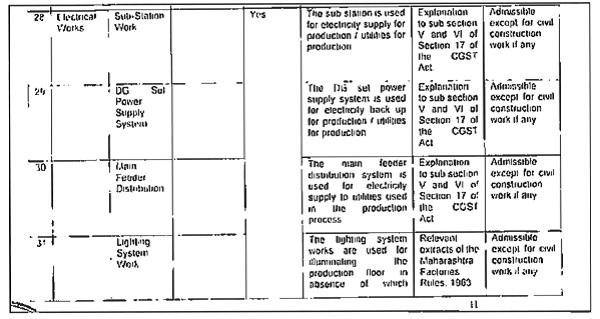
Seeking inference from the above ruling and in comparison, with the Contract, the current supply under question covers the sub-station electrical works, lighting system works and lightning protection system, and accordingly, the applicant has stated that ITC shall be eligible on the same.
14. The Applicant also places its reliance on the very recent ruling of Authority for Advance Ruling, Gujarat in the case of M/ s. Elixir Industries Private Limited [2024 (7) TMI 982], wherein, it has been held that ITC with respect to installation of electrical cable/wires. Extract of relevant ruling is re-produced below for ease of reference.
“The applicant’s averment is that they are not hit by 17 (5) (c), ibid. The applicant further stales that they have capitalized the basic value as capital goods and the tax portion is being availed as ITC. Therefore, it is not hit even by the explanation. As far as 17 (5) (d) is concerned, the applicant states that they are covered by the explanation which defines plant and machinery and that they are also not hit by the three exclusions listed in the explanation, The ITC that the applicant wishes to avail is on capital goods viz cables/ wires, equipment viz 750 meters new 66 KV S/ Cable (3+1), 630 mm square aluminium corrugated sheath/ G cable line for installation of 66 KV feeder bay at sub-station of GETCO. On a specific query raised during the course of personal hearing, it was stated by the representative of the applicant that though these are underground cables, them are not fixed to earth; that they are kept in a duct and can be removed/opened as and when arm maintenance is required to be done on these goods. Even on this count, the ITC sought by the applicant is not blocked by sub-sections 17 5 (c) & (d), ibid.”
The Applicant has highlighted that the same is applicable in its case as the electrical cables are being installed in the busducts that are laid in the factory premises for power supply to the machineries. Further, those busducts can be removed or opened for any kind of maintenance work that are required to be carried out and placed back. Accordingly, the Applicant submits that ITC is not blocked by limitations placed under Section 17(5)(c)/ (d) and is eventually eligible to be availed.
15. The Applicant also places reliance on the ruling of Hon’ble CESTAT Delhi in the case of M/ s. Steel Authority of India Ltd. v. CCE & ST Razpur, [2016 (343)
E.L.T. 805 (Tri. – del)1 wherein Tribunal allowed credit of taxes paid on light fittings/structures lamps, high mast light, tubes/glasses and allied fixtures as they are necessary for illumination and enable round the clock operation of the assessee’s factory. According to the Tribunal, since the light structures are classifiable under Chapters 84, 85 and 9405 of the Central Excise Tariff, the fact that these fixtures become part of the civil structure/immovable property was no basis to deny credit of taxes paid. Considering the above, it is the submission of the Applicant that the ITC must be eligible for the Applicant on the subject transaction.
16. In relation to the second query on the availment of ITC on advance portion paid, the applicant has submitted that as per the clause 8 of Contract, the Applicant has paid the Supplier an amount equal to 10% of the Contract price as an advance, upon issuance of Letter of Award. The Supplier has issued tax invoice for receipt of this advance payment (`first invoice’). However, there will be no actual supply of goods or services or both at that specific point in time when such first invoice was issued. The Applicant states that while it has fulfilled most of the conditions specified in Section 16(2) of the CGST Act, for availment of ITC, the condition with respect to receipt of supply as mentioned under Section 16(2)(b) of CGST Act, i.e., “(b) he has received the goods or services or both.”
Referring the above, it can be understood that the Applicant would not stand to fulfill the above condition at the time of receiving the invoice pertaining to payment of advance. This means that the ITC is eligible only upon receipt of supply of goods or services or both as the case may be, which concludes only once the last invoice is raised by the Supplier wherein such advance is concluded to be fully adjusted.
17. The Applicant states that the Supplier once commences to execute the Contract starts to issue his subsequent invoices (`running bills’ or `RA bills’) based on completion of payment milestones as defined in the Contract. When the Supplier starts to raise the RA bills, he has three components which is gross billing, adjustment of advance (raised in the first invoice), and the net billing. In the instant case, the Supplier has adjusted 10% of the gross amount on all RA bills as the mobilization advance which was paid during the time of issuance of first invoice. The Applicant has submitted sample copies of invoices (first invoices and one RA bill) raised by the Supplier and have also highlighted the portion of adjustment as discussed above.
18. The Supplier began raising invoices with respect to the supply under question in the FY 2023-24. However, the receipt of last invoice wherein the advances are fully adjusted, was issued in FY 2024-25. As per Section 16(4) of the CGST Act,
“(4) A registered person shall not be entitled to take input tax credit in respect of any invoice or debit note for supply of goods or services or both after the thirtieth day of November following the end of financial near to which such invoice or debit note pertains or furnishing of the relevant annual return, whichever is earlier.”
19. In the instant case, on a plain reading, time limit to avail ITC on the first invoice raised by the Supplier shall fall on 30 November 2024. On the contrary, the Applicant would not have fulfilled the conditions to avail such ITC as the receipt of goods or services or both would fall after the above-said time limit. As per the doctrine of Harmonius Construction, a provision of the statute should not be interpreted or construed in isolation but as a whole, so as to remove any inconsistency or repugnancy. Moreover, it may be noted that the Section 16(2) contains a non-obstante clause overriding other provisions of Section16. Given the same, the provisions of Section 16(2) shall prevail in case of any conflict between Section 16(2) and other sub-sections of Section 16. Basis the above provisions, the right to avail ITC arises after the last date of availing the said credit as per as per Section 16(4).
20. Further, the Applicant has referred to the ruling of Hon’ble Allahabad High court in the case of M/s. Century Laminating company V/ s. Commissioner of Central Excise, Meerut [2015 (3) TiVII 130 – Allahabad High Court], wherein it has been held as follows:
“when certain goods based on the invoice was received during the period of six months but the last and final lot was received after the period of six months, we are of the opinion that Rule 57D(6) now Rule 57G(2) of the Rules being procedural in nature does not dis-entitle the claim of the assessee for claiming Modvat credit. In the absence of any deliberate delay, coupled with the fact that the transaction executed by the assessee, being a bonafide one and, based on the direction of the Superintendent, Central Excise dated 8th February, 1995, the assessee, in the instant case, was entitled for Modvat credit”
21. Therefore, based on the above contentions, the Applicant is of the view that it can avail the credit on input tax on receipt of supply of goods or services or both against an invoice irrespective of the receipt of supply after the last date under Section 16(4) of the CGST Act. Without prejudice to the above, and with the above-said time limit (on a plain reading) fast approaching as on the date of filing this present application, the Applicant sought to secure the Input Tax Credit on the invoices as a precautionary measure by availing it in the GSTR-3B return of the tax period – October 2024. Nonetheless, they have assured that the credit will not be utilized until an outcome on this application is provided.
5. The applicant is under the administrative control of State Tax. The concerned authorities of the Center and State were addressed to report if there are any pending proceedings against the applicant on the issues raised by the applicant in the ARA application and for comments on the issues raised.
5.1 No remarks has been received from the Centre Authority as well as State Authority. Hence, it is construed that there is no pending proceedings on the questions raised by the applicant in their advance ruling application.
6. Personal Hearing
6.1 The applicant was given an opportunity to be heard on 16.04.2025. Shri. Rajaram R. and Shri. Gowtham T. of M/s. Ernst & Young LLP, appeared for the personal hearing as the authorized representative (AR) of the applicant, The AR reiterated the submissions made in their application.
6.2 They explained that the applicant is engaged in the manufacture of injection moulding machinery and its accessories. They further stated that the applicant is expanding its business operation and have constructed a new factory adjacent to the existing factory and has incurred capital expenditure towards procurements in relation to setting up the new facility. The procurement under this contract, like LT panels, busducts, Electrical works, light fixture are movable in nature and that the same can be removed without substantial damage and can be re-installed. When the Members enquired about the capitalization aspect, the AR explained that while the portion relating to civil work is capitalized as building, the other fixtures and electrical works are capitalized as Plant and Machinery’ in their books of accounts. Likewise, when the Members enquired about the mode of availment of ITC, especially when the contract is a composite one involving both civil work and installation of goods, the AR explained that ITC is availed only on the fixture/ panel portion and not on the civil work portion, based on the break up available under `Cost Abstract’ and ‘Bill of Quantities’ that forms part of the contract. They further stated that the ITC availed on the fixtures in question will not be utilized until an outcome to this application is provided. They cited the ruling of AAR, Maharashtra in the case of M/s. Nipro India Corporation (P) Ltd., in their support.
6.3 Owing to change in the constitution of the AAR bench, clue to transfer and posting of one of the members of the bench, another opportunity for hearing was offered to the applicant, and Mr. Ranjit V Jolly, and Mr. Gowtham T, of M/s.Ernst & Young LLP, appeared for the personal hearing on 24.07.2025, as the authorized representatives (AR) of M/s.Shibaura Machine India (P) Ltd. They reiterated the submissions made already during the original hearing held on 16.04.2025. In addition to the same, they emphasized the fact that all the electrical installation meant for the expansion of factory are fixed to immovable property above the ground, and that nothing is under the floor or fixed to earth. Further, the panels, racks, bus-ducts, etc., are movable in nature and can be dismantled or removed without any damage to the immovable property. They contended that in effect, these electrical installations are to be considered as an apparatus whereby the same gets covered as Plant and Machinery’, as defined under the GST law. They reiterated that the ruling of AAR, Maharashtra in the case of M/s.Nipro India Corporation (P) Ltd., is in support of their interpretation. When the Members enquired as to whether they are seeking ITC on all the electrical installations meant for the expansion of factory or not, they explained that they are seeking answer on the ITC eligibility on all the electrical installations.
7. Discussions and Findings:
7.1 We have carefully examined the submissions made by the applicant in their advance ruling application and the submissions made during the personal hearing. We have also considered the issue involved, the relevant facts and the applicant’s submission / interpretation of law in respect of question on which the advance ruling is sought.
7.2 We note that the applicant is engaged in the business of manufacture of injection moulding machinery and accessories. Since they are expanding their business operation, they have constructed a new factory adjacent to their exiting factory, whereby they have incurred capital expenditure towards procurements in relation to setting up of this factory. We further take note of the fact that in the instant case, they have entered into a separate contract with the Supplier for “Supply, installation, testing & commissioning of Electrical Works” for the new factory.
7.3 To begin with, the relevant provisions of Section 16(1) of the CGST Act, 2017, that prescribes the eligibility and conditions for taking ITC, is reproduced below :-
“(1) Every registered person shall, subject to such conditions and restrictions as mail be prescribed and in the manner specified in section 49, be entitled to take credit of input tax charged on any supply of goods or services or both to him which are used or intended to be used in the course or furtherance of his business and the said amount shall be credited to the electronic credit ledger of such person.”
It could be observed from the above, that the most crucial phrase to the entire scheme involving availment of ITC is “used or intended to be used in the course or furtherance of his business”. While the said legal provision provides for entitlement of credit of input tax charged on any supply of goods or services or both
which are used or intended to be used in the course or furtherance of business, it also comes up with a rider, viz., “subject to such conditions and restrictions as may be prescribed”.
7.4 It may be seen that the provisions of Section 17 of the CGST Act, 2017 discusses about the ITC that is blocked. The relevant provisions of sub-section (5) to Section 17, which impacts the issue in the instant case, is as given below :-
“(5) Notwithstanding anything contained in sub-Section (1) of Section 16 and subsection (1) of section 18, input tax credit shall not be available in respect of the following, namely;
(a) motor vehicles ——-
(b)
(c) works contract services when supplied for construction of an immovable property (other than plant and machinery) except where it is an input service for further supply of works contract service;
(d) goods or services or both received by a taxable person for construction of an immovable property (other than plant or machinery) on his own account including when such goods or services or both are used in the course or furtherance of business.
Explanation.- for the purposes of clauses (c) and (d), the expression “construction” includes re-construction, renovation, additions or alterations or repairs, to the extent of capitalization, to the said immovable property:’
Accordingly, it becomes clear that the embargo in relation to availment of ITC in the instant case revolves very much around clauses (c) and (d) of Section 17(5) of the Act, ibid, and both the clauses restricts ITC availment on receipt of Works Contract service, or on receipt of any goods or service or both, when made for ‘construction of an immovable property.
7.5 Further, the expression “plant and machinery” as defined in the explanation under Section 17 of the COST Act, 2017, is extracted as below :-
Explanation.- For the purposes of this Chapter and Chapter VI, the expression “plant and machinery” means apparatus, equipment, and machinery fixed to earth by foundation or structural support that are used for making outward supply of goods or services or both and includes such foundation and structural supports but excludes–
(i) land, building or any other civil structures;
(ii) telecommunication towers; and
(iii) pipelines laid outside the factory premises.
Whereby it is evident that the expression ‘plant and machinery’ talks about an apparatus, equipment and machinery fixed to earth, either by foundation or by structural support, where we observe that the crucial phrase under the instant definition is “used for making outward supply of goods of services or both”.
7.6 However, it could be seen from the provisions of section 17(5)(c) of the Act, that the phrase, viz., ‘other than. plant and machinery’, finds a place under the said clause, from which it gets conveyed that availment of ITC on ‘plant and machinery’ is not blocked under the said provision. It is to be noted here that even the phrase
`other than plant or machinery’ that was part of clause (d) of Section 17(5), now stands amended as ‘other than plant and machinery’, retrospectively with effect from 1.07.2017 onwards, through S1.No.124 of the Finance Act, 2025 (No.7 of 2025), which reads as below :-
“124. In Section 17 of the Central Goods and Services Tax Act, in sub-section (5), in clause id), –
(i) for the words ‘plant or machinery”, the words ‘plant and machinery” shall be substituted and shall be deemed to have been substituted with effect from the 1st dau of July, 2017;
(ii) the Explanation shall be numbered as Explanation 1 thereof; and after Explanation 1 as so numbered, the following Explanation shall be inserted, namely:-
`Explanation 2. — For the purpose of clause (d), it is hereby clarified that notwithstanding anything to the contrary contained in any judgement, decree or order of any court, tribunal, or other authority, any reference to “plant or machinery” shall be construed and shall always be deemed to have been construed as a reference to ‘plant and machinery”,’.”
7.7 With these aspects in mind, we now proceed to examine the transaction involved and its purpose, in order to determine the ITC eligibility or otherwise in the in the instant case. Accordingly, the crucial aspects that are to be discussed and decided in the instant case of the applicant, are :-
(i) Whether the execution of project in the instant case results in the creation of an immovable property or not?
(ii) Whether the resultant electrical installation for the factory gets categorised as Plant and Machinery’ or not? and
(iii) Whether the execution of the project qualifies as Works Contract’ or not?
7.8.1 In this regard, we note that the applicant has entered into a Contract Agreement with M/ s. SMCC Construction India Limited, New Delhi for execution of `Electrical LT works for New Factory Project’, to come up alongside the existing facility at Chembarambakkarn, Chennai. Therein, the ‘Scope of Work’ has been specified as “Supply, Installation, Testing and Commissioning of Electrical Works”. Further, under clause (3) to ‘Article I. General Principles’ of the General Conditions of Contract, we observe the following remarks, viz.,
“(3) The Contractor shall complete the Work and deliver the Permanent Work to the owner in accordance with the Contract, and the Owner shall make the payments of the Contract Sum as described in the Contract Agreement to the Contractor as per the terms of the Contract Agreement.”
In addition to the same, under the ‘Cost Abstract’ of the Contract, a detailed breakup leading to arrival of total cost for the Electrical works has been specified, wherein the cost involved for the supply of materials and that of installation have been furnished separately, as in the table below :-
| SI No | Description | Amount (INR) | |
| Supply | Installation | ||
| 1 | Section I – LT Panels | 38,971,770 | 340,091
4,944,412 |
| 2 | Section II – Busduct | 34,241,141 | |
| 3 | Section III – LT Electrical Works | 96,618,564 | 14,319,644 |
| 4 | Section IV – Lightning Protection System | 5,847,110
14,812,190 |
2,947,952
2,508,896 |
| 5 | Section V – Light fixtures | ||
| 6 | Section VI – Civil Works | 3,846,259 | 2,437,110 |
| Subtotal Cost for Electrical Works | 194,337,034 | 27,498,105 | |
| Total Cost for Electrical Works | 221,835,139 | ||
7.8.2 We note that the Applicant has stated in the application filed by them that the impugned supply under question is solely for the purpose of electrical works for the purpose of factory expansion and its associated miscellaneous civil works. They have also contended that the contents of the supply such as LT panels, bus-ducts, electrical LT works, lightning protection and light fixtures are not embedded in the earth and is movable; that the electrical apparatus, cable works, panels, bus-ducts are placed on the overhead racks and are not rooted in the ground/ floor rendering it immovable or not possible to be maintained; that in the instant case, all the electrical components and apparatus supplied vide the Contract are movable, customizable to add more equipment and maintainable in case of any repairs. Accordingly, the Applicant submits this Contract for erection of these electrical components does not fall under the ambit of immovable property as mentioned in Section 17(5)(c) and (d) of the COST Act.
7.8.3 From the scope of the contract entered into between the parties, it could be seen that the agreement is not just for installation/commissioning of electrical works, and it is a composite one of Works Contract’ Service involving “Supply, Installation, Testing and Commissioning of Electrical Works”, as indicated in the table above, wherein the break-up of the cost involved on Supply and Installation of Electrical works has been provided separately. In this regard, we observe that when a comprehensive electrical installation for a new factory set-up begins, the electrical fittings are mostly concealed into the wall/floor of the building. They are concealed or fitted on to the building through pipes as it serves the dual purpose of safety and aesthetics. Further, on installation of the electrical fittings meant for the factory/facility, they do not have an independent existence and it becomes part and parcel of the entire building/infrastructure and thereby a part of the immovable property. This apart, we find under the General Clauses Act, 1897, `Immovable Property’ has been defined under Section 3(26) as “Immovable Property shall include land, benefits arising out of land and things attached to the earth, or permanently fastened to anijthinq attached to the earth.” Accordingly, irrespective of the fact whether a particular thing is directly attached to earth, or permanently fastened to anything that is attached to earth like the walls, pillars, etc., it becomes part of such immovable property. It could be seen that electrical installations are normally fastened to the wall or roof of the building which in turn is attached to earth, thereby becoming part of the immovable property. The fact that a clause in the contract itself, specifies the permanent and immovable nature of the executed project, viz., “(3) The Contractor shall complete the Work and deliver the Permanent Work to the owner in accordance with the Contract,”, proves the case in point.
7.8.4 At this juncture, we note that during the personal hearing held on 16.04.2025, when the Members enquired about the capitalization aspect, the AR had stated while the portion relating to civil work is capitalized as building, the other fixtures and electrical works are capitalized as ‘Plant and Machinery’ in their books of accounts. In this regard, it is seen that the Accounting Standards prescribe accounting of revenue expenses and capital expenses. If the expenses are in the nature of capital expenses and are related to fixed assets, then they are capitalised. Merely, accounting an immovable property as a movable property or accounting a particular item under a different head, does not preclude the immovable nature of the item being accounted.
7.9.1 Accordingly, we now move on to discuss as to whether the resultant electrical installation for the factory gets categorised as ‘Plant and Machinery’ or not? In general parlance, an installation or even a factory is referred to as a `Plant’, and a Machinery is taken to mean A group of parts or machines arranged to perform a useful function’. However, it is to be noted that the categorisation as to ‘Plant and Machinery’, for the purposes of availment of ITC, is not to be determined as it is meant in general parlance, and that the same is liable to be determined strictly in line with the definition prescribed under the statute. Further, the expression ‘Plant and Machinery’ is to be considered in toto per se, and that the same cannot be seen as a ‘Plant’ as such, or as a `Machinery’ as such, or as `Plant or Machinery’. Accordingly, the expression “plant and machinery” as defined in the explanation under Section 17 of the CGST Act, 2017, is taken to mean an –
(a) apparatus, equipment or a machinery;
(b) which are fixed to earth either by foundation or by structural support;
(c) which are used for making outward supply of goods or services or both;
7.9.2 At this juncture, we take cognizance of the fact that the terms Apparatus’, `Equipment’, ‘Machinery’ are not defined under the GST Law, and so we consider the definitions of the respective items as provided by the Applicant in their application for advance ruling, drawing inference to Mc-Graw Hills dictionary, wherein these items have been defined as follows :
‘Apparatus – A compound instrument designed to carry out a specific function.
Equipment One or more assemblies capable of performing a complete function.
Machinery – A group of parts or machines arranged to perform a useful function.’
It could be seen from the above, that the comprehensive electrical installation involving various items like LT panels, bus-ducts, electrical LT works, lightning protection and light fixtures are meant to perform a whole lot of functions including regulating and conducting the flow of electrical energy, providing lighting, etc., in relation to the entire factory set-up, which is very much general in nature. Whereas, a Machinery, Apparatus, or an Equipment on the other hand are seen as individual units, meant for a specific or an intended function. We are therefore of the opinion that the overall electrical installation meant to carry out varied functions cannot be considered as an apparatus, equipment or machinery.
7.9.3 As far as the phrase ‘fixed to earth either by foundation or by structural support’, goes, it clearly conveys the fact that the apparatus, equipment or machinery is to be either fixed to earth or supported through a structure. Whereas, the electrical installation in the instant case get assimilated into the building/infrastructure, thereby becoming a part of the immovable property.
7.9.4 With regard to the phrase which are used for making outward supply of goods or services or both’, it could be seen that this phrase becomes the most crucial aspect of the definition of ‘Plant and Machinery’. It conveys the fact that even in the event of considering the electrical installation as an apparatus, equipment or machinery, they should be used for making outward supply of goods or services or both. Since the electrical installation in the instant case does not perform a specific function as in the case of an apparatus, equipment or machinery, and as it just facilitates the functioning of the factory in general, we are of the opinion that it is not capable of being used directly for making outward supply of goods or services or both.
7.10.1 With regard to the aspect as to whether the transaction involved in the instant case qualifies as ‘Works contract’ or not, we note that under SI.No.8 of the Statement of relevant facts furnished along with the application for advance ruling, the applicant had contended that the above said electrical works fall under SAC 995461 — Electrical Installation Services including electrical wiring and fitting services, fire alarm installation services leviable to CST at the rate of 18%. In this regard, we find that the contract of goods and services which are naturally bundled and supplied in conjunction with each other, as in the instant case, gets covered as a ‘composite supply’ as defined under Section 2(30) of the CGST Act, 2017 which is reproduced below :-
“(30) ‘composite supply’ means a supply made by, a taxable person. to a recipient consisting of two or more taxable supplies of goods or services or both, or any combination thereof, which are naturally bundled and supplied in conjunction with each other in the ordinary course of business, one of which is a principal supply;”
When the said composite supply involves a contract for building, construction, erection, installation or commissioning of any immovable property, wherein the transfer of property in goods is involved in the execution of such contract, it becomes a classic case of ‘works contract’ service, which is defined as under Section 2(119) of the Act, ibid, i.e.,
“(119) ‘works contract’ means a contract for building, construction, fabrication, completion, erection, installation, fitting out, improvement, modification, repair, maintenance, renovation, alteration or commissioning 21 anti immovable Property wherein transfer of property in. goods (whether as goods or in some other form) is involved in the execution of such contract;”
And such composite supplies under specific circumstances, are to be treated as a supply of ‘Services’, as laid down in paragraph 6 of Schedule II of the CGST Act, 2017, which reads thus,
“6. Composite supply
The following composite supplies shall be treated as a supply of services, namely:—
(a) works contract as defined in clause (119) of section 2; and
(b) supply, by way of or as part of any service or in. any other manner whatsoever, of goods, being food or any other article for human consumption or any drink (other than alcoholic liquor for human. consumption), where such supply or service is for cash, deferred payment or other valuable consideration.”
7.10.2 On perusal of the sample copies of the invoices raised by the contractor, viz., M/ s. SMCC Construction India Limited, related to the same contract (LOA dated 28.06.2023), furnished along with the application for advance ruling filed in the instant case, it is seen that under the Invoice No.TN/CO/23-24/055 dated 28.07.2023, for receipt of advance (10% of LOA), the ‘Type of Services’ has been specified as ‘Construction Service’ with SAC code : 995413, whereas in the case of Invoice No.TN/CO/23024/174 dated 06.03.2024, for the receipt of `4th RA for Monthly Progress Payment for the month of January 2024′ the same has been specified as ‘Installation Service’ with SAC Code : 995461. Irrespective of the fact that different nomenclature has been assigned by the supplier for two different bills raised for the same contract, the fact remains that the instant case of the applicant ideally gets covered as a composite service of Works Contract’ as specified under Section 2(119) of the CGST Act, 2017.
7.11 From the above, we infer the following aspects, in relation to the contract involved in the instant case, i.e.,
(a) That the Electrical LT works proposed in the contract is for the ‘New Factory Project’ which is a comprehensive one meant for the entire factory, and not in relation to a specific machinery/equipment.
(b) That the execution of the said project amounts to rendition of a composite “Works Contract” Service by the supplier, in as much as it involves supply of materials as well as supply of service including installation, testing, commissioning, etc.
(c) That the output, viz., the electrical installation for the factory, results in a Permanent Work’ of immovable nature to be delivered to the owner.
(d) That the said output (electrical installation) cannot be considered as ‘Plant and Machinery’ as defined under the Act.
Under the facts and circumstances of the instant case, we are of the considered opinion that the GST paid on the receipt of Works Contract’ service involving electrical installations for the new factory project, do not become eligible for availment of ITC as they are blocked under clause (c) of the Section 17(5) of the CGST Act, 2017. Notwithstanding the same, even in the event of considering the said supply as an independent ‘Construction’ or ‘Installation’ service, the same again stands blocked under clause (d) of the Section 17(5) of the Act, ibid.
7.12 At this juncture, we find that the applicant has relied on the case laws in respect of (1) the ruling of Authority for Advance Ruling, Maharashtra in the case of M/ s. Nipro India Corporation Private Limited 12018 (10) TMI 745]; and (ii) the ruling of Authority for Advance Ruling, Gujarat in the case of M/ s. .Elixir Industries Private Limited [2024 (7) TMI 982]. In this regard, we wish to state that as per Section 103(1) of the CGST Act, 2017, advance rulings are applicable only to the applicant concerned. However, the persuasive effect that it brings to the context of the case shall be considered provided the facts and circumstances of the case remains the same. On perusal of case involving M/s.Elixir Industries (P) Ltd., we note that it discusses about the eligibility of wires/cables used for transmission of electricity from the power station to the factory premises of the applicant concerned, whereby the case becomes distinguishable, as the issue involved is quite different from the instant case. As far as the ease involving M/s.Nipro India Corporation (P) Ltd., is concerned, it is seen that the admissibility to ITC has been discussed individual system-wise, viz., Sub-station work, DG Set, Main Feeder, Lighting System,
Telephone system, LAN system, etc. In this regard, we observe that while the said ruling has been pronounced on 28.05.2018, the rulings that were pronounced later, viz., (i) The Ruling dated 30.09.2019 of the Karnataka Authority for Advance Ruling in the case of M/s. Embassy Industrial Park (11 Ltd., and (ii) The Appellate Order dated 04.10.2023 of the Gujarat Appellate Authority for Advance Ruling in the case of M/s. The Varachha Co-op Bank Ltd., have ruled otherwise, i.e., ITC in relation to electrical fittings/works is held to be ineligible. Therefore, in our opinion, the case laws cited by the applicant in support of their defence, do not come to their aid.
7.13 Accordingly, once it is held that the ITC related to electrical installation for the new factory is not available to the applicant in the instant case, the question of answering the other query, viz., ‘What should be the basis to arrive the timeline to avail ITC on tax invoice raised by Supplier to bill “Advance Component” of the Contract and Subsequent Adjustment of Advance in the Service Bills showing both Gross and Net amount.”, does not arise, as the same is directly related to the specific contract involved in the instant case, and is very much dependent on the main query.
7.14 In view of the above, we rule as under:
Ruling
1. The taxes under GST paid on the electrical installation work carried out for expansion of factory for manufacturing activity is not eligible for availment of Input Tax Credit (ITC) by the applicant, as it is blocked under Sections 17(5)(c) and 17(5) (d) of the CGST/TNGST Acts, 2017.
2. The question of answering the second query on the timeline to avail ITC on the ‘Advance component’ involved in the instant contact, does not arise, as the main query on availment of ITC on the said contract is answered in negative.