US Tariffs on Indian Goods reduced to 18%: Recent developments, Sectoral Impact, and Reading Between the Lines of Official Announcements
Introduction
Trade relations between India and the United States have once again taken centre stage following recent announcements by the leadership of both countries regarding tariff rationalisation and broader economic cooperation. In particular, the reduction of U.S. tariffs on Indian goods has been widely welcomed by exporters and market participants.
However, beyond the headline reduction in tariff rates, a careful reading of official communications from both sides reveals differences in scope, emphasis, and legal certainty, which are crucial for businesses, trade professionals, and policy observers.
This article analyses the latest U.S. tariff developments affecting Indian exports, the sectors impacted, and the important distinctions between the announcements made by Donald J. Trump and Narendra Modi.
Background: Evolution of U.S. Tariffs on Indian Exports
The United States periodically revises tariff structures as part of its trade and economic policy. In recent years, Indian exports to the U.S. have faced additional duties under reciprocal tariff frameworks aimed at addressing perceived trade imbalances.
During 2025, these tariffs resulted in effective duty rates of up to 25% on several categories of Indian goods. The impact was particularly felt in labour-intensive and price-sensitive sectors, prompting sustained diplomatic engagement between the two governments.
Recent Announcement: Reduction of U.S. Tariffs to 18%
Following high-level discussions, the United States announced a reduction of reciprocal tariffs on Indian goods from 25% to 18%. This development is significant for Indian exporters, as it improves price competitiveness in the U.S. market and partially offsets earlier tariff pressures.
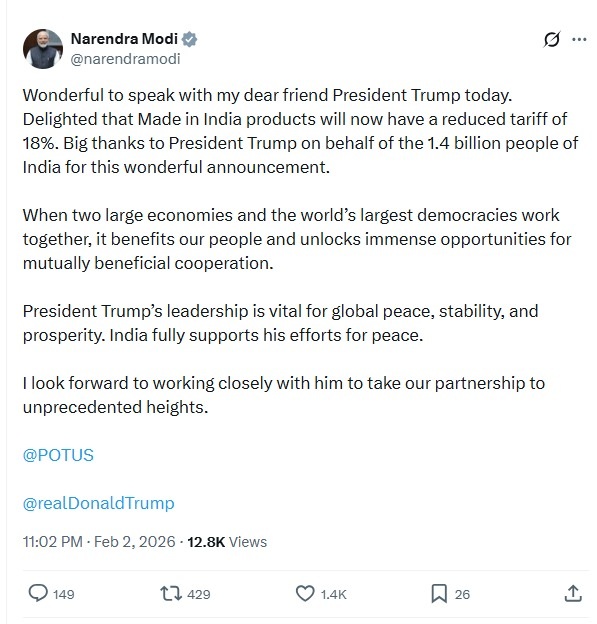
Prime Minister Modi, in his public statement, welcomed this move and highlighted that “Made in India products will now have a reduced tariff of 18%”, emphasising the broader benefits of cooperation between the world’s largest democracies.
From an exporter’s standpoint, this reduction is the most concrete and immediately actionable outcome of the recent engagement.
Sectors Impacted by U.S. Tariff Changes
The tariff reduction has relevance across multiple sectors, including:
- Textiles and Apparel – Among the most sensitive sectors, where tariff relief directly affects margins and competitiveness
- Gems and Jewellery – A key export segment with high exposure to U.S. markets
- Leather, Footwear, and MSME Manufacturing – Labour-intensive sectors benefitting from any duty reduction
- Engineering and Chemical Goods – Where tariffs influence long-term supply contracts
Certain sectors such as pharmaceuticals, electronics, and critical inputs have historically enjoyed exemptions or lower exposure due to strategic and supply-chain considerations.
Divergence in Official Announcements: What Was Said and What Was Not
While both leaders welcomed the strengthening of bilateral trade ties, the content of their announcements differs in material ways, which merits closer examination.
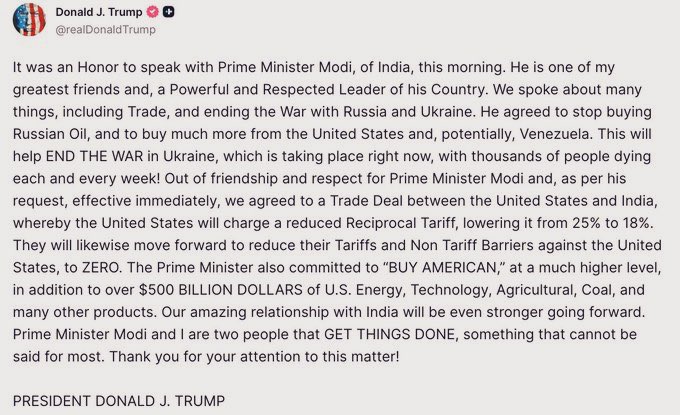
U.S. Announcement: Broader Trade Commitments Outlined
President Trump’s statement went beyond tariff reduction on Indian goods and referred to a wider trade understanding, including:
- Reduction of U.S. reciprocal tariffs on Indian goods to 18%
- India moving towards zero tariffs and removal of non-tariff barriers on U.S. goods
- Commitments linked to “Buy American”
- Large-scale purchases of U.S. energy, agricultural, technology, and other products
The reference to zero tariffs and elimination of non-tariff barriers on U.S. goods was a prominent part of the U.S. communication.
Indian Announcement: Focused and Outcome-Based
In contrast, Prime Minister Modi’s statement was deliberately narrower in scope and focused on confirmed outcomes. The Indian announcement:
- Explicitly acknowledged the reduction of U.S. tariffs on Indian goods to 18%
- Emphasised strategic cooperation, peace, and economic opportunity
- Did not explicitly mention:
- Zero tariffs on U.S. goods entering India
- Removal of non-tariff barriers
- Quantified import commitments
This difference is not merely semantic; it carries legal and policy significance.
Why the Difference Matters: A Trade Law Perspective
In international trade practice:
- Public statements are not binding instruments
- Tariff changes require formal notifications, customs amendments, or trade agreements
- Until reflected in Indian Customs Tariff schedules or official notifications, any reference to zero tariffs remains indicative rather than enforceable
Accordingly, while the U.S. announcement outlines an aspirational and forward-looking trade framework, the Indian communication confines itself to verifiable and implemented outcomes.
For practitioners, this distinction reinforces a familiar principle: In trade and customs law, what is notified matters more than what is narrated.
Practical Implications for Businesses and Professionals
- The 18% tariff on Indian exports to the U.S. can be treated as a confirmed development
- Any assumption of zero-duty access for U.S. goods into India should be approached with caution until officially notified
- Importers and exporters should rely on customs notifications, tariff schedules, and CBIC communications, not solely on political announcements
- Advisory positions should remain conservative until legal instruments are issued
Conclusion
The recent tariff reduction is undoubtedly a positive step for Indian exporters and reflects improving trade engagement between India and the United States. However, the contrast between the two announcements highlights the importance of reading policy developments with precision rather than enthusiasm alone.
While political statements set direction, trade compliance ultimately follows written law, notifications, and enforceable agreements. Until further formal measures are issued, the reduction of U.S. tariffs to 18% stands as the clearest and most immediate outcome of the current engagement.
******
Author’s Note: This article is based on public announcements and available information at the time of writing. Trade and tariff measures become effective only upon formal notification and legal implementation. Readers should track official customs and policy updates for actionable guidance.
For any query related to above article, or if you face any issue in Income Tax, GST, SEZ, STPI, MCA compliances etc., especially in cases involving legal proceedings, notices, litigation, or demand matters. Please feel free to contact us at the details mentioned below:
Contact: +91-7842796315; Email: [email protected]