Abstract
The gig economy creates a significant legal paradox: workers are regulated by sophisticated algorithms that mimic corporate management, but they are only protected by fragmented welfare measures and aspirational policy language. This article investigates that contradiction using India’s Code on Social Security 2020[1], the landmark IFAT litigation, Karnataka’s pioneering 2025 statutory framework, and the explosive 10-minute delivery crisis that resulted in a nationwide strike by over two lakh workers on New Year’s Eve 2025. Drawing on Rajya Sabha MP Raghav Chadha’s parliamentary intervention and Telangana’s historic payout to families of murdered gig workers, it contends that India has moved from invisibility to recognition, but not from welfare to rights. Concrete reforms are proposed to address this gap.
Keywords: Algorithmic Management · Gig Workers · Misclassification · Platform Labour Rights · Social Security · Telangana · Quick Commerce
The Invisible Workforce That Runs India
Consider the morning rush in Hyderabad. A delivery partner on a motorcycle weave through Jubilee Hills traffic, phone mounted on the handlebar and a thermal bag slung around his back. An algorithm chose his route. The platform determined his compensation per order. His customer-facing rating, based on reviews he cannot refute, affects whether he receives any orders at all. If he refuses two consecutive assignments, the software reduces his allocations. If an unexplained complaint is filed against his account, he will be terminated without notification, appeal, or redress.
He is not a worker. He’s a ‘delivery buddy.’[2]
This is the gig economy in action: massive, necessary, and legally invisible. An estimated 7.7 million gig workers power India’s food delivery, ride-hailing, and quick-commerce sectors now, with that figure expected to rise to 23 million in 2030[3]. Hyderabad has emerged as one of India’s fastest-growing gig markets, surpassing numerous tier-1 cities in terms of demand growth, with rapid commerce, health tech, finance, and e-commerce all driving expansion[4]. Telangana’s Tier 2 cities, Warangal and Nizamabad, are now following the same trend.
Despite their economic importance, these workers are on the margins of legal protection. They are managed by systems that operate just like employers, regulating task allocation, pricing, hours, performance appraisal, and termination, yet the law continues to treat them as self-employed business owners. The outcome is a structural contradiction, which this article will investigate and suggest must be resolved.
“They are managed by systems that function precisely like employers — while the law continues to treat them as self-employed entrepreneurs.”
Managed by Robots: Algorithmic Control as the New Supervision
‘Managed by robots’ is hardly hyperbole. It accurately describes how platform work is structured. No human supervisor informs a Zomato rider what orders to accept, how fast to ride, or what score to keep.[5] All of this is accomplished by an algorithm, which does it with greater precision and consistency than any human management.
Algorithmic management systems assign tasks based on proximity and availability scores, dynamically adjust rider incentives to shape behaviour (surge pricing for high-demand slots and cancellation penalties), generate performance dashboards that rank workers against peers, and deactivate when metrics fall below thresholds—all without human intervention.
Labour law, in its conventional form, evaluated employment by looking for supervision, control, economic dependency, and integration into corporate activities.[6] The gig economy includes all these features. They’ve merely been digitized. A worker can, in theory, log off whenever he wants. However, once logged in, every part of his job—what he does, how much he gets, how he is evaluated, and whether he continues to work at all—is defined by machine-administered rules that he did not agree to and cannot argue with.
This is why the UK Supreme Court’s rationale in Uber BV v Aslam is so powerful[7]. That decision determined that Uber drivers were ‘workers’ under UK employment law, rejecting the contractual fiction of independent contractor status. The Court looked beyond the label to the facts: Uber determined fares, regulated client access, imposed service standards, and handled all payments. The driver’s ‘decision’ was a fabrication perpetuated by a more powerful contracting party. The Court reasoned that the nature of the relationship should be determined by actual conduct rather than contract terms drafted unilaterally by the more powerful side.[8]
Aslam does not bind Indian courts. However, it addresses difficulties with identical structures. When an Indian platform controls the price, allocation, rating process, and deactivation trigger, the economic reality is subordination, regardless of the contract.
Protected by Vibes: What India’s Law Actually Offers
The Code on Social Security, 2020
India’s principal legislative reaction is the Code of Social Security, 2020, which went into effect on November 21, 2025. It is the only one of the four new Central Labour Codes that explicitly recognizes non-standard digital labour. Section 2(35) defines a ‘gig worker’ as someone who works outside of a traditional employer-employee relationship[9]. Section 2(61)[10] defines a ‘platform worker’ as someone who works via an online platform. Section 2(6)[11] defines an ‘aggregator’ as a digital middleman that connects them with customers.
These categories are introduced for the first time in Indian labour legislation. That is significant. However, it also limits the Code’s capabilities.
The Code establishes a funding mechanism under which aggregators may be required to contribute one to two percent of annual turnover, subject to a cap, and creates social security schemes such as life and disability insurance, accident insurance, health and maternity benefits, old-age protection, and crèche facilities[12]. It envisions a National Social Security Board that has control over unorganized workers, such as gig and platform workers. Minimum wages, provident fund contributions, collective bargaining rights, protection against arbitrary dismissal, and industrial dispute remedies: none of these automatically apply to a person recognised only under the Social Security Code.
“Recognition without enforceability is pity, not law.”
The result is a paradox of acknowledgement. The law sees the gig worker but does not fully protect him. He is visible enough to be counted, not yet secure enough to enforce his rights.
The Ten-Minute Delivery Crisis: A Nation’s Wake-Up Call
The Code establishes a funding mechanism under which aggregators may be required to contribute one to two percent of annual turnover, subject to a cap, and creates social security schemes such as life and disability insurance, accident insurance, health and maternity benefits, old-age protection, and crèche facilities. It envisions a National Social Security Board that has control over unorganized workers, such as gig and platform workers.
On New Year’s Eve 2025, nearly two lakh delivery workers in India went on strike[13]. Their demands weren’t abstract. They wanted the ten-minute limit to be eliminated. They desired accident insurance, health coverage, and work security. They sought to avoid being held accountable for a promise the platform made to customers without considering the individuals who had to uphold it.
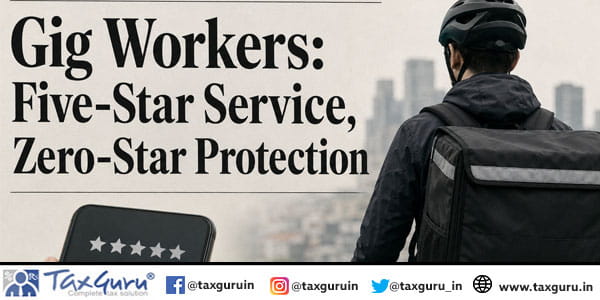
The earnings picture rendered the legal position impossible to ignore. The official minimum wage in Delhi in 2025 was roughly three times what Zomato’s CEO stated as the average hourly wages for delivery partners.[14] Workers were working more than 10 hours each day — more than 80% of those polled reported doing so—but yet earning less than the minimum wage[15]. Labour law ordinarily prohibits exposing workers to hazardous conditions without protective measures. But because these workers were classified as ‘partners,’ those protections simply did not apply.
During the strikes, a crucial and concerning element emerged: platforms attempted to undermine collective action by giving five to six times regular incentive rates to individuals who stayed working, and in certain cases, staff were apparently deployed to dissuade the organisation. Union leaders were unequivocal: it was the strike, not moral persuasion; that had shifted platforms.
When the administration finally held a meeting with the union labour minister in January 2026, the results were so small as to be ludicrous. Platforms voluntarily decided to remove the phrase ’10-minute’ from their branding. Blinkit discreetly modified its tagline. Zepto claimed to deliver ‘in minutes.’[16] The algorithmic pressure remained unchanged.
The case demonstrates the structural flaw in India’s existing approach: when the government’s answer to a crisis that wounded workers, prompted a national walkout, and exposed a basic failing of labour law is voluntary rebranding, the framework does not function as law. It functions as a suggestion.
Raghav Chadha and the Parliament That Noticed
One of the more interesting subplots of the 10-minute delivery problem was the discrepancy between how rapidly Indian policy responds to consumer concerns vs. worker issues—and how one senator exposed that disparity.
Raghav Chadha, a Rajya Sabha MP, had expressed concern over the ₹250 price of a cup of tea at Indian airports[17]. The Ministry of Civil Aviation quickly responded by creating the UDAN Yatri Café plan and lowering the price to ₹10. That response time—to a customer pricing complaint—was excellent.[18]
When Chadha mentioned the 10-minute delivery concept during Zero Hour in Parliament, the analogy was subtle but damaging.[19] He had met the delivery workers in person. He was clear: they were not faceless contractors handling entrepreneurial risk. They were someone’s father, husband, brother, or son, speeding into traffic to deliver onions and bread to a customer before the timer ran out. He termed the model downright cruel, and he was not incorrect.
The contrast Chadha presented is more than just rhetorical. It demonstrates a structural bias in how Indian regulatory attention is distributed. Consumer pricing, which is obvious, middle-class, and commercially salient, elicits a prompt administrative response. Worker safety, which is less visible, primarily working-class, and commercially inconvenient, requires extensive lobbying, union pressure, and government participation before anything moves. Even then, the movement is voluntary.
The fact that this inequality exists within the same legal and administrative framework, in the same year, on problems of comparable public importance, reflects poorly on how the gig economy has been democratically managed.
Telangana’s Lead: From Policy to Payout
While the Centre accepted voluntary rebranding as achievements, Telangana took a more concrete approach, sending compensation to the families of workers who died on the job.
The Telangana government provided ₹5 lakh in financial support to the families of five gig and platform workers who died in road accidents while on duty, marking a first-of-its-kind gesture in India. Each family received a total of ₹15 lakh, including ₹10 lakh from separate platforms.[20]
The five employees were Ahmed Bin Abdul Khader (Swiggy delivery worker), G Shyam Sundar (Uber bike taxi driver), Lokurthi Naresh (Zomato delivery worker), Garlapati Shashidhar Reddy (taxi driver), and Daravath Mahesh (Blinkit delivery worker).[21] Every name on the list serves as a warning that algorithmic management can have physical implications.
Labour Minister G. Vivek Venkataswamy praised the Telangana Gig and Platform Workers Union (TGPWU) for making this possible. TGPWU founder president Shaik Salauddin, who had been lobbying Chief Minister A. Revanth Reddy and the labour department on the issue, characterized it as a historic victory, underlining that it was about dignity rather than charity.[22] This underscores the Telangana government’s commitment to the welfare and dignity of workers in the digital economy,” he stated.
Telangana’s activity fits inside a larger framework. The Telangana Department of Labour commissioned the Centre for Good Governance (CGG) to perform a comprehensive primary study, which included in-person interviews with workers in Hyderabad’s ridesharing, food delivery, and e-commerce industries. That study, which also drew on the Code on Social Security 2020, the Motor Vehicle Aggregators Guidelines 2020, and Rajasthan’s 2023 gig workers law, proposed a framework for worker and aggregator registration with competent authorities, a dedicated welfare fund, and a welfare board with genuine implementation power.[23]
The Telangana government’s dedication to establishing a comprehensive gig worker safety policy, supported by statistics, union pressure, and administrative will, is the most aggressive and cohesive state-level reaction in India outside of Karnataka.
Karnataka’s 2025 Law: A Template Worth Studying
Karnataka’s 2025 Platform-Based Gig Workers (Social Security and Welfare) Act represents India’s most structurally important state-level intervention. With the formation of a Gig Workers’ Welfare Board in January 2026, Karnataka moved from legislative promise to administrative implementation, providing a model for other governments to follow.
Three aspects of the Karnataka model demand special emphasis. First, it offers means for registration, contribution, and grievance, rather than simply using aspirational language. Second, it puts welfare-fee duties on aggregators and requires data exchange, connecting platform earnings to worker protection in a way that the national code does not. Third, it brings algorithmic transparency by forcing platforms to reveal how job allocation, ratings, and adverse actions work, addressing the gig economy’s most fundamentally important source of power asymmetry.[24]
The Karnataka model isn’t flawless. Welfare-based regulation still leaves open problems like work status, minimum salaries, unionization rights, and the procedural fairness of deactivation. A worker who is registered with a welfare board, obtains accident insurance, and is covered by a contribution system is better protected than before, but not in the same sense that an employee is.
Nonetheless, Karnataka highlights an important point: state governments can be the most active centres of regulatory innovation when federal change is cautious and modest. In a federal organization where labour is a concurrent subject, this is a feature rather than a flaw. States have both authority and, increasingly, the political motivation to act.
IFAT and the Constitutional Argument
The Indian Federation of App-Based Transport Workers (IFAT) case, which is currently pending before the Supreme Court, is arguably the most significant ongoing legal proceeding in India involving platform labour[25]. Its relevance stems from the constitutional framework it has presented to the Court, rather than any previous decisions.
The petition invokes Articles 14, 21, and 23.[26] Article 14—the right to equality—becomes applicable when gig workers are routinely excluded from the protection structures that apply to economically equivalent workers in traditional employment.[27] Article 21—the right to life and dignity—is violated when persons who work full-time hours are denied living, health care, and reasonable working conditions.[28] Article 23—the prohibition on forced labour—enters when structural economic coercion removes meaningful bargaining power, leaving workers with no real choice about the terms on which they work.[29]
The IFAT case is strategically significant because it departs from solely statutory arguments. It does not inquire if gig workers fall inside established labour categories. It questions whether the Constitution requires the state to protect workers whose labour fuels digital markets, but whose legal status is purposefully uncertain. That is a more basic question, and the answer, given India’s extensive jurisprudence on Article 21, could be yes.
The case also draws attention to deactivation as a constitutional issue. When an automated flag removes app access — a worker’s sole source of revenue — without warning, explanation, or hearing, the issue is not simply contractual.
It implicates due process, livelihood, and the protection of fundamental rights against technically private actors who exercise quasi-governmental power over workers’ lives.
The Fuel Hike Trap and the Broader Pattern
The 10-minute delivery crisis was not an isolated incident. It fits into a pattern that the Telangana Gig and Platform Workers Union have recorded with growing accuracy.
When fuel prices climb in Telangana, as they did through 2025, the entire burden falls on delivery workers.[30] Platforms serving Ola, Uber, Rapido, Amazon, Swiggy, Zomato, Blinkit, and Zepto have routinely refused to increase per-order prices or ride charges to match rising operational costs. Workers are required to spend greater time on the road to maintain pay levels that were previously below the minimum wage. Unlike salaried employees, who may receive fuel allowances or work from home when costs rise, gig workers cannot avoid travel-related expenses; they are the travelers.
This dynamic exemplifies what economists term risk transfer: the platform carries economic advantage and brand value, while operational risks — accidents, fuel costs, traffic, weather, physical injury — are totally passed on to the worker[31]. When a worker is classed as an independent contractor, the law considers this a free-market distribution of risk between equal parties. It isn’t. A contract disguises structural imbalance.
The TGPWU’s ongoing efforts—for heatwave protection, enforceable fuel-cost adjustment mechanisms, and accident insurance—aim to decrease that gap through campaigning. However, advocacy is not law. Without enforced legislative norms, each campaign is won, lost, or ignored based on political expediency rather than worker rights.
The Legal Gaps That Must Be Closed
Misclassification
The simple word ‘partner’ deprives a worker of minimum wages, provident fund payments, and dismissal protection, whereas the platform retains all employer rights. India’s classification examinations were built for an economy based on factories and offices, not applications and algorithms[32]. They should be revised to treat digital control and economic dependency as main markers of employment status rather than secondary factors.
Deactivation Without Due Process
Removing app access is effectively dismissal. When it occurs without notice, explanation, or a method for the worker to respond, it violates the most fundamental norms of procedural fairness that Indian administrative and service law have safeguarded for decades. Automated deactivation via algorithmic flag, with no human review or appeal, is constitutionally dubious under Article 21[33]. A statutory right to notice, explanation, and appeal before deactivation must be established.
Algorithmic Opacity
Workers cannot contest what they do not see. The platform algorithms that determine work allocation, rating weights, income opportunities, and deactivation triggers are proprietary and opaque. This is not a neutral characteristic of technology; it is a structural advantage that platforms have in all disputes with the labour they manage. Karnataka has started to address this issue. Every state, and ultimately Parliament, should follow.
Social Security as Floor, Not Ceiling
The Code of Social Security was a crucial starting point. Welfare boards, contribution systems, and registration frameworks provide the foundation of a more equitable system. But they’re only on the floor. Minimum pay, collective bargaining, contribution portability across platforms, and protection from arbitrary deactivation must be included in the framework above. The legislation must transition from welfare to rights.
What Reform Must Look Like
The gig economy won’t regulate itself. Every voluntary concession obtained thus far —whether the cosmetic removal of ’10-minute’ from platform branding or platform contributions to welfare funds in states that enacted legislation—has resulted from prolonged pressure: strikes, litigation, union campaigns, and legislative scrutiny. This is not how rights should function.
Concrete legislative and administrative improvements are needed.
- A legislative right to notice, reasons, and appeal before deactivation, enforced in labour courts rather than just welfare boards.
- Mandatory algorithmic transparency: platforms must show workers how jobs are assigned; ratings are generated, and what causes negative actions.
- Portable, interoperable social security contributions are collected across all platforms where a worker registers, so gig workers are not penalized for using various apps.
- Updated classification exams include digital control and economic dependence as main indications of employment status.
- Extension of minimum wage protections to platform workers, with aggregator-side liability for enforcement.
- Strengthened welfare boards with genuine grievance powers, worker representation, and enforcement mechanisms — not merely advisory roles.
- Mandatory accident insurance and health cover, especially for workers in physically hazardous categories such as delivery and ride-hailing.
Telangana’s reimbursement to the families of five murdered gig workers is an example of what governmental intervention can do. It should not be a one-time gesture of goodwill. It should become a legally mandated, uniformly managed entitlement—and the foundation for a complete framework that views the death of a delivery worker in the line of duty as a labour issue rather than a philanthropic cause.
Conclusion
Gig labourers in India are no longer anonymous. They are mentioned in the 2020 Social Security Code. The IFAT litigation is constitutionalizing their claims. Karnataka legislated for them. Telangana paid out compensation to the families of workers who died while on duty. Raghav Chadha addressed them in Parliament as individuals rather than abstractions.
However, visibility is not a protection. A delivery worker’s name in a legislation does not cover him against the accident that may occur tomorrow. A welfare board that cannot compel compliance provides comfort, not rights. An algorithm that dismisses a worker without reason is not bound by aspirational policy of language.
The gap between recognition and rights is exactly where platform businesses have developed their revenue models. They function between the typical employer-employee relationship, in which obligations are clear and enforced, and the independent contractor relationship, in which they are not. They purposefully fill that gap, keep it legal, and profit from it structurally.
Closing that gap would need judges willing to go beyond contractual labels, legislatures prepared to update frameworks intended for a pre-digital economy, and state governments eager to use their concurrent jurisdiction to innovate where the Centre has lagged. It necessitates considering algorithmic management as labour governance, with all the duties that come with that position.
India has made the initial step. The gig worker exists legally. The next stage is to ensure that the law does more than just look; it must act, enforce, and protect.
The views expressed are personal.
Author:

Author: Abhisikta Nandy |

Co-Author: Advocate Y. Balachander Reddy |
Reference
[1] Code on Social Security, No. 36 of 2020, § 1(3) (India), notified S.O. 4805(E) (Nov. 21, 2025).
[2] Zomato Ltd., Terms of Service for Delivery Partners, 3.1 (2024) (classifying delivery personnel as independent service partners rather than employees).
[3] NITI Aayog, India’s Booming Gig and Platform Economy: Perspectives and Recommendations on the Future of Work 2–3 (2022).
[4] Telangana Dep’t of Labour, Study on Gig and Platform Workers in Telangana (Centre for Good Governance, 2024) [hereinafter CGG Study].
[5] Vili Lehdonvirta, Cloud Empires: How Digital Platforms Are Overtaking the State and How We Can Regain Control 45–67 (2022); see also Alex Rosenblat, Uberland: How Algorithms Are Rewriting the Rules of Work 78–92 (2018).
[6] Workmen of Hindustan Lever Ltd. v. Hindustan Lever Ltd., (1984) 4 SCC 392 (discussing the control test for determining employer-employee relationships under Indian labour law); see also Silver Jubilee Tailoring House v. Chief Inspector of Shops, AIR 1974 SC 37.
[7] Uber BV v. Aslam [2021] UKSC 5 (appeal taken from [2018] EWCA Civ 2748).
[8] Id. at ¶ 85; see also O’Kelly v. Trusthouse Forte plc [1983] ICR 728, 762 (CA) (establishing that economic reality governs employment classification notwithstanding contractual labels).
[9] Id. § 2(35).
[10] Id. § 2(61).
[11] Id. § 2(6).
[12] Id. §§ 114(1), 114(7)
[13] All India Gig Workers Union, Statement on National Delivery Workers’ Strike (Dec. 31, 2025); see also Indian Fed’n of App-Based Transport Workers, Press Release: New Year’s Eve Strike (Dec. 31, 2025).
[14] Deepinder Goyal, Remarks at Startup India Roundtable (Oct. 2025) (transcript on file); Delhi Gov’t, Minimum Wages Notification, No. F.12(1)/MW/Lab/2024 (Apr. 1, 2025).
[15] Centre for Internet and Society, Delivered to Precarity: Working Conditions of Platform Delivery Workers in India 18–22 (2025).
[16] Ministry of Labour & Employment, Minutes of Meeting with Gig Worker Union Representatives (Jan. 8, 2026) (on file with authors); see also Blinkit, Brand Update Communication (Jan. 2026).
[17] Raghav Chadha, Rajya Sabha, Zero Hour Statement (Apr. 3, 2023), in Rajya Sabha Debates, 260th Sess. (2023).
[18] Ministry of Civil Aviation, UDAN Yatri Café Scheme, Circular No. AV.11012/1/2023-DT (Apr. 2023).
[19] Raghav Chadha, Rajya Sabha, Zero Hour Statement (Jan. 6, 2026), in Rajya Sabha Debates, 267th Sess. (2026).
[20] Government of Telangana, Dep’t of Labour, Press Release: Ex-Gratia to Families of Deceased Gig Workers (Dec. 2025).
[21] Id.; Telangana Gig & Platform Workers Union, Statement on Compensation to Deceased Workers’ Families (Dec. 2025) [hereinafter TGPWU Statement].
[22] TGPWU Statement, supra note 23.
[23] Code on Social Security, supra note 9; Ministry of Road Transport & Highways, Motor Vehicle Aggregator Guidelines 2020, G.S.R. 756(E) (Nov. 27, 2020); Rajasthan Platform Based Gig Workers (Registration and Welfare) Act, No. 5 of 2023 (Rajasthan).
[24] Karnataka Gig Workers Act, supra note 27, § 18.
[25] Indian Fed’n of App-Based Transport Workers v. Union of India, W.P. (C) No. 1107/2022 (pending before the Supreme Court of India) [hereinafter IFAT v. Union of India].
[26] INDIA CONST. arts. 14, 21, 23; IFAT v. Union of India, supra note 30 (petition ¶¶ 12–18).
[27] INDIA CONST. art. 14; see Indra Sawhney v. Union of India, AIR 1993 SC 477 (discussing the scope of the right to equality under Article 14).
[28] INDIA CONST. art. 21; see Consumer Educ. & Research Centre v. Union of India, (1995) 3 SCC 42, 61 (holding that the right to health and livelihood are components of the right to life under Article 21).
[29] INDIA CONST. art. 23; People’s Union for Democratic Rights v. Union of India, AIR 1982 SC 1473 (interpreting Article 23 to encompass structural economic compulsion as a form of forced labour).
[30] Petroleum Planning & Analysis Cell, Ministry of Petroleum & Natural Gas, Daily Price Monitor (Oct.–Dec. 2025).
[31] Guy Davidov, A Purposive Approach to Labour Law 77–95 (2016); see also Miriam A. Cherry, Beyond Misclassification: The Digital Transformation of Work, 37 Comp. Lab. L. & Pol’y J. 577, 591 (2016).
[32] Standard Vacuums Refining Co. v. Their Workmen, AIR 1960 SC 948 (applying the control and integration tests developed for traditional employment relationships); see also Hussainbhai v. Alath Factory Thozhilali Union, (1978) 4 SCC 257.
[33] INDIA CONST. art. 21; Delhi Transport Corp. v. D.T.C. Mazdoor Congress, AIR 1991 SC 101 (holding that termination of employment without a hearing violates Article 21 where livelihood is at stake).
*****
Author: Abhisikta Nandy | B.A. LL.B. (IPR Hons.)
Co-Author: Advocate Y. Balachander Reddy | LL.M. IPR & Corporate Laws, P.G. College of Law, O.U.