Income Tax : Income without satisfactory explanation is taxed at a special high rate under Section 115BBE. The provisions place strict liabilit...
Income Tax : Detailed overview of penalties under various sections of the Income Tax Act, covering defaults in tax payment, reporting, document...
Income Tax : An overview of Sections 68-69D of India's Income-tax Act, which empower tax authorities to assess unaccounted income from unexplai...
Income Tax : A Comprehensive Analysis of Undisclosed Incomes under Sections 68 to 69D of the Income-tax Act, 1961, Taxation of these Incomes Un...
Income Tax : ITAT Chennai rules unaccounted customer deposits, with traceable identities and commercial substance, are liabilities, not income ...
Income Tax : Delhi ITAT held that investments in immovable properties cannot be treated as unexplained once payments are made through disclosed...
Income Tax : Madras High Court held that a reference to the District Valuation Officer was valid because the Assessing Officer had effectively ...
Income Tax : ITAT Mumbai held that prolonged non-payment of interest and repeated amendments to loan agreements justified benchmarking AE loans...
Income Tax : The ITAT Hyderabad held that additions for alleged cash payments cannot be sustained merely on the basis of third-party seized doc...
Income Tax : The Tribunal held that excess stock found during survey had direct nexus with business operations. It ruled that such income shoul...
Income without satisfactory explanation is taxed at a special high rate under Section 115BBE. The provisions place strict liability on taxpayers to justify the nature and source of funds.
The issue was whether rejection of books and GP estimation was justified due to missing records. ITAT upheld the addition, ruling that failure to produce bills, vouchers, and stock records justified estimation.
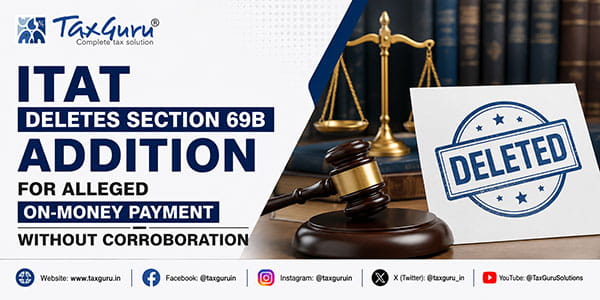
The case involved addition for alleged on-money payment based on search findings of a builder. The ITAT ruled that absence of corroborative evidence and denial of cross-examination makes the addition unsustainable.
ITAT held that addition under Section 69B based only on a loose sheet seized from a third party cannot be sustained when the assessee was denied cross-examination. The ruling treats such action as a violation of natural justice.
The Tribunal ruled that entries found in a third-party pen drive cannot justify addition without independent corroboration. Failure to allow cross-examination violated principles of natural justice, leading to deletion.
The Tribunal deleted ₹2 lakh cash addition as no incriminating material directly linked the assessee to alleged on-money. Reliance solely on pen drive data and third-party statements without cross-examination was held insufficient.
ITAT Mumbai deleted Sec 69 addition for alleged on-money, holding third-party statements and pen-drive data without cross-examination or corroboration are invalid evidence.
ITAT deleted the addition made under Section 153C as no incriminating material directly linked the buyer to alleged cash payments. Reliance solely on third-party pen drive data and statements was held insufficient.
The Tribunal ruled that reassessment completed after the taxpayer s death without issuing notice to legal heirs is void ab initio. Legal heirs are not obligated to inform the Revenue about the death.
ITAT held that Excel sheets recovered from a third party cannot justify addition without direct evidence linking the assessee. In absence of corroboration and cross-examination, the cash investment addition was deleted.