Income Tax : Income without satisfactory explanation is taxed at a special high rate under Section 115BBE. The provisions place strict liabilit...
Income Tax : Detailed overview of penalties under various sections of the Income Tax Act, covering defaults in tax payment, reporting, document...
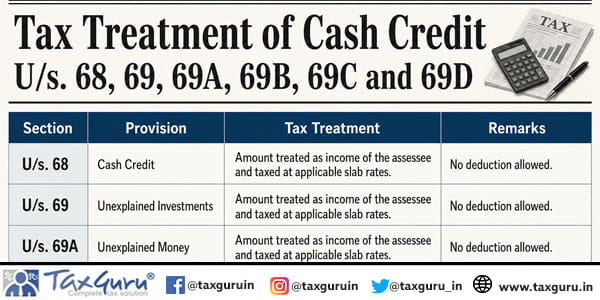
Income Tax : An overview of Sections 68-69D of India's Income-tax Act, which empower tax authorities to assess unaccounted income from unexplai...
Income Tax : A Comprehensive Analysis of Undisclosed Incomes under Sections 68 to 69D of the Income-tax Act, 1961, Taxation of these Incomes Un...
Income Tax : ITAT Chennai rules unaccounted customer deposits, with traceable identities and commercial substance, are liabilities, not income ...
Income Tax : Delhi ITAT held that investments in immovable properties cannot be treated as unexplained once payments are made through disclosed...
Income Tax : Madras High Court held that a reference to the District Valuation Officer was valid because the Assessing Officer had effectively ...
Income Tax : ITAT Mumbai held that prolonged non-payment of interest and repeated amendments to loan agreements justified benchmarking AE loans...
Income Tax : The ITAT Hyderabad held that additions for alleged cash payments cannot be sustained merely on the basis of third-party seized doc...
Income Tax : The Tribunal held that excess stock found during survey had direct nexus with business operations. It ruled that such income shoul...
The Tribunal condoned a 298-day delay in filing appeal, holding that substantial justice must prevail over technicalities. It deleted additions on exempt gratuity and commuted pension, ruling they cannot be taxed as salary.
The Tribunal ruled that when purchases are disallowed as non-genuine without questioning the source of payment, section 69C cannot be invoked. A plausible disallowance under section 37(1) cannot be revised under section 263 merely to change the charging provision.
ITAT Delhi held that day of arrival should be excluded while computing number of stayed in India. Accordingly, the status of assessee is non-resident. Thus, the appeals of the assessee is allowed.
The Tribunal examined whether Section 153A could be applied to the search year itself. It held that invoking Section 153A for the wrong assessment year was invalid, rendering the assessment void.
The Tribunal noted that no construction investment occurred during the year under appeal. Accordingly, no addition for unexplained investment could be sustained in that assessment year.
The Tribunal deleted additions made solely on third-party Excel data after holding that denial of cross-examination of the key witness violated natural justice. The ruling confirms that such denial is fatal where the statement forms the foundation of the addition.
The Tribunal held that additions based solely on third-party statements and seized digital data cannot survive without allowing cross-examination. The matter was remanded for fresh adjudication after granting due opportunity to the assessee.
The Tribunal ruled that the enhanced tax rate under Section 115BBE cannot be applied retrospectively for demonetisation-period transactions. As the tax effect at normal rates fell below the monetary limit, the Revenue’s appeal was dismissed.
The lower authorities confirmed an addition without considering permissible valuation variation. The Tribunal held that ignoring the 10% tolerance under section 50C renders the addition invalid.
The Tribunal held that issuing a Section 143(2) notice is compulsory once a return is filed under Section 148. Absence of such notice vitiates jurisdiction and nullifies the reassessment.