Income Tax : Explains when food and hospitality expenses qualify as business deductions and outlines the tests under Section 37(1) to distingui...
Income Tax : Explains how Section 37(1) restricts deductions to expenses exclusively for business and highlights gray-area items like home offi...
Income Tax : ITAT Ahmedabad held settlement payments in foreign civil cases are deductible under Section 37(1) as compensatory, not penal, and ...
Income Tax : Summary of Section 37(1) IT Act for business expenditure deduction. Covers "wholly and exclusively" test, commercial expediency, ...
Income Tax : Examines the tax implications of employer-funded education, covering employer deductions and employee taxation. Includes analysis ...
Income Tax : The Supreme Court held that interest paid on borrowed funds was deductible under Section 36(1)(iii) because the loan was used for ...
Income Tax : The Supreme Court held that grants disbursed by a statutory corporation formed part of its core business functions and qualified a...
Income Tax : ITAT Mumbai held that although foreign commission expenditure was non-genuine and liable for disallowance, amounts already written...
Income Tax : ITAT Chennai held that before the 2016 amendment, DSIR approval under Section 35(2AB) related to the in-house R&D facility and not...
Income Tax : The Mumbai ITAT allowed deduction of professional fees paid for facilitating remittances relating to Iranian-origin imports affect...
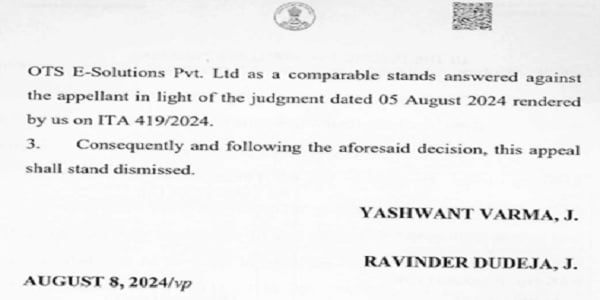
ITAT Delhi held that while selecting the comparables transactions or entities, in case of international transactions, the basis should be one of similarity with the control transactions/entities and mere broad similarity is not sufficient.
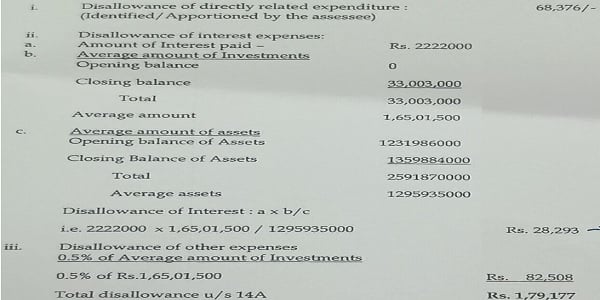
The Tribunal upheld deletion of a Section 14A disallowance after noting that the taxpayer did not earn any exempt income in the relevant assessment year. The ruling reiterates that Section 14A cannot be invoked in the absence of exempt income.
ITAT Mumbai held that rejecting Transactional Net Margin Method (TNMM) as the Most Appropriate Method (MAM) for benchmarking guarantee fee is not justifiable since assessee doesn’t undertake any risk of profit or loss on the said transaction.
The ITAT ruled that extensive repairs to a 25-year-old factory building were revenue in nature since no new asset or enduring advantage arose. The addition treating the expense as capital was deleted.
The Tribunal held that payment for cement shortage during transport arose from contractual obligation and was compensatory in nature. As no statutory violation was established, deduction under Section 37(1) was allowed.
The Tribunal held that purchases cannot be treated as bogus merely because the supplier did not file an income tax return. Verified GST filings and inventory records established transaction genuineness.
The Tribunal remanded the matter after noting that expenses already disallowed by the assessee were again disallowed during processing, resulting in double addition. The issue was sent back to the Assessing Officer for fresh consideration.
ITAT Mumbai quashed 143(3) order post-search, deleted ₹96.77L suppressed sales addition, allowed Sec 37(1) expenses & CWIP write-off as revenue in 153A assessment.
The Tribunal upheld addition of interest accrued on security deposits that was not disclosed in the return. It ruled that accrued interest must be taxed when not voluntarily offered by the assessee.
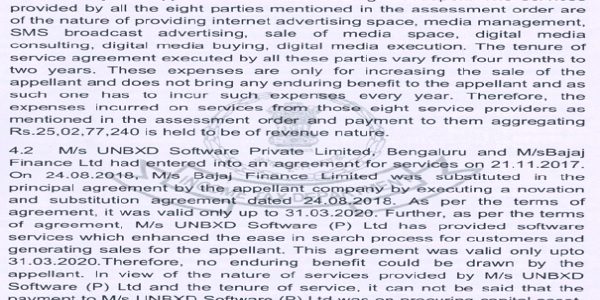
Tribunal held that recurring software expenses such as licence renewals and database support fees are revenue in nature since no capital asset or ownership right was created. Deduction under Section 37(1) was allowed and Revenue’s appeal was dismissed.