Income Tax : The Tribunal held that penalty under Section 271DA cannot be imposed when the assessment order lacks recorded satisfaction of a 26...
Income Tax : Supreme Court ruling on cash property deal cites wrong tax law (269ST instead of 269SS), but mandates reporting of large cash tra...
Income Tax : Simplified penalty timelines under Section 275 effective April 2025, including changes in penalty powers, omissions, and clarifica...
Income Tax : Income Tax Act amendments propose penalties by Assessing Officers instead of Joint Commissioners. Omission of section 271BB and ch...
Income Tax : Post-Finance Bill 2025, penalties under specified sections of the Income-tax Act will be levied by the Assessing Officer, with Joi...
Income Tax : It has also been decided that the restriction on cash transaction under section 269ST shall not apply to withdrawal of cash from ...
Income Tax : Gujarat High Court held that reassessment proceedings based on loose papers referring to non-agricultural land could not justify r...
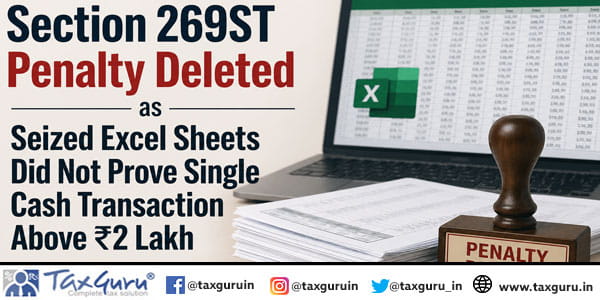
Income Tax : The Tribunal held that consolidated Excel entries showing aggregate cash sales were insufficient to establish receipt of ₹2 lakh...
Income Tax : The issue was whether multiple medical bills constituted a single transaction under Section 269ST. The Tribunal held that separate...
Income Tax : The tribunal examined whether penalties could continue when the fresh assessment order did not record satisfaction for initiating ...
Income Tax : The Court issued notice in a plea to quash criminal proceedings where the applicant argued that alleged cash payments exceeding â‚...
Income Tax : Circular No. 22 of 2017 F.No.370142/10/2017-TPL Government of India Ministry of Finance Department of Revenue (Central Board of Di...
Gujarat High Court held that reassessment proceedings based on loose papers referring to non-agricultural land could not justify reopening where assessee had sold agricultural land. Court ruled that alleged escapement of income was based only on hypothesis and conjecture.
The Tribunal held that consolidated Excel entries showing aggregate cash sales were insufficient to establish receipt of ₹2 lakh or more in a single transaction, and penalty under Section 271DA could not be sustained.
The issue was whether multiple medical bills constituted a single transaction under Section 269ST. The Tribunal held that separately billed services are independent transactions, so penalty was not justified.
The tribunal examined whether penalties could continue when the fresh assessment order did not record satisfaction for initiating them. It ruled that absence of such satisfaction makes the penalties invalid in law.
The Court issued notice in a plea to quash criminal proceedings where the applicant argued that alleged cash payments exceeding ₹2 lakh should first be examined under Section 269ST of the Income Tax Act.
The Tribunal held that penalty under Section 271DA cannot be imposed when the assessment order lacks recorded satisfaction of a 269ST violation. The ruling confirms that satisfaction by the Assessing Officer is a mandatory precondition.
ITAT Delhi ruled that penalties under section 271DA cannot be levied without the AO recording satisfaction in the assessment order, following Supreme Court precedent.
The Karnataka High Court set aside a penalty notice and order under Section 271DA for violating Section 269ST, holding the proceedings were time-barred. Following the K. Umesh Shetty precedent, the Court ruled that the delay between the AO’s reference and the penalty notice constituted unreasonable laches, vitiating the entire action.
ITAT Ahmedabad held that provisions of section 69A r.w.s. 115BBE of the Income Tax Act gets applicable as source of undisclosed income admitted during the course of survey not explained. Merely disclosing and paying tax doesn’t protect assessee from clutches of section 69A.
SC mandates reporting of cash transactions over ₹2L under Section 269ST, directing courts, IT authorities, and registrars to ensure compliance and curb violations.