Income Tax : The Tribunal held that penalty under Section 271DA cannot be imposed when the assessment order lacks recorded satisfaction of a 26...
Income Tax : Supreme Court ruling on cash property deal cites wrong tax law (269ST instead of 269SS), but mandates reporting of large cash tra...
Income Tax : Simplified penalty timelines under Section 275 effective April 2025, including changes in penalty powers, omissions, and clarifica...
Income Tax : Income Tax Act amendments propose penalties by Assessing Officers instead of Joint Commissioners. Omission of section 271BB and ch...
Income Tax : Post-Finance Bill 2025, penalties under specified sections of the Income-tax Act will be levied by the Assessing Officer, with Joi...
Income Tax : It has also been decided that the restriction on cash transaction under section 269ST shall not apply to withdrawal of cash from ...
Income Tax : Gujarat High Court held that reassessment proceedings based on loose papers referring to non-agricultural land could not justify r...
Income Tax : The Tribunal held that consolidated Excel entries showing aggregate cash sales were insufficient to establish receipt of ₹2 lakh...
Income Tax : The issue was whether multiple medical bills constituted a single transaction under Section 269ST. The Tribunal held that separate...
Income Tax : The tribunal examined whether penalties could continue when the fresh assessment order did not record satisfaction for initiating ...
Income Tax : The Court issued notice in a plea to quash criminal proceedings where the applicant argued that alleged cash payments exceeding ...
Income Tax : Circular No. 22 of 2017 F.No.370142/10/2017-TPL Government of India Ministry of Finance Department of Revenue (Central Board of Di...
अर्जुन: हे माधव, प्रणाम! मेरी एक समस्या का निवारण कीजिए। कृष्ण: कहिए अर्जुन! बताइए क्या समस्या हैं? अर्जुन: माधव, मुझे यह बताए कि GST कानून के तहत एक टैक्सपेयर कितने रुपए का नकद में लेन-देन कर सकता हैं? कृष्ण: वत्स! GST कानून में नकद लेन-देन को लेकर कोई भी प्रावधान नहीं हैं परन्तु इनकम टैक्स […]
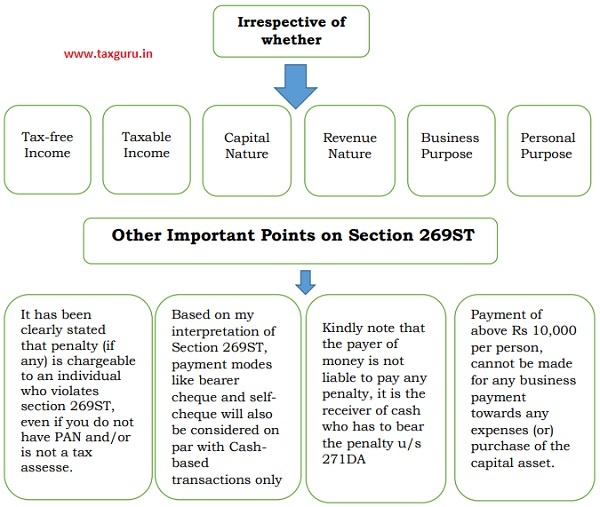
As we all know about the section 269ST, which was introduced by the Central Government in the Income Tax Act, 1961 by the Finance Act, 2017, to curb tax evasion, regulation and circulation of black money. 1. Basic Understanding of Section 269ST As per section 269ST, any person who enters into a transaction of Rs […]
Central Government is putting all efforts to curb use of cash which is focused on un-accounted transactions. As we all know, not all transactions that are transacted in cash hold the colour of un-accounted money, the contrary is that all the un-accounted transactions takes place in cash.
With an aim to hold control over black money transaction and also to promote the digital transactions, the provisions of section 269ST of the Income Tax Act were introduced and made effective from 1st April 2017. The provisions of section 269ST mandate specific modes of undertaking transactions. In case the person fails to comply with […]
To put restriction on the cash transactions & promote digital economy, section 269ST was inserted in the Income-tax Act, 1961 vide Finance Act, 2017 w.e.f 1st April 2017. Article discusses Provisions of Section 269ST which Prohibits receipt of an amount of Rs. 2 lakh or more by a person, Section 271DA which provides penalties for […]
SECTION 269ST- Treatment of Cash Transactions above Rs. 2 Lakhs You can repay your loan amount to any HFC (Housing finance company) or NBFC (Non-banking finance company) in cash provided each loan installment is less than Rs 2 lakhs. The government in the last budget introduced Section 269ST. Under the section, cash transactions exceeding Rs.2 […]
As we all are aware of Section 269ST which was introduced by finance act, 2017 in Income tax act, 1961 by the central government in order to curb the tax evasion, regulation and circulation of Black money. This article will cover the detailed analysis of the said section alongwith some practical examples. 1. Basic Understanding […]
In this article we will understand why section 269ST is introduced and what is the need of invoking such provisions, Section 269ST was introduced by finance act, 2017 in Income tax act, 1961 by the central government in order to curb the tax evasion, regulation and circulation of Black money. Most of the transactions in […]
Finance Act 2017, instead of amending section 273B, inserted a proviso to section 271DA itself to the effect that, no penalty shall be imposable if such person proves that there were good and sufficient reasons for the contravention of section 269ST. However, what could constitute good and sufficient reasons for contravention have not been defined.
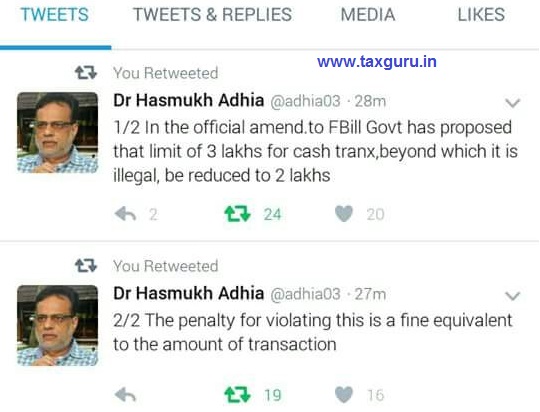
The Finance Bill, 2017 has proposed to introduce a new section 269ST in the Income Tax Act with effect from 01st April, 2017. This section aims for restricting the cash transaction for achieving the mission of the Government to move towards less cash economy to reduce generation and circulation of black money in the economy.