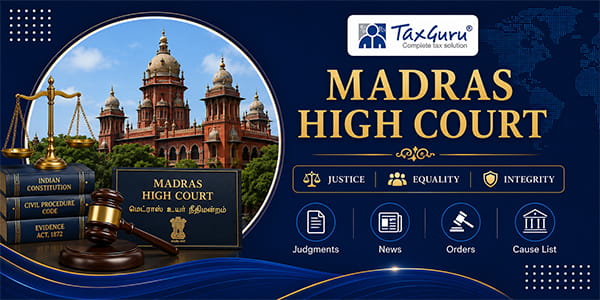
Access significant and up-to-date high court judgments for legal insights and precedent. Stay informed about the latest legal decisions and their impact on various areas of law.
Goods and Services Tax : The Gujarat High Court held that supplier tax payment remains mandatory for ITC claims under Section 16(2)(c). However, ITC cann...
Income Tax : The article explains how the High Court held that corporate guarantee fees do not qualify as Fees for Technical Services under the...
Goods and Services Tax : The Andhra Pradesh High Court held that refund arising from an unconstitutional GST levy carries a constitutional right to interes...
Corporate Law : The Allahabad High Court observed that criminal case delays are caused not only by judicial officers but also by inadequate infras...
Corporate Law : The Delhi High Court quashed a POCSO FIR after noting that the relationship was consensual and the parties were married with a chi...
Corporate Law : Supreme Court ruled that CoC and RP can surrender financially burdensome assets voluntarily, clarifying moratorium under section 1...
Income Tax : Gujarat HC has directed CBDT to ensure that there is a mandatory one-month gap between date for furnishing tax audit reports (unde...
Income Tax : Rajasthan High Court granted a one-month extension for filing TARs under Section 44AB for AY 2025-26, citing delayed audit utility...
Income Tax : The Gujarat High Court is hearing a petition from the Chartered Accountants Association regarding persistent glitches on the new I...
Corporate Law : SC clarifies limits of High Court's writ powers in IBC cases and recognises Indian CIRP as foreign main proceeding in cross-border...
Goods and Services Tax : The Karnataka High Court held that blocking an electronic credit ledger under Rule 86A without a pre-decisional hearing was unsust...
Goods and Services Tax : The Karnataka High Court held that Section 83 of the CGST Act does not mandate a pre-decisional hearing before provisional attachm...
Income Tax : The Bombay High Court held that reassessment proceedings issued beyond three years for AY 2018-19 were invalid because approval wa...
Goods and Services Tax : Telangana High Court granted bail in a GST fake ITC case involving alleged wrongful availment of Rs.21.89 crore credit. The Court ...
Goods and Services Tax : The Jharkhand High Court held that a taxpayer cannot bypass the statutory appellate mechanism merely by alleging non-service of no...
Income Tax : The Court held that membership cannot be granted where the underlying flats do not exist and are merely refuge areas. It ruled tha...
Corporate Law : Bombay High Court implements "Rules for Video Conferencing 2022" for all courts in Maharashtra, Goa, and union territories, effect...
Income Tax : CBDT raises monetary limits for tax appeals: Rs. 60 lakh for ITAT, Rs. 2 crore for High Court, and Rs. 5 crore for Supreme Court, ...
Corporate Law : The Delhi High Court mandates new video conferencing protocols to enhance transparency and accessibility in court proceedings. Rea...
Income Tax : Income Tax Department Issues Instructions for Assessing Officers after Adverse Observations of Hon. Allahabad High Court in in Civ...
The Court clarified that local self-government bodies are not automatically exempt from GST on all activities. It ruled that such claims require factual scrutiny and cannot bypass the statutory appellate mechanism.
The case addressed whether multiple financial years can be combined in a single show cause notice under GST law. The Court held such consolidation impermissible, emphasizing that each financial year is a separate tax period.
The case examined whether a tax order for FY 2019–20 was time-barred. The Court held that notification-based extensions validly extended the limitation period, making the order legally valid.
The case examined the legality of imposing both late fee and general penalty for the same default. The Court ruled that such overlapping penalties are unjustified and unsustainable. The decision clarifies that only one penal consequence can be applied in such cases.
The High Court set aside the rejection of GST registration revocation, holding that Rule 23 permits filing within 270 days. It ruled that the authority wrongly rejected the application on delay grounds and directed reconsideration after hearing the taxpayer.
The High Court held that GST revocation cannot be denied solely due to portal time limits where genuine hardship exists. It directed the authority to accept a manual application and decide the matter on merits within a fixed timeframe.
GST registration was cancelled for six months of non-filing of returns, and the taxpayer was unable to apply for revocation due to portal time limits. The High Court directed acceptance of a physical application and ordered a decision within three weeks.
The case addresses the continued failure to release ITR utilities on time despite earlier court directions. The Court adjourned the matter after CBDT failed to file a required affidavit, highlighting ongoing compliance gaps.
The case examined if income details could be disclosed under RTI during a matrimonial dispute. The Court ruled that such disclosure violates privacy and is not justified without public interest.
High Court held that reliance solely on affinity test and cultural traits was insufficient where extensive documentary records, including pre-constitutional entries and family validity certificates, supported the Scheduled Tribe claim.