Union Budget 2026 – Reforms in Banking Sector & Key Actions that can be taken by Public Sector Banks
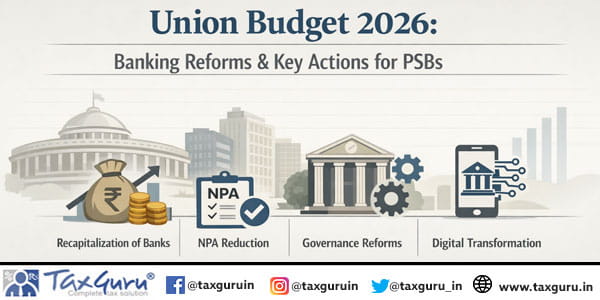
The Union Budget 2026–27, marked a strategic pivot from crisis-management to reform-led growth — particularly for financial intermediation and banking. The Budget underscores confidence in the banking system’s resilience, while laying out a roadmap to transform India’s banking ecosystem under the Viksit Bharat 2047 vision. Key proposals reinforce structural efficiency, expand credit delivery, deepen markets, and enhance stability, inclusion and governance in the sector.
1. High-Level Committee on Banking (Viksit Bharat)
Proposal
Set up a High-Level Committee to review and recommend reforms for India’s banking sector aligned with the Viksit Bharat 2047 vision.
Reason Behind Proposal
- The banking sector currently showcases improved balance sheets, strong profitability and enhanced asset quality. The committee is intended to evaluate next phase reforms focusing on structure, governance and preparedness for future challenges.
Impact of the Proposal
- A detailed reform agenda will likely emerge, targeting:
- operational efficiency,
- competitiveness,
- risk-management frameworks,
- consumer protection,
- credit access to strategic sectors.
Interpretation (Banking Sector Point of View)
- The committee’s recommendations can drive:
- improved strategic planning,
- standardization of governance practices,
- integration of technology and risk analytics,
- a shift toward future-ready banking systems.
Banks will gain clarity on structural priorities and long-term strategic direction.
What it shows:
- Government: Gains an evidence-based reform roadmap to support national growth targets.
- Banks: Receive clear, phased reform blueprints to booster performance, competitiveness and stakeholder trust.
2. Public Sector NBFC Restructuring (PFC & REC)
Proposal
Restructure public sector Non-Banking Financial Companies by integrating entities such as PFC and REC for greater scale and efficiency.
Reason Behind Proposal
- To strengthen institutional capacity, improve financing capabilities for infrastructure and power sectors, and enhance systemic credit flow.
Impact of the Proposal
- Larger, more robust NBFCs can:
- support long-term credit requirements,
- deepen outreach into underserved sectors,
- complement bank financing capacity.
Interpretation (Banking Sector Point of View)
- Facilitates credit ecosystem integration — enabling banks to co-lend with stronger NBFCs, share risk, and widen credit penetration (especially in infrastructure and MSME finance).
What it shows:
- Government: Builds robust development finance institutions to back national priorities.
- Banks: Can leverage expanded partner networks for risk distribution and higher credit deployment without proportionate capital strain.
3. Review of FEMA (Non-Debt Instruments) Rules
Proposal
Comprehensive review of FEMA (Non-Debt Instruments) rules to modernize and make them more user-friendly for foreign investments.
Reason Behind Proposal
- Align foreign investment frameworks with evolving economic priorities and global investor expectations.
Impact of the Proposal
- Potential increase in foreign capital flows into:
- banking,
- financial services,
- financial markets.
Interpretation (Banking Sector Point of View)
- Easier foreign investment norms enhance banks’:
- capital base,
- access to global funding channels,
- competitiveness with international peers.
What it shows:
- Government: Attracts foreign capital, strengthens reserves and deepens markets.
- Banks: Benefit from enhanced funds availability and stronger balance sheets.
4. Expansion of Corporate & Municipal Bonds
Proposal
Encourage deeper corporate and municipal bond markets as alternative sources of finance.
Reason Behind Proposal
- Reduce reliance on traditional bank credit for infrastructure and corporate financing, thereby diversifying funding sources.
Impact of the Proposal
- Larger bond markets:
- provide long-term funding,
- relieve pressure on bank balance sheets,
- support infrastructure and public projects.
Interpretation (Banking Sector Point of View)
- While bank lending remains core, alternative markets help mitigate risk concentration and improve asset-liability matching.
What it shows:
- Government: Funds infrastructure with deeper market instruments.
- Banks: Can act as intermediaries and investors, enhancing fee income and risk diversification.
5. TReDS, MSME Credit & Liquidity Support
Proposal
Leverage the Trade Receivables Discounting System (TReDS) to improve liquidity for MSMEs via:
- mandated use for government purchases,
- credit guarantees,
- linking to asset-backed securities markets.
Reason Behind Proposal
- MSMEs are critical credit clients — improving their liquidity strengthens credit quality and reduces defaults.
Impact of the Proposal
- Enhances receivables financing, reduces working capital stress, and improves asset quality in MSME portfolios.
Interpretation (Banking Sector Point of View)
- TReDS can reduce financing costs, widen client bases & digitize credit workflows.
What it shows:
- Government: Boosts MSME sector growth.
- Banks: Gain better risk visibility and improved loan performance.
6. Infrastructure Risk Guarantee Fund
Proposal
Set up a fund to provide partial credit guarantees for infrastructure lending.
Reason Behind Proposal
- Encourages higher risk-taking in long-tenor infrastructure loans without burdening lender balance sheets.
Impact of the Proposal
- Lower perceived risk for banks,
- Increased willingness to finance critical projects.
Interpretation (Banking Sector Point of View)
- Helps banks support national capex agenda while managing provisioning burdens better.
What it shows:
- Government: Accelerates infrastructure delivery.
- Banks: Achieve stable returns with mitigated risk exposure.
Key Actions that can be taken by Public Sector Banks:
1. Strategic & Governance Actions:
a) Prepare for High-Level Banking Committee Reforms
Action Points
- Constitute an internal reform readiness group (Strategy + Risk + IT + HR)
- Conduct a gap analysis on:
- Governance structure
- Board processes
- Risk management frameworks
- Technology adoption
- Prepare bank-specific reform proposals for submission when committee consultations begin
Why it matters
- Reforms will shape PSB structure till Viksit Bharat 2047
- Early preparedness = first-mover advantage
b) Strengthen Board & Governance Discipline
Action Points
- Improve Board-level risk oversight
- Strengthen independence of:
- Audit Committee
- Risk Management Committee
- Formalise performance-linked accountability for senior management
Budget Link
Emphasis on structural efficiency and governance-led banking
2. Credit & Balance Sheet Strategy:
a) Recalibrate Infrastructure Lending Strategy
Action Points
- Identify priority infrastructure sectors aligned with government capex
- Actively leverage Infrastructure Risk Guarantee Fund
- Increase exposure through:
- Consortium lending
- Take-out financing
- Partial risk cover structures
Outcome
- Higher long-tenor lending with controlled NPAs and provisioning
b) Leverage NBFC Restructuring (PFC / REC)
Action Points
- Build co-lending & risk-sharing frameworks with restructured NBFCs
- Use NBFCs for:
- Project appraisal support
- Sectoral expertise (power, infra)
- Reduce direct balance-sheet concentration
Why
NBFC scale-up = extended credit arm for banks
3. MSME & TReDS Execution:
a) Aggressive Adoption of TReDS
Action Points
- Mandate TReDS onboarding for:
- All eligible MSME borrowers
- Government-linked vendors
- Integrate TReDS data with:
- Credit appraisal
- Early warning systems
- Offer preferential pricing for TReDS-backed exposure
Benefits
- Lower default risk
- Faster MSME liquidity
- Improved asset quality
b) Simplify MSME Credit Delivery
Action Points
- Reduce documentation layers for repeat MSME borrowers
- Increase use of:
- Cash-flow based lending
- Digital scorecards
- Align credit policy with credit guarantee schemes
Budget Signal
MSME credit deepening is a national priority
4. Capital Markets & Non-fund Income:
a) Deepen Role in Corporate & Municipal Bonds
Action Points
- Strengthen:
- Investment banking desks
- Debt syndication teams
- Act as:
- Arranger
- Underwriter
- Anchor investor
- Increase fee-based income from bond markets
Why
- Budget encourages market-based financing
- Reduces pressure on traditional loan books
b) Prepare for FEMA (Non-Debt Instruments) Liberalization
Action Points
- Upgrade internal FEMA compliance systems
- Train teams on:
- Foreign investment inflows
- Cross-border banking
- Position PSBs as foreign capital facilitators
Outcome
- Improved access to low-cost foreign funds
5. Risk Management & Compliance:
a) Upgrade Risk Analytics
Action Points
- Strengthen:
- Sectoral concentration monitoring
- Early stress detection
- Use data from:
- GST
- TReDS
- Digital footprints
- Align provisioning policies with long-tenor infra exposure
b) Align with New Income Tax Act, 2025
Action Points
- Update internal systems for:
- TDS / TCS changes
- MAT and buyback taxation impacts
- Train treasury and compliance teams
Ensure zero-defect tax compliance to avoid penalties
6. Technology & Digital Readiness:
a) Accelerate Digital Credit & Monitoring
Action Points
- Expand use of:
- AI-based credit assessment
- Automated monitoring tools
- Integrate DPI, GSTN, MCA, TReDS data
- Improve turnaround time (TAT) for loans
b) Cybersecurity & Data Governance
Action Points
- Strengthen cyber resilience
- Improve data governance for:
- Regulatory reporting
- Compliance surveillance
Align IT systems with future supervisory expectations
7. HR, Capacity building & culture:
a) Skill Upgrade for Officers
Action Points
- Train officers in:
- Infrastructure finance
- Bond markets
- Risk-based pricing
- Digital lending
- Build sector-specialist verticals
b) Shift Mindset: From Recovery to Growth
Action Points
- Move from NPA-repair mindset to growth-with-discipline
- Encourage responsible risk-taking
- Align performance metrics with:
- Quality credit growth
- Fee income
- Governance standards
So for the banking community, this Budget is not just about immediate fiscal allocations — it sets a blueprint for sustained evolution. The proposed reforms can unlock new opportunities in credit intermediation, asset management, technology integration, and global competitiveness. With aligned implementation, these measures can be mutually beneficial for both the government’s economic goals and the banking sector’s growth trajectory.
*****
You can reach to me at [email protected]