Commercial Taxes Officer Special Vs RSWM Ltd. (Rajasthan High Court)
These revision petitions under Section 84 of the Rajasthan Value Added Tax Act, 2003 (‘the RVAT Act, 2003’) are directed against the judgment of the Rajasthan Tax Board, Ajmer dated 15/10/2018 passed in appeals filed by the respondent assessee, whereby, the appeals have been allowed and the orders passed by the Assessing Officer and the Appellate Authority have been set aside.
The respondent assessee was issued five separate entitlement certificates for interest subsidy @ 2.5% for its five units by the State Level Screening Committee, Jaipur (‘SLSC’) under the provisions of Rajasthan Investment Promotion Scheme, 2003 (‘RIPS, 2003’), which were modified on 10/3/2010 by the SLSC, whereby, the interest subsidy @ 2.5% over seven years from 9/3/2007 except for thermal power plants was allowed.
By order dated 28/2/2011, the petitioner department determined the base tax for the year 2005-2006 and allowed the amount of subsidy over and above Rs.1,70,15,001 after considering the submissions and material on record. Whereafter, the Commercial Taxes Officer (Special Circle) passed orders dated 1/12/2012, 27/2/2013, 29/3/2013 and 21/6/2013 allowing the subsidy to the assessee under RIPS, 2003 for various quarters i.e. from 1/4/2011 to 30/6/2011, 1/7/2011 to 30/9/2011, 1/10/2011 to 31/12/2011 and 1/1/2012 to 31/3/2012.
On 27/5/2016 the department issued show cause notices under Sections 26 and 55 of the RVAT Act, 2003, for changing the base tax payable by the assessee. The assessee submitted reply to the show cause notices. On 22/6/2016, the department passed final order under Section 26 and 55 of the RVAT Act, 2003 read with Clause 9 (B)(viii) and 10 of the RIPS, 2003, whereby, the interest subsidy allowed to the assessee for various quarters was modified and the demand along with interest was created.
Feeling aggrieved the assessee filed appeals before the appellate authority, Commercial Taxes, Ajmer. The appellate authority by its order dated 31/3/2017 allowed the appeal qua one quarter holding the assessment as time barred and for the rest three quarters dismissed the appeals filed by the assessee.
The assessee then approached the Rajasthan Tax Board, Ajmer aggrieved by the order dated 31/3/2017. The Tax Board by the impugned judgment dated 15/10/2018 allowed the appeals and set aside the orders dated 22/6/2016 and 31/3/2017.
Learned counsel for the petitioner submitted that the order passed by the Tax Board is ex-facie against the law and as such the same deserves to be quashed and set aside.
Submissions were made that the Tax Board came to the conclusion that the department could not exercise powers under Section 26 of the RVAT Act, 2003 as the said power was not available under the RIPS, 2003 and also came to the conclusion on merits of the dispute that the amount of ‘partial exemption received by the assessee’ was not part of ‘payable tax’ and, therefore, basis for raising the demand was also quashed. It was vehemently submitted that the findings on both the issues are incorrect and deserve to be set aside.
It was emphasized that initially in RIPS, 2003 there was no provision for taking action under Section 26 or 33 of the RVAT Act, 2003, which provisions pertain to escaped assessment and rectification of mistake, respectively. However, vide amendment dated 10/10/2008, the provision for exercise of power under Section 33 of the RVAT Act, 2003 was introduced. In the subsequent Schemes i.e. Rajasthan Investment Promotion Scheme, 2010 (‘RIPS, 2010) and Rajasthan Investment Promotion Scheme, 2014 (‘RIPS, 2014) it was specifically provided that the orders passed under the Schemes shall be subject to provisions of RVAT Act, 2003 and the Central Sales Tax Act, 1956 and by order dated 30/4/2018 provisions of RIPS, 2003 were further amended and vide Clause 5 of the amendment order a new Clause 9A providing for procedure for disbursement of subsidy was introduced and provisions similar to the RIPS, 2010 and RIPS, 2014 pertaining to applicability of RVAT Act, 2003 and the Rajasthan Goods and Services Tax Act, 2017 (‘the RGST Act’) were inserted.
It was submitted that the intention of the legislature from the beginning is very clear, whereby, in each subsequent Schemes/RIPS, 2010 and RIPS, 2014 the provisions of RVAT Act, 2003 have been made applicable, which necessarily means that the provisions of Section 26 and 33 of the RVAT Act, 2003 are also attracted in the cases under RIPS, 2003 and, therefore, the determination made by the Tax Board by holding that at the relevant time the provisions of RVAT Act, 2003 were not applicable to the RIPS, 2003, cannot be sustained.
It was submitted that a bare look at the Amendment, 2018 would reveal that the RIPS, 2003 itself has been amended by introducing Clause 9A and, therefore, the objection, if any, has no basis and, consequently the judgment passed by the Tax Board deserves to be quashed and set aside.
Reliance was placed on Sree Bank Ltd. Vs. Sarkar Dutt Roy & Company : AIR 1966 SC 1953, State of Karnatake vs. Hansa Corporation : AIR 1981 SC 463 and Commissioner of Income Tax, Calcutta vs. National Taj Traders : AIR 1980 SC 485.
Further submissions were made that once the Tax Board had come to the conclusion that the Assessing Officer had no jurisdiction to pass the order impugned, there was no occasion for the Tax Board to have gone into the merits of the dispute raised inasmuch as, the same has created a precedent, which was not necessary for adjudication of the dispute. Without prejudice to the above submission, it was submitted that the determination made on merits also is factually incorrect and is based on wrong interpretation of the applicable provisions and, therefore, the same deserves to be set aside.
Learned counsel appearing for the respondent assessee vehemently opposed the submissions. It was submitted that the revision petitions have no substance inasmuch as the Tax Board has thoroughly and meticulously dealt with all the issues involved and has rightly come to the conclusion that in absence of any provision applying provisions of RVAT Act, 2003 including Section 26 to RIPS, 2003, the Assessing Officer had no jurisdiction to pass the orders impugned and, therefore, the petitions deserve to the dismissed.
It was submitted that admittedly the RIPS, 2003 did not contain any provision applying the provisions of RVAT Act, 2003 to the assessments made under the Scheme. The fact that the provision was introduced in the subsequent Schemes i.e. RIPS, 2010 and RIPS, 2014 are of no avail insofar as the assessments made under the RIPS, 2003 are concerned. The very fact that by the amendment introduced in RIPS, 2003 in the year 2008 the provisions of Section 33 were made applicable and in the amendment made in the year 2018, the provisions of RVAT Act. and RGST Act were made applicable to RIPS, 2003 clearly brings out the absence of said provisions and inapplicability of the RVAT Act to the RIPS, 2003.
It was also emphasized that the amendment introduced in the year 2018 cannot be termed as retrospective so as to apply to the case of the respondent, as the plain reading of the amendment reveals that the same has been inserted ‘with effect from 1/7/2017’ and as such, the plea sought to be raised about retrospectivity of the provisions has no basis.
It was submitted that the very action of the department in issuing notice and passing orders based on audit objection is also without jurisdiction.
Reliance was placed on Commissioner of Income Tax (Central)-I, New Delhi vs. Vatika Township Private Limited : (2015) 1 SCC 1 and Monnet Ispat and Energy Limited vs. Union of India & Ors. : (2012) 11 SCC 1.
On merits of the dispute, it was submitted that the entire basis for reassessment is non-existent as the assessee was rightly allowed the subsidy and the interpretation sought to be placed on the term ‘tax payable’ by including the amount of ‘partial exemption’ granted under the CST Act cannot be sustained. It was submitted that the judgment passed by the Tax Board does not call for any interference and the revision petitions deserve to be dismissed.
I have considered the submissions made by learned counsel for the parties and have perused the material available on record.
The facts are not in dispute, whereby, initially under the RIPS, 2003 the orders were passed determining the amount of subsidy to the respondent assessee by orders dated 1/12/2012, 27/2/2013, 29/3/2013 and 21/6/2013 for four quarters beginning from 1/4/2011 and ending with 31/3/2012. Whereafter, a notice under Section 26 of the RVAT Act, 2003, which pertains to escaped assessment was issued on 27/5/2016 and after hearing the assessee, the Commercial Taxes Officer, Special Circle-II, Bhilwara by its order dated 22/6/2016 came to the conclusion that the assessee was allowed excess subsidy based on its interpretation of the words ‘tax payable’ in the Scheme and consequently raised the demand along with interest.
The appellate authority on appeals filed by the assessee, negated all the objections raised pertaining to the exercise of jurisdiction by the Assessing Officer for three quarters and also upheld the determination made on merits.
The Tax Board on appeals filed by the assessee by its impugned judgment dated 15/10/2018 inter alia came to the following conclusion qua the jurisdiction of the assessing authority:
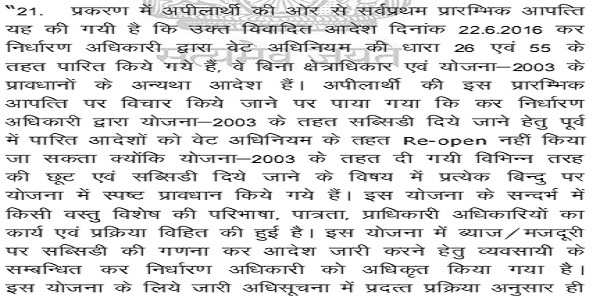
It was held that the provisions of RVAT Act, 2003 were not applicable to RIPS, 2003 and, therefore, the order passed under RIPS, 2003 could not be reopened.
On merits of the dispute, it was inter alia held as under: