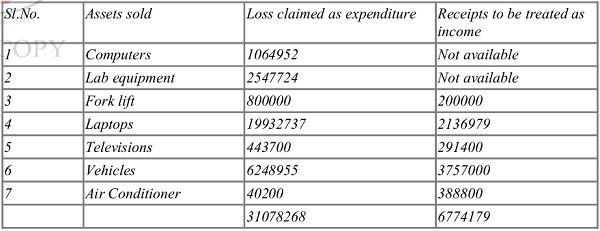
Income Tax : Smt. Ranjana Kumari/Kalta Vs DCIT/ACIT (Central) (ITAT Chandigarh) The appeals involved three assessees belonging to the Kalta Gro...
Income Tax : Learn the updated provisions governing rectification, assessments, reassessments, and appeals under the Income-tax Act. This guide...
Income Tax : The article explains how the Finance Acts, 2025 and 2026 have reshaped the Updated Return regime under Section 139(8A). It highlig...
Income Tax : The Supreme Court has remitted reassessment cases for fresh consideration after the retrospective insertion of Section 147A, leavi...
Income Tax : This article explains why reassessment proceedings may be invalid if the Assessing Officer merely relies on Investigation Wing rep...
Income Tax : Learn about the new block assessment provisions for cases involving searches under section 132 and requisitions under section 132A...
Income Tax : Discover how Finance Act 2021 revamped assessment and reassessment procedures under Income-tax Act, impacting notices, time limits...
Income Tax : Humble Representation for modification of Section 151 of the Income Tax Act relating to Sanction for issue of Notice under sec. 14...
Income Tax : Income Tax Gazetted Officers’ Association requested CBDT to issue Clarification in respect of the judgement of Hon’ble Supreme...
Income Tax : In view of Indiscriminate notices by income Tax Department without allowing reasonable time it is requested to Finance Ministry an...
Income Tax : Where unaccounted sales were established through seized material, only the net profit embedded therein was liable to tax, and not ...
Income Tax : ITAT Mumbai remanded the case to examine whether Section 56(2)(x) applied based on the agreement date and to consider refund of ex...
Income Tax : ITAT Bangalore remanded a Section 69A addition after holding that an APMC commission agent's entire sale proceeds could not be tre...
Income Tax : ITAT Kolkata condoned appeal delay, set aside the CIT(A)'s order, and remanded the assessment for fresh adjudication after grantin...
Income Tax : ITAT Mumbai quashed reassessment after finding no Section 143(2) notice and that the AO issued a final order disguised as a draft ...
Income Tax : The department has identified high-risk cases through its Insight Portal for AYs 2022-25. It directs officers to initiate reassess...
Income Tax : ITAT Chandigarh held that ITO Ward-3(1), Chandigarh had no jurisdiction to issue notice to an NRI and hence consequently the asses...
Income Tax : Explore the latest guidelines for issuing notice under Section 148 of the Income Tax Act, 1961. Understand key procedures, amendme...
Income Tax : Explore e-Verification Instruction No. 2 of 2024 from the Directorate of Income Tax (Systems). Detailed guidelines for AOs under I...
Income Tax : Supreme Court in the matter of Shri Ashish Agarwal, several representations were received asking for time-barring date of such cas...
The Tribunal invalidated reassessment proceedings since the Section 148 notice was issued after 01.04.2021, making it time-barred. The ruling reinforces strict limitation compliance for reopening cases.
The case examined reopening based on a prior disallowance under Section 80IB(10). The Court found that the disallowance had already been reversed by appellate authorities. Therefore, reopening based on the same ground was held invalid.
The Court held that reassessment cannot be initiated after expiry of the limitation period under the old regime. The notice issued after six years was declared invalid.
Orissa High Court held that assessment order set aside as proceedings under section 148 of the Income Tax Act initiated without serving of statutory notice. Accordingly, matter remitted back to AO to serve notice u/s. 148 as not hit by limitation u/s. 149.
ITAT confirmed validity of reassessment based on cash deposit information. However, it reduced addition by applying peak credit theory due to withdrawal patterns
The Court quashed the Section 148A(d) order for not aligning with binding Supreme Court decisions. It directed fresh adjudication following the principles laid down in earlier rulings.
The Court examined whether reassessment based on search could extend beyond statutory timelines. It held that the notice for AY 2015–16 was issued beyond the permissible ten-year period. The ruling confirms that limitation provisions must be strictly followed.
The issue involved reopening based on alleged share transfer through a loan structure. The Court held reassessment invalid as the foundational fact was incorrect.
The case involved reassessment triggered by a search conducted in 2022. The Court ruled that reopening beyond the 10-year statutory limit is not permissible.
The Supreme Court dismissed the Revenue’s appeal citing unexplained delay and no merit in challenging the High Court ruling. The High Court had quashed reassessment for lack of facts specific to relevant assessment years.