Income Tax : Courts have held that non-compliance with mandatory procedures under Section 144B renders faceless assessment orders void. The rul...
Income Tax : Budget 2026 introduces sweeping retrospective amendments affecting limitation, reassessment jurisdiction, DIN validity, and TPO ti...
Income Tax : The ITAT held that an assessment completed before receiving the DVO report under section 50C(2) is invalid. All additions and disa...
Income Tax : Overview of the Faceless Scheme for Income Tax: electronic assessments, appeals, penalties, and rectifications with no physical in...
Income Tax : Faceless Income-tax proceedings and e-assessments under Section 144B simplify taxpayer compliance. Use the e-filing portal for ele...
Income Tax : In view of Indiscriminate notices by income Tax Department without allowing reasonable time it is requested to Finance Ministry an...
Income Tax : Lucknow CA Tax Practicioners Association has made a Representation to FM for Extension of Time Limit for Assessment cases time bar...
Income Tax : The Kerala High Court, today admitted a batch of Writ Petitions challenging the constitutional validity of the Faceless Assessment...
Income Tax : ITAT Indore held that appellate order violated principles of natural justice after finding that key hearing notices were sent to a...
Income Tax : The Hyderabad ITAT held that purchases cannot be treated as bogus merely because the supplier failed to respond to a notice under ...
Income Tax : Tribunal noted the assessee’s contention that only his share in jointly owned properties could be taxed instead of the entire tr...
Income Tax : Tribunal held that deduction for bad debts is allowable in the year in which the debts are actually written off in the books of ac...
Income Tax : Court upheld the validity of the Section 148 notice but set aside the assessment order after finding that notices were sent to an ...
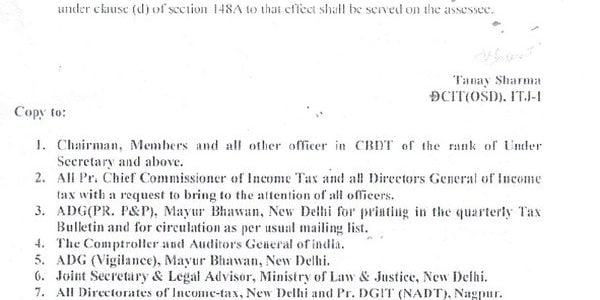
Income Tax : CBDT issues guidelines for IT verification under Section 144B(5), detailing circumstances for digital and physical checks, effecti...
Income Tax : In pursuance of sub-section (3) of section 144B of the Income-tax Act, 1961, the Central Board of Direct Taxes hereby makes the fo...
Income Tax : Standard Operating Procedure (SOP) for Assessment Unit (AU), Verification Unit (VU), Technical Unit (TU) and Review Unit (RU) unde...
Income Tax : Roll out of first phase of changes in ITBA functionalities for Faceless Assessment due to amendments in Section 144B by Finance Ac...
Income Tax : National Faceless Penalty Centre, in accordance with the guidelines issued by the Board, may,–– (a) in a case where imposit...
ITAT deleted ₹14.74 lakh addition as identical source was accepted in spouse’s case. Alleged on-money payment lacked corroborative evidence.
Tribunal ruled that once consideration was received and possession handed over in an earlier year, subsequent registration cannot shift taxability. Revenue’s reliance on Insight Portal data was rejected.
ITAT Mumbai held allotment letter is an agreement to sell; stamp duty value on booking/allotment date applies u/s 56(2)(x) where payments were via banking channels. ₹45.03L addition set aside for verification.
The Tribunal ruled that mere circulation of funds among group entities does not prove round-tripping unless supported by cogent evidence. Suspicion alone cannot justify addition under Section 68.
ITAT held that labeling transactions as accommodation entries without investigation is impermissible. With all three ingredients satisfied, the addition of ₹86.90 lakh was removed.
ITAT held that reassessment proceedings initiated by NFAC before Notification No. 18/2022 dated 29.03.2022 were without jurisdiction. Since Section 151A became effective only upon notification, the entire reassessment and related penalty were quashed.
The ITAT Bangalore held that the entire cost of construction claimed by the assessee while computing capital gains on sale of property could not be outrightly disallowed merely due to lack of complete supporting documents.
The ITAT Bangalore held that reopening of assessment was invalid as it was based on an incorrect assumption that the assessee had claimed bogus long-term capital gains (LTCG) from penny stock transactions.
ITAT Mumbai held that the provision for leave encashment made on actuarial basis constitutes an ascertained liability and is allowable as deduction. Accordingly, the said ground is allowed.
The Tribunal held that revision under Section 263 is invalid where the Assessing Officer examined records and adopted a plausible view. Mere disagreement or desire for further enquiry is insufficient.