The Companies Act is a legislation that governs the formation, functioning, and management of companies. Explore the key provisions, compliance requirements, and legal framework under the Companies Act.
Company Law : The Companies Act, 2013 and related rules now require most public and private companies to issue and transfer securities only in d...
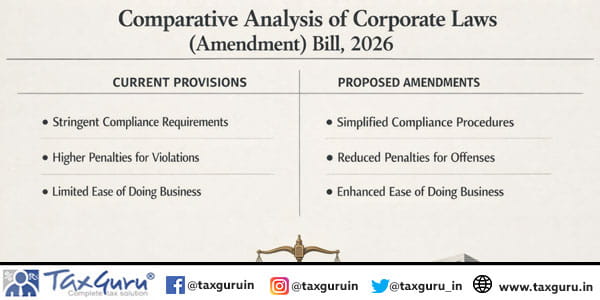
Company Law : The Companies Law Amendment Bill, 2026 proposes major reforms in corporate governance, compliance, and digital regulation. This ar...
Company Law : This guide explains the complete legal procedure for shifting a company’s registered office within the same state but under a di...
Company Law : Section 56 of Companies Act, 2013 requires execution of a proper instrument of transfer for transfer of interest of a member in a ...
Corporate Law : The article explains how digital adjudication systems, virtual hearings, and online compliance platforms are reshaping India’s c...
Company Law : Provisional list of audit firms of listed companies yet to file NFRA-2 for 2023-24. Filing deadline was 30.11.2025; fines apply fo...
Company Law : ICSI recommended restoring public access to basic company master data without mandatory login requirements. The representation sta...
Company Law : NFRA introduced guidelines to evaluate audit firms’ compliance and quality control systems. The framework emphasizes governance,...
Company Law : ICSI highlights delays in marking defective forms by RoCs under CCFS 2026. It urges MCA to mandate time-bound processing or allow ...
Company Law : The issue is ambiguity in filing authority during liquidation. ICSI has requested clarity to enable liquidators to maintain statut...
Company Law : The Madras High Court permitted Nidhi companies to submit fresh replies against NDH-4 rejection orders and directed authorities to...
Company Law : Legal Analysis and Narrative Brief: Dale and Carrington Investment Pvt. Ltd. and Another v. P.K. Prathapan and Others (Supreme Cou...
Company Law : The case examined whether Tribunal approval was required for extending preference share redemption. It was held that such extensio...
Company Law : The Tribunal held that allegations of siphoning ₹30 lakh were not supported by any evidence tracing funds to the respondent. Mer...
Company Law : The Court held that a separate meeting of sub-class shareholders is not required when identical terms are offered to the entire cl...
Company Law : ROC Pune held that procedural lapses in a private placement involving one investor formed part of a single integrated transaction ...
Company Law : ROC Pune penalized a start-up company and its officers for delayed filing of e-Form MGT-14 relating to a Special Resolution under ...
Company Law : ROC Pune penalized a company and its directors for delayed filing of e-Form PAS-3 relating to private placement allotment under Se...
Company Law : ROC Pune penalized a company and its directors for utilizing private placement funds before filing return of allotment under Secti...
Company Law : ROC Mumbai-II imposed penalty under Section 450 after a company incorrectly mentioned the AGM date in Form AOC-4 XBRL. The order h...
Authorities held that failure to display a complete registered office address violated Section 12(3)(a) of the Companies Act. The case reinforces that even procedural lapses can attract the maximum statutory penalty if left unrectified.
This article breaks down Section 12 requirements on maintaining and verifying a registered office. The key takeaway is that non-compliance can trigger penalties and strike-off action.
The tribunal held that a petition is not maintainable where the applicant is neither a shareholder nor member, and where disputes stem from a private MoU rather than company affairs.
The case highlights how inadequate communication between auditors and those charged with governance violates auditing standards. The key takeaway is that timely, documented, and two-way communication is mandatory, not optional.
Courts and regulators now treat related party transactions as a core governance issue rather than procedural compliance. The key takeaway is that boards must demonstrate real oversight under Section 188.
The Centre has amended rules governing part-time appointments to the national financial reporting regulator. The move updates the list of senior officials nominated from key oversight institutions.
The regulator held that partial disclosure in balance sheet notes is insufficient under section 134. Listed companies must make clear and complete related party disclosures.
The regulator held that Annual Reports are official publications mandatorily requiring CIN disclosure. Repeated non-compliance led to the maximum penalty on both the company and its officers.
The Companies Act, 2013 limits immunity for non-executive directors by linking liability to knowledge and diligence. Courts now require active oversight rather than passive board membership.
ROC Chennai ruled that boards must explain every audit qualification or adverse remark. Non-compliance resulted in penalties under the Companies Act.