Income Tax : The article explains how Section 45(5A) shifted the capital gains trigger for landowners from JDA execution to issuance of the com...
Income Tax : The new law treats gains from depreciable assets as short-term capital gains for all purposes, not merely for computation. This ef...
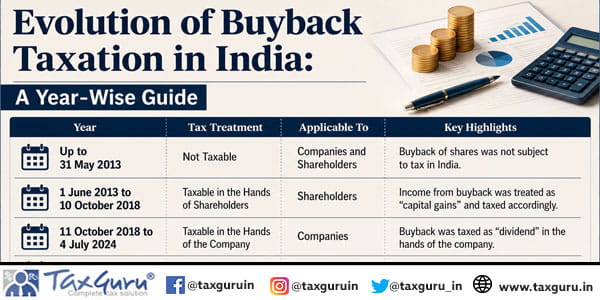
Income Tax : The reform replaces dividend-based taxation with capital gains to ensure only real income is taxed. It removes the distortion of t...
Income Tax : Establishes that higher tax burdens on promoters under the new regime require companies to reassess payout strategies. The takeawa...
Income Tax : The distinction between slump sale and itemised asset sale determines how capital gains are taxed. A true slump sale applies Secti...
Income Tax : India and France have signed a protocol granting full taxing rights on capital gains from share sales to the country of company re...
Income Tax : Govt rationalizes long-term capital gains tax, reducing rates to 12.5% and simplifying holding periods. Relief provided for pre-Ju...
Income Tax : Finance Bill 2024 amends Section 55 to include fair market value for unlisted shares in IPOs. Changes apply retroactively from Apr...
Income Tax : The Finance Bill 2024 proposes a streamlined and rationalized taxation system for capital gains, with changes including reduced ho...
Income Tax : From April 1, 2025, Section 47 will exclude transfers of capital assets under gifts or wills from capital gains tax, with specific...
Income Tax : The ITAT ruled that the Assessing Officer wrongly adopted the stamp duty valuation despite contrary valuation material on record. ...
Income Tax : Delhi ITAT held that before the amendment effective from 01.04.2015, exemption under Section 54 could be claimed for investment in...
Income Tax : ITAT Indore held that Section 54 exemption cannot be denied merely for failure to deposit capital gains in the Capital Gain Deposi...
Income Tax : The Tribunal ruled that delayed filing or incorrect disclosure in Form 67 does not automatically disentitle an assessee from claim...
Income Tax : The Tribunal upheld tax addition where agricultural land was acquired below stamp duty valuation and DVO-determined fair market va...
Income Tax : The government has authorised all non-rural branches of 19 banks to operate Capital Gains Account Scheme accounts, enhancing taxpa...
Income Tax : The amendment introduces electronic payment modes for capital gains deposits and clarifies the effective date of deposit. It enhan...
Income Tax : Ministry of Finance notifies IREDA bonds issued post-July 9, 2025, as long-term specified assets under Section 54EC for income tax...
Income Tax : Ministry of Finance announces amendment to Section 48 of the Income-tax Act, 1961, introducing a new cost inflation index effectiv...
Income Tax : The Ministry of Finance, through the Central Board of Direct Taxes (CBDT), issued Notification No. 44/2024-Income-Tax on May 24, 2...
The Tribunal held that a registered JV agreement with possession in 2011 constituted transfer under section 2(47). Capital gains could not be taxed in AY 2017-18 and had to be aligned to the correct year.
The issue was whether reassessment could survive when objections to reopening were ignored. The Tribunal ruled that non-disposal of objections violates mandatory procedure and renders the reassessment void ab initio.
This ruling clarifies that an assessee can be treated as an agent of a non-resident only if income is received directly or indirectly for the NRI. In the absence of such receipt or business connection, representative assessment fails.
ITAT held that when the same property valuation has been accepted in co-owners’ cases, a contrary view cannot be taken for another co-owner. Consistency in tax treatment is mandatory.
The issue was whether sale involved only land or land with a residential house. The Tribunal ruled that the property sold included a residential structure, entitling the assessee to Section 54 exemption upon deposit in the capital gains scheme.
The Supreme Court held that capital gains from indirect transfers deriving value from Indian assets were taxable in India. The key takeaway is that treaty protection cannot shield arrangements lacking real commercial substance.
Alleged additions for suppressed sales, disallowances, and capital gains were rendered void once the revision order was quashed. The case underscores the doctrine of consequential invalidity.
The ruling confirms that Section 14A cannot be invoked mechanically without actual expenditure linked to exempt income. Growth mutual funds earning taxable gains fall outside its scope.
The Tribunal ruled that Section 14A cannot be invoked where borrowed funds were not used to earn exempt income. Disallowance was deleted after finding investments were made from interest-free funds.
The Tribunal held that the first appellate authority has a statutory duty to decide grounds on merits and cannot dismiss them as not adjudicated for want of details. Orders violating sections 250(6) and 251(1) were set aside and remanded for fresh adjudication.