Finance : Secondary SGB buyers must now pay 12.5% LTCG tax, unlike primary holders. The change reshapes returns and investment strategies in...
Income Tax : Establishes that higher tax burdens on promoters under the new regime require companies to reassess payout strategies. The takeawa...
Finance : The Supreme Court has allowed taxpayers to challenge retrospective amendments validating JAO reassessment actions. It stayed ongoi...
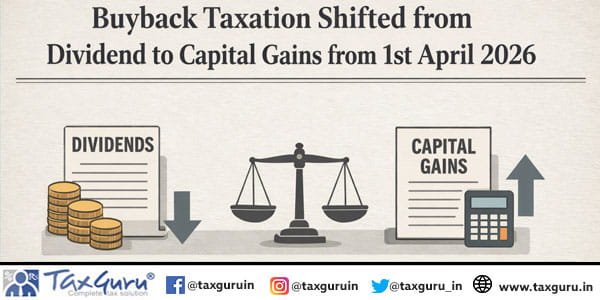
Income Tax : The issue arose from taxing buybacks as dividends, causing higher tax burden and unusable capital losses. The reform restores capi...
Income Tax : The Supreme Court has admitted a case to resolve conflicting interpretations of due dates for PF/ESI contributions. The ruling wil...
Income Tax : The amendments focus on reassessment timelines, electronic communication, and procedural clarity. The changes aim to reduce litiga...
Income Tax : The Government introduced reforms to simplify tax dispute resolution, including broader immunity provisions and expanded scope for...
Income Tax : A focused session breaks down recent Budget amendments affecting NRI taxation. It highlights how changes impact income, investment...
CA, CS, CMA : Budget 2026 prioritises easing compliance, reducing penalties, and cutting litigation rather than raising tax rates. The reforms a...
Custom Duty : New baggage rules and processing regulations are notified, replacing earlier frameworks and aligning customs procedures for passen...
Goods and Services Tax : Discover the key amendments in the Finance (No. 2) Bill, 2024, affecting CGST, IGST, UTGST, and Cess Act, including tax exemptions...
Income Tax : A petition has been filed in the Madras High Court challenging the section 271J of the Income Tax Act inserted vide Finance Act 2...
Income Tax : U/s 250(4), the CIT (A) has the power to direct enquiry and call for evidence from the assessee. Under Rule 46A, the assessee has ...
Income Tax : CBDT updated DIN rules to align with new provisions introduced under the Finance Act, 2026. The circular mandates DIN for most tax...
Income Tax : The Finance Act, 2026 prescribes income-tax rates, surcharge, and cess for the assessment year 2026–27. It establishes the legal...
Excise Duty : The government has withdrawn an earlier central excise exemption notification with effect from 2 February 2026. The rescission is ...
Excise Duty : The government has extended key excise provisions and introduced a specific duty structure for CNG blended with biogas. The key ta...
Excise Duty : The government has reduced the effective National Calamity Contingent Duty on specified tobacco products. The key takeaway is a ca...
Union Budget 2026–27 proposes certain targeted amendments under GST. The changes are not rate-oriented but structural in nature and largely focus on resolving long-pending issues faced by taxpayers, particularly service exporters, refund applicants and businesses dealing with post-supply discounts.
Explains the Budget 2026 proposal allowing SEZ units to sell to DTA units at reduced duty and how it simplifies approvals while lowering costs.
India’s 89th Union Budget was presented on a Sunday for the first time, marking a historic departure from tradition and setting the stage for major tax law reforms.
This covers major tax reforms introduced to simplify compliance and reduce litigation. The key takeaway is a shift toward trust-based and technology-driven taxation.
This explains how Budget 2026 retrospectively clarifies that only the Jurisdictional Assessing Officer can issue reassessment notices. The key takeaway is that notice-stage litigation is largely settled.
The budget focuses on fiscal discipline, predictable taxation, and long-term growth rather than headline tax cuts. It signals a shift toward structural maturity and economic resilience.
The new law replaces dividend-style taxation on buybacks with capital gains treatment. Retail investors now pay tax only on real profits instead of the entire buyback amount.
The Finance Bill, 2026 replaces automatic tax-free redemption with strict eligibility conditions. Only original subscribers holding bonds until maturity retain the exemption.
The issue highlighted is Budget 2026’s failure to address everyday compliance and procedural problems. The key takeaway is that systemic inefficiencies and complexity continue despite promises of simplification.
The Budget projects steady growth with fiscal discipline while introducing structural tax reforms. The key takeaway is stability in rates alongside simplification and long-term competitiveness.