Finance : Secondary SGB buyers must now pay 12.5% LTCG tax, unlike primary holders. The change reshapes returns and investment strategies in...
Income Tax : Establishes that higher tax burdens on promoters under the new regime require companies to reassess payout strategies. The takeawa...
Finance : The Supreme Court has allowed taxpayers to challenge retrospective amendments validating JAO reassessment actions. It stayed ongoi...
Income Tax : The issue arose from taxing buybacks as dividends, causing higher tax burden and unusable capital losses. The reform restores capi...
Income Tax : The Supreme Court has admitted a case to resolve conflicting interpretations of due dates for PF/ESI contributions. The ruling wil...
Income Tax : The amendments focus on reassessment timelines, electronic communication, and procedural clarity. The changes aim to reduce litiga...
Income Tax : The Government introduced reforms to simplify tax dispute resolution, including broader immunity provisions and expanded scope for...
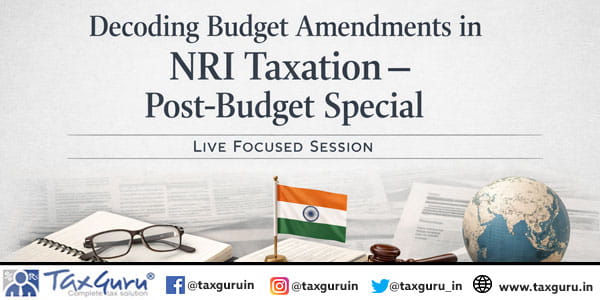
Income Tax : A focused session breaks down recent Budget amendments affecting NRI taxation. It highlights how changes impact income, investment...
CA, CS, CMA : Budget 2026 prioritises easing compliance, reducing penalties, and cutting litigation rather than raising tax rates. The reforms a...
Custom Duty : New baggage rules and processing regulations are notified, replacing earlier frameworks and aligning customs procedures for passen...
Goods and Services Tax : Discover the key amendments in the Finance (No. 2) Bill, 2024, affecting CGST, IGST, UTGST, and Cess Act, including tax exemptions...
Income Tax : A petition has been filed in the Madras High Court challenging the section 271J of the Income Tax Act inserted vide Finance Act 2...
Income Tax : U/s 250(4), the CIT (A) has the power to direct enquiry and call for evidence from the assessee. Under Rule 46A, the assessee has ...
Income Tax : CBDT updated DIN rules to align with new provisions introduced under the Finance Act, 2026. The circular mandates DIN for most tax...
Income Tax : The Finance Act, 2026 prescribes income-tax rates, surcharge, and cess for the assessment year 2026–27. It establishes the legal...
Excise Duty : The government has withdrawn an earlier central excise exemption notification with effect from 2 February 2026. The rescission is ...
Excise Duty : The government has extended key excise provisions and introduced a specific duty structure for CNG blended with biogas. The key ta...
Excise Duty : The government has reduced the effective National Calamity Contingent Duty on specified tobacco products. The key takeaway is a ca...
The Union Budget 2026 extends tax deductions for IFSC units to 20 years and provides a concessional 15% tax rate post-holiday, strengthening GIFT City’s global competitiveness.
The Budget outlines a 6.8–7.2% GDP growth outlook, fiscal consolidation roadmap, and inclusive development strategy guided by three Kartavyas.
The law now taxes debt-heavy funds, MLDs, and certain international products as short-term at slab rates. Investors must reassess holding strategies and expected post-tax returns.
Budget 2026 proposes deleting the special intermediary rule, shifting place of supply to the recipient’s location. This restores destination-based GST and allows qualifying cross-border services to be treated as zero-rated exports.
The analysis explains how buy-back taxation shifted from company-level tax to shareholder dividend tax and is proposed to return to capital gains.
FAST-DS 2026 targets inadvertent non-reporting such as dormant bank accounts or foreign RSUs. It allows clean-up at a significantly lower cost with legal certainty.
The Budget cuts harsh tax rates, eases appeal deposits, and extends filing timelines to reduce compliance stress. It signals a shift toward certainty, lower litigation, and voluntary compliance.
The Budget restricts capital gains tax exemption on SGBs only to original subscribers. Secondary market buyers now face taxation at redemption, altering investment outcomes.
Budget 2026 strengthens MSMEs through a new equity fund, expanded TReDS financing, and low-cost compliance assistance. The key takeaway is a holistic push to scale, fund, and formalise MSMEs.
Fiscal deficit cut, steady tax policy, and financial reforms define a prudent Budget, but success depends on execution, growth sustainability, and market stability.