Summary: Under the Income Tax Act, 1961, and the Income Tax Bill, 2025, income is classified under five heads, with “Profits and Gains of Business or Profession” being particularly significant. Depreciation under Section 32 plays a vital role in computing taxable income. Depreciation is allowed on tangible assets such as buildings, machinery, plant, or furniture, as well as intangible assets like patents, copyrights, trademarks, licenses, franchises, and other commercial rights (excluding goodwill). For depreciation to apply, two conditions must be satisfied: the asset must be owned (wholly or partly) by the assessee and used for business or profession. Assets acquired through hire purchase also qualify, per CBDT Circular No. 9. However, depreciation is not allowed on land cost. “Plant” includes ships, vehicles, books, scientific apparatus, and surgical equipment, but excludes tea bushes, livestock, buildings, and furniture. Depreciation at 100% is allowed on machinery or plant costing up to ₹5,000. Illustratively, if an asset is owned but not used in the relevant year (e.g., a truck bought but not used until the next year), depreciation cannot be claimed. Conversely, if a firm buys an asset using firm funds but registers it in a partner’s name, the firm remains the owner and can claim depreciation. Historically, rates of 50–100% applied to certain blocks of assets, but since AY 2018–19, the maximum rate is capped at 40%, except for specified motor vehicles acquired in a defined period, which were eligible for 45%.
Under the Income Tax Act, 1961 there were five heads of Income under section 14 and under the Income Tax Bill- 2025 also there are five heads of Income under clause 13, as under:
(1) Salaries;
(2)Income from House Property;
(3) Profits and gains of business or profession;
(4) Capital gains; and
(5) Income from other sources.
For the purpose of computation of total income of an assesse on which tax is to be charged, income from various sources is to be computed under the above heads. All the heads of income have its different importance. Amongst all the head of income most important is Income from Business or Profession. This head of income is covered from Sections 28 to 44BD. Out of these sections, section 32 pertaining to Depreciation is important section.
Depreciation allowance is allowable on assets like buildings, machinery, plant or furniture used for the purpose of business or profession (Section 32(1)
1. The assets should be owned, wholly or partly, by the assesse. This means that two or more assesses owning depreciable assets and using them in their business or profession will be eligible to claim depreciation on the fractional value of such assets owned by each of them; and
2. The assets should be used for the purpose of assesses business or profession.
Up to 31st March, 1998, depreciation was allowed only on intangible assets i.e. buildings, machinery, plant or furniture, from 1st April,1998 depreciation is allowed on know-how, patents, copyrights, trademarks, licenses, franchises or any other business or commercial rights of similar nature, not being goodwill of business or profession.
3. “Plant” has been defined to include ships, vehicles, books, scientific apparatus and surgical equipment used for the purposes of business or profession but does not include tea bushes or livestock, or buildings or furniture and fittings [Section 43(3)].
- Depreciation is not allowable on the cost of the land on which building is erected, it will be allowed only on the cost of building construction.
- As per section 32(1), assets should be owned by assesses. The question is machinery acquired on higher purchase for his business or profession depreciation is allowable, where ownership is not of assesse? Assesse is allowed depreciation under circular no 9.
- Depreciation of full cost in respect of books: Depreciation @ 100% allowed on machinery or plant whose cost does not exceed Rs. 5,000.
We know that depreciation is allowed if the asset is owned by assesse and asset is to be used for the purpose of business. That means both the conditions are to be fulfilled. If ownership is of assesse but asset is not used for the purpose of business or profession, depreciation is not permissible.
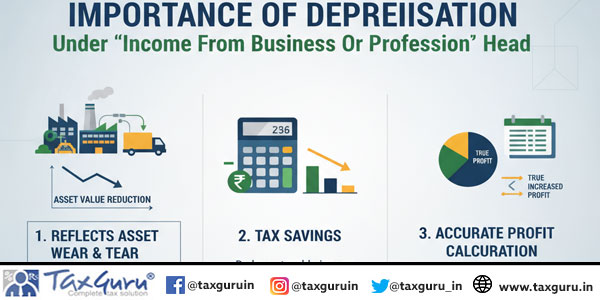
Example: ABC & Company, doing business of transportation. During the year 2024-25, company had purchase truck on 25th March, 2025 and registered in its name at RTO. Due to religious belief they have started using the truck from 2nd April, 2025.
Can the company will get depreciation for the Assessment Year 2025-26?
Simply the answer is NO., because both the conditions are not fulfil, ownership is there but use of truck is not done during the year 2024-25.
If a partnership firm has purchased a car from the fund of firm, but due to the benefit of registration with RTO, car has been purchase in the name of partner. The payment is made from the firm’s fund. In this case though the car is registered in the name of partner, ownership is with firm and firm is entitle to get depreciation. As per section 14 of the Indian Partnership Act, any vehicle purchased from the fund of firm, the owner is firm only.
Rate of depreciation up to assessment year 2027-18 were 50%, 60%, 80% and 100% on various block of assets while there after it has been reduced to maximum 40%, but for motor buses, motor lorries and motor taxies used in a business of running them on hire, acquired on or after 23.08.2019 but before 1.4.2020 is put to use before 1st April, 2020 was 45%. Since assessment year 2018-19 on words there is no changes in rate of depreciation on assets.