
Bosch Limited Vs ACIT (ITAT Bangalore)
ITAT Bangalore held that provision for long term service award is made on actuarial valuation and amount provided for in the books of accounts based on actuarial valuation cannot be said to be contingent.
Facts-
The assessee has debited a sum of Rs.19,44,73,470 towards provision for doubtful debts. The assessee submitted before the AO that the provision for doubtful debts is an allowable expenditure by placing reliance on CIT vs Sandvik Asia Ltd. The AO rejected the contention of the assessee and disallowed the claim by stating that the provision is a contingent liability and therefore cannot be allowed. On further appeal, the CIT(Appeals) confirmed the disallowance by stating that only the actual write off can be allowed as a deduction and not any provision made for doubtful debts.
Further, a sum of Rs.57,81,98,819 has been claimed towards provision for long term service award. The AO disallowed the expenditure for the reason that the liability is contingent in nature as the employee for whom such provision has been made may suffer from disqualification subsequently which make him ineligible for such award and that there is no guarantee that this amount would be expensed in future date. On further appeal, the CIT(A) held that provision can be allowed only if liability to incur it has accrued during the year and if a liability to incur accrues in the future years, it cannot be allowed in the present year.
Conclusion-
We notice that the coordinate Bench of the Tribunal in assessee’s own case (IT(TP)A No.1556, 1582/Bang/2014) has considered the similar issue and held that the writing off does not necessarily require credit to be given to each debtor’s account. If bad debts are debited in profit and loss account and credited to another account named as “bad debt reserve account, bad debt suspense account etc,” the requirement of writing off is met even though individual debtor’s accounts are not credited.
Held that the assessee has reduced the provision for bad debts from Sundry Receivables and the same is debited to the Profit & Loss account. Therefore, respectfully following the decision of the coordinate Bench, we direct the AO to delete the impugned disallowance.
With regard to long term service award it is held that the assessee makes payment towards long term service awards for employees who continued their services with the assessee for certain number of years that would be paid on completion of the required number of years of service. The assessee follows actuarial valuation as per the AS-15 to arrive at the amount to be provided towards long term service awards. The main contention of the revenue is that the liability is uncertain/contingent since the employees may not put in the required number of services. However we notice that the provision is made based on actuarial valuation and when the valuation is done based on actuarial basis, certain element towards the uncertainty of the liability is discounted and the amount to be provided for is arrived at. Therefore, the amount provided for in the books of accounts based on actuarial valuation cannot be said to be contingent as contended by the revenue.
FULL TEXT OF THE ORDER OF ITAT BANGALORE
2. This appeal is against the order of the CIT(Appeals), Bangalore-9, Bangalore dated 31.3.2018 for the assessment year 2013- 14.
3. The assessee raised grounds pertaining to the following issues:-
Deduction u/s. 35(2AB) Computed on Net Expenditure as opposed to Gross Expenditure Disallowance of provision for bad and doubtful debts
i) Disallowance of provision for long term service award
ii) Disallowance of expenditure u/s. 14A of the Act
iii) Recomputation of depreciation claimed upon reducing the industrial subsidy from the cost of the asset
iv) Disallowance of expenditure claimed u/s. 37 of the Act
v) Disallowance of expenditure incurred towards purchase of application software
vi) Disallowance of provision made towards leave availment under section 43B(f) of the Act
vii) Disallowance of deduction u/s. 80JJAA of the Act
viii) Disallowance of interest paid under the Micro, Small and Medium Enterprises Development Act, 2006
ix) Disallowance of forex loss on forward contracts
x) Disallowance of depreciation on intangibles arising from purchase of SPX Pvt. Ltd.
xi) Disallowance of expenditure incurred towards shifting of plant in Goa
4. The assessee also raised additional grounds with regard to applicability of Dividend Distribution Tax [DDT] rate as per Income-tax Act, 1961 [the Act] or DTAA and also with regard to Education Cess & Higher Secondary Education Cess. The additional grounds raised are pure legal issue, which does not require investigation of new facts. Hence, placing reliance on the judgment of the Hon’ble Apex Court in the case of National Thermal Power Co. Ltd. v. CIT (1998) 229 ITR 383 (SC), we admit the additional grounds. During the course of hearing, the ld AR did not press for additional ground pertaining to Cess in view of the recent statutory amendment and hence the same is dismissed as not pressed. Ground No1 is general and does not warrant any adjudication.
5. DEDUCTION U/S 35(2AB) of the Act
6. Ground No. 2 raised by the assessee reads as follows:
7. “2 DEDUCTION U/S. 35(2AB) OF THE ACT COMPUTED ON NET EXPENDITURE AS OPPOSED TO GROSS EXPENDITURE
2.1. That the CIT(A) erred in upholding the action of the Respondent in allowing weighted deduction under Section 35(2AB) of the Act only on the net expenditure as against granting the same on the gross expenditure.
2.2. That the CIT(A) ought to have appreciated that in terms of Section 35(2AB) of the Act, deduction ought to be allowed on ‘any expenditure’ and not on the net expenditure.
2.3. That the CIT(A), erred in disregarding the binding decision of the Hon’ble Tribunal in Appellant’s own case for an earlier year and a few other rulings.
2.4. That the CIT(A) by placing misguided reliance on the decision of the Hon’ble Karnataka High Court in Tejas Network Ltd. v. DCIT (reported in [2015] 60 taxmann.com 309) grossly erred in directing the Respondent to approach the Central Board of Direct Taxes in order to obtain a decision as regards the quantum of deduction to be allowed under Section 35(2AB).”
8. The assessee has claimed a 100% deduction of Rs.133,66,47,170 u/s. 35(2AB) of the Act by debiting the P&L account. During the course of hearing, the AO called upon the assessee to furnish the evidence for the claim. The assessee submitted the necessary approval of R&D expenses filed to DSIR and also report in Form 3CL received from DSIR. The AO noticed that in the report DSIR has allowed an amount of Rs.27,25,39,000 as eligible expenditure u/s. 35(2AB) and therefore the AO restricted the claim to this extent and disallowed the balance amount of Rs.106,41,08,170.
9. The CIT(Appeals) directed the AO to refer the case to CBDT by following the decision of the Karnataka High Court in the case of Tejas Networks Ltd. v. DCIT, [2015] 60 taxmann.com 309. Aggrieved, the assessee is in appeal before the Tribunal.
10. During the course of hearing, the ld AR submitted that the issue is covered by the decision of the coordinate Bench in assessee’s own case and considering the parity of facts for the year under consideration also, the ld. AR prayed that the order of the CIT(Appeals) may be set aside. With regard to the reliance placed by the CIT(Appeals) in the case of Tejas Networks Ltd. (supra), the ld. AR submitted that assessee’s case is clearly distinguishable since in the case of Tejas Networks Ltd. (supra) the issue in question was, whether the activities carried on were scientific research or not. The ld. AR submitted that in assessee’s case that is not the issue in question, but it is the quantum of deduction that is in dispute and therefore the decision of the Hon’ble High Court in the case of Tejas Networks Ltd. (supra) is not applicable in assessee’s case.
11. The ld. DR relied on the decision of the lower authorities. 12. We have heard the rival submissions and perused the material on record. We notice that the coordinate Bench in assessee’s own case [IT(TP)A No.1556 & ITA No.15 82/Bang/2014] has considered similar issue and it was observed that –
“9. The next issue relates to claim of weighted deduction made by the assessee u/s 35(2AB) of the Act. During the year under consideration, the assessee claimed a sum of Rs.40.96 crores as weighted deduction u/s 35(2AB) of the Act. The assessee had claimed weighted deduction on the gross amount of expenditure incurred by it on R & D activities. However, the A.O. took the view that the deduction is allowable on the net amount of expenditure, i.e., expenditure as reduced by related income. Accordingly, the A.O. restricted the claim of the assessee u/s 35(2AB) of the Act on the net amount of expenditure, i.e., expenditure after deduction of related income. The same resulted in an addition of Rs.29.03 crores. The Ld. CIT(A) confirmed the said addition.
We heard the parties on this issue and perused the record. We notice that an identical issue has been considered by the coordinate bench in assessment year 2008-09 (supra) and it was decided in favour of the assessee. For the sake of convenience, we extract below the operative portion of the order passed by the coordinate bench in 200 8-09.
“Thus it is clear that the Tribunal while deciding this issue has followed the decision of Hon’ble jurisdictional High Court in the case of DCIT Vs. Microlab (supra) as well as decision of the Hon’ble Madras High Court in the case of CIT Vs. Wheels India Pvt. Ltd. 336 ITR 513 wherein it was held that the income earned by the assessee from the R & D Centre cannot be reduced for the for the purpose of allowing the deduction under Section 35(2AB) because the said income is part of the total & 751/Bang/2014 income of the assessee. Accordingly in principle the issue was decided in favour of the assessee that the income earned by the assessee from R&D Centre cannot be reduced from the expenditure for the purpose of deduction under Section 35(2AB) of the Act. However, since the relevant details and facts were not available before the Tribunal to give a finding about the nature of the receipt whether income /revenue or reimbursement of the expenditure or grants therefore, the issue was set aside to the record of the Assessing Officer for limited purpose of verification of the said fact. The learned Departmental Representative has raised a very serious objection that neither the Assessing Officer nor this Tribunal has jurisdiction to tinker with the amount of expenditure as given in the approval certificate by the DSIR. In support of his contention he has relied upon a series of decisions however, we find that the decisions relied upon by the ld. DR on the issues that once the DSIR approved the R&D Centre then the Assessing Officer cannot deny the claim of the assessee on the ground that the assessee is not eligible for weighted deduction under Section 35(2AB) of the Act. Further in the case in hand there is no dispute regarding the gross total expenditure and the receipts therefore, there is no question of tinkering with the details given by the DSIR in the approval order. The only question is the computation of quantum of weighted deduction under Section 35(2AB) and on the specific aspect of receipts of the R&D Centre are required to be reduced or not from the expenditure for this purpose. There is no dispute about the nature of the receipts as it is manifest from the details given in the certificate issued by the DSIR and also not disputed by the & 751/Bang/2014 Assessing Officer that these receipts are in the nature of fees and service charges and part of the total income of the assessee. Therefore in view of the binding precedent of the Hon’ble jurisdictional High Court in the case of CIT Vs. Microlabs Ltd. (supra) as well as the decision of the co- ordinate Bench of this Tribunal in assessee’s own case for the Assessment Years 2005-06 & 200607, we hold that the receipts of the R&D Centre which is in the nature of revenue/income being part of the total income of the assessee cannot be reduced from the gross expenditure of in-house R&D Centre for the purpose of weighted deduction under Section 35(2AB) of the Act. Hence, we allow the claim of the assessee and set aside the orders of the authorities below qua this issue.”
Following the order passed by the coordinate bench in 2008-09, we set aside the order passed by Ld CIT(A) on this issue and direct the A.O. to allow the deduction u/s 35(2AB) of the Act on the gross amount of expenditure.”
13. Respectfully following the above decision, we set aside the order of the CIT(Appeals) and direct the AO to allow deduction u/s. 35(2AB) on the gross amount of expenditure. This ground is allowed in favour of the assessee.
14. BAD AND DOUBTFUL DEBTS
15. Ground No. 3 raised by the assessee reads as under:
“3 DISALLOWANCE OF PROVISION FOR BAD AND DOUBTFUL DEBTS
3.1. That the CIT(A) erred in upholding the action of the Respondent in disallowing the provision for bad and doubtful debts.
3.2. That the CIT(A) grossly erred in disregarding the binding decisions relied upon by the Appellant, despite the same being squarely applicable to the facts of the Appellant’s case.
3.3. That the CIT(A) erred in placing undue reliance on the efforts being made to recover the amounts without appreciating the treatment to the same given in the audited books of accounts maintained by the Appellant, conformably with the settled principles of accounting.”
16. The assessee has debited a sum of Rs.19,44,73,470 towards provision for doubtful debts. The assessee submitted before the AO that the provision for doubtful debts is an allowable expenditure by placing reliance on CIT vs Sandvik Asia Ltd (ITA Nos.563 C/w/564/2006). The AO rejected the contention of the assessee and disallowed the claim by stating that the provision is a contingent liability and therefore cannot be allowed. On further appeal, the CIT(Appeals) confirmed the disallowance by stating that only the actual write off can be allowed as a deduction and not any provision made for doubtful debts.
17. Before us, the ld. AR submitted that the assessee has actually written off the impugned amount by debiting the P&L account. In this regard, the ld AR drew our attention to Note 19 of statement of financials where the amount written off as provision for doubtful debits is reduced from the trade receivables (pg. 92 of PB). The ld. AR also drew our attention to the break-up of other expenses in Note 32 where the impugned amount is debited to the P&L account (pg. 94 of PB). The ld.AR further submitted that the detailed movement of provision for bad debts was submitted before the lower authorities from which it would be clear that the amount was provision made during the year is debited to the P&L account and therefore should be allowed as a deduction. In this regard the ld AR relied on the decision of the Hon’ble Supreme Court in the case of Vijaya Bank vs CIT (323 ITR 166).
18. We have heard the rival submissions and perused the material on record. We notice that the coordinate Bench of the Tribunal in assessee’s own case (IT(TP)A No.1556, 1582/Bang/2014) has considered the similar issue and held that –
“18. We heard Ld. D.R. on this issue and perused the record. We notice that the Hon’ble Karnataka High Court has considered an identical issue in the case of Sandvik Asia Limited and it has been decided in favour of the assessee by following the decision rendered by Hon’ble Supreme Court in the case of Vijaya Bank. For the sake of convenience, we extract the order passed by the Hon’ble Karnataka High Court in the case of Sandvik Asia Limited.
“2. The assessee claimed deduction in respect of doubtful debts for the assessment years 1996-97 and 1998-99. The assessee had adopted in the P & L account provision for doubtful debts of Rs. 16.94.455/- for the assessment year 1996-97 and Rs. 8,32,905/- for the assessment year 199899. Since the methodology followed by the assessee to write off was not in accordance with the provisions of Section 36(1)(vii) of the Income Tax Act, 1961, it’s claim was not allowed. Aggrieved by the said order, the assessee preferred appeal to the Commissioner of Income Tax (Appeals). The appellate Commissioner held the writing off does not necessarily require credit to be given to each debtor’s account. If bad debts are debited in profit and loss account and credited to another account named as “bad debt reserve account, bad debt suspense account etc,” the requirement of writing off is met even though individual debtor’s accounts are not credited. Therefore, he held, the Assessing Officer was not justified in disallowing the provision for doubtful debts in each assessment year.
3. Aggrieved by the said order, the Revenue preferred appeal to the Tribunal, which has confirmed the said order. However, the Tribunal held that it is not made mandatory that the write off can be only by squaring-up the account of debtors, The law is that the write off should be made in the accounts. In this case the assessee has debited the profit and loss account and order entry is by way of reduction of such sum from the total debtors account. Thus, the provision of Section 36(1)(vii) of the Act is duly complied with and therefore the appellate Commissioner was justified in allowing the claim of bad debt. Aggrieved by the said order the Revenue has preferred these appeals.
4. The Apex Court in the case of VIJAYA BANK v. COMMISSIONER OF INCOME TAX reported in (2010) 323 ITR 166 (SC) Volume 323 has held as under:-
“6. The first question is no more res integra. Recently, a Division Bench of this Court in the case of Southern Technologies Limited v. Joint Commissioner Of Income Tax, Coimbatore reported in (2010) 320 ITR 577, (in which one of us S.H Kapadia J. was a party) had an occasion to deal with the first question and it has been answered, accordingly, in favour of the assessee, vide paragraph 25, which reads as under (page 604 “Prior to April 1, 2989, the law, as it then stood, took the view that even in cases in which the asssssee(s) makes only a provision in its accounts for bad debts and interest thereon and even though the amount is not actually written off by debiting the profit and loss account of the assessee and crediting the amount to the account of the debtor, the assessee was still entitled to deduction under section 36(1)(vii), (See CIT v. Jwala Prasad Tiwarl (1953) 24 ITR 537 (Bom) and Vithaladas H. Dhanjibhai Bardanwaia v. CIT (1981) 130 ITR 95 (Guj), Such state of law prevailed up to and including the assessment year 1988-1989, However, by insertion (with effect from April 1, 1989) of a new Explanation in Section 36(2)(vii), it has been clarified that any bad debt written off as irrecoverable in the account of the assessee will not include any provision for bad and doubtful debt made in the accounts of the assessee. The said amendment indicates that before April 1, 1989, even a provision could be treated as a write off. However, after April 1, 1989, a distinct dichotomy is brought in by way of the said Explanation to Section 36(1)(vii). Consequently, after April 1, 1989, a mere provision for Bangalore bad debt would not be entitled to dichotomy, one must understand “how to write off”. If an assessee debits an amount of doubtful debt to the profit and loss account and credits the asset account like sundry debtor’s account, it would constitute a write off of an actual debt. However, if an assessee debits “provision for doubtful debt” to the profit and loss account and makes a corresponding credit to the “current liabilities and provisions” on the liabilities side of the balance sheet, then it would constitute a provision for doubtful debt. In the latter case, the assessee would not be entitled to deduction after April 1, 1989”.
“8. Coming to the second question, we may reiterate that it is not in dispute that Section 36(1)(vii) of the 1961 Act applies both to banking and non-banking businesses. The manner in which the write off is to be carried out has been explained hereinabove. It is important to note that the assessee Bank has not only been debiting the profit and loss account to the extent of the impugned bad debt, it is simultaneously reducing the amount of loans and advances or the debtors at the yearend, as stated hereinabove. In other words, the amount of loans and advances or the debtors at the year end in the balance sheet is shown as net of the provisions for the impugned debt. However, what is being insisted upon by the Assessing Officer is that mere reduction of the amount of loans and advances or the debtors at the year end would not suffice and in the interest of transparency, it would be desirable for the assessee bank to close each and every individual account of loans and advances or debtors as a pre condition for claming deduction under Section 36(1)(vii) of the 1961 Act. This view has been taken by the Assessing Officer because the Assessing Officer apprehended that the assessee-Bank might be taking the benefit of deduction under section 36(1)(vii) of the 1961 Act, twice over. (See order of the Commissioner of Income-Tax Appeals) at pages 66, 67 and 72 of the paper book, which refers to the apprehensions of the Assessing Officer). In this context, it may be noted that there is no finding of the Assessing Officer that the assesses had unauthorisedly claimed the benefit of deduction under section 36(1)(vii) twice over. The order of the Assessing Officer is based on an apprehension that, if the assessee fails to close each and every individual account of its debtor, it may result in the assessee claiming deduction twice over. In this case, we are concerned with the interpretation of Section 36(1)(vii) of the 1961 Act. We cannot decide the matter on the basis of apprehension/desirability. It is always open to the Assessing Officer to call for details of individual debtor’s account if the Assessing Officer has reasonable grounds to believe that the assessee has claimed deduction, twice over. In fact, that exercise has been undertaken in subsequent years. There is also a flip side to the argument of the Department. The assessee has instituted recovery suits in courts against its debtors. If individual accounts are to be closed, then the debtor/defendant in each of those suits would rely upon the bank statement and contend that on amount is due and payable in which event the suit would be dismissed.”
In the light of the judgment of Apex Court, there is no merit in this appeal.
5. The appeals are dismissed answering the substantial question of law in favour of the assessee and against the Revenue.”
We have noticed earlier that the assessee has reduced the amount of provision for doubtful debts from the amount of sundry debtors in the balance sheet. Accordingly, respectfully following the decision rendered by Hon’ble Karnataka High Court, we direct the A.O. to delete the impugned disallowance.”
19. From the perusal of the facts it is noticed that the assessee has reduced the provision for bad debts from Sundry Receivables and the same is debited to the Profit & Loss account. Therefore respectfully following the decision of the coordinate Bench, we direct the AO to delete the impugned disallowance.
20. PROVISION FOR LONG TERM SERVICE AWARD
21. Ground No. 4 raised by the assessee reads as follows:
“4 DISALLOWANCE OF PROVISION FOR LONG TERM SERVICE AWARD
4.1. That the CIT(A) erred in upholding the action of the Respondent in treating the long service award as a contingent expenditure, without appreciating the fact that the liability having undoubtedly accrued and the Appellant had applied a scientific basis to arrive at the quantum of the liability.
4.2. That the CIT(A) erred in holding that the method applied by the Appellant as not scientific in nature, examining the same.
4.3. That the CIT(A), contrary to the material on record, grossly erred in holding that the Appellant had not provided any details as regards the provisions created for the long term service award, and has thereby exhibited clear lack of application of mind.
4.4. That the CIT(A) grossly erred on holding that the claim was unreasonable by going into a working of his own without putting the Appellant on notice.
4.5. That the CIT(A) ought to have appreciated that as the Appellant follows the mercantile system of accounting and reports the provision on the basis of actuarial valuation report, the liability accrued to the Appellant crystallises during the relevant financial year and when such liability is qualified on a rational and reasonable basis, the same is allowable.”
22. During the AY 2013-14, a sum of Rs.57,81,98,819 has been claimed towards provision for long term service award. The AO disallowed the expenditure for the reason that the liability is contingent in nature as the employee for whom such provision has been made may suffer from disqualification subsequently which make him ineligible for such award and that there is no guarantee that this amount would be expensed in future date. On further appeal, the CIT(A) held that provision can be allowed only if liability to incur it has accrued during the year and if a liability to incur accrues in the future years, it cannot be allowed in the present year. The CIT(A) relied on the decision of Karnataka High Court in the case of CIT v. Microland Ltd.[2012] 18 taxmann.com 80 (Kar). The CIT(A) further verified the reasonableness of the expenses based on the actual amount paid and held that when the existing provisions is sufficient to cover the amount paid, there is no requirement to provide for any further amount towards long term service award. Aggrieved, the assessee is in appeal before the Tribunal.
23. The ld. AR submitted that the assessee has done an actuarial valuation for the liabilities towards long term service award and has claimed the deduction based on the same. The ld. AR submitted that when the valuation is done based on actuarial basis, all contingencies including discounting towards resignation, death, etc. are eliminated and therefore the contention of the AO that the liability is contingent in nature cannot be accepted. The ld. AR further submitted that since the assessee is following the mercantile system of accounting, the provision made towards long term service award determined on actuarial valuation basis is a crystallized liability of the year and therefore should be allowed. The ld. AR also submitted that the assessee has submitted before the lower authorities, the basis of actuarial valuation in accordance with Accounting Standard (AS- 15) which the lower authorities failed to take into consideration. The ld. AR placed reliance on the decision of the Supreme Court in the case of Bharath Earth Movers v. CIT (2000) 112 Taxman 61 (SC).
24. The ld. DR supported the orders of the lower authorities.
25. We have heard the rival submissions and perused the material on record. We notice that the Supreme Court in the case of Bharath Earth Movers (supra) held that –
“4. The law is settled: if a business liability has definitely arisen in the accounting year, the deduction should be allowed although the liability may have to be quantified and discharged at a future date. What should be certain is the incurring of the liability. It should also be capable of being estimated with reasonable certainty though the actual quantification may not be possible. If these requirements are satisfied, the liability is not a contingent one. The liability is in praesenti though it will be discharged at a future date. It does not make any difference if the future date on which the liability shall have to be discharged is not certain.”
26. The assessee makes payment towards long term service awards for employees who continued their services with the assessee for certain number of years that would be paid on completion of the required number of years of service. The assessee follows actuarial valuation as per the AS-15 to arrive at the amount to be provided towards long term service awards. The main contention of the revenue is that the liability is uncertain/contingent since the employees may not put in the required number of services. However we notice that the provision is made based on actuarial valuation and when the valuation is done based on actuarial basis, certain element towards the uncertainty of the liability is discounted and the amount to be provided for is arrived at. Therefore, the amount provided for in the books of accounts based on actuarial valuation cannot be said to be contingent as contended by the revenue. In view of the above discussion and relying on the decision of the Apex Court in the case of Bharath Earth Movers (supra), we hold that the provision made by the assessee towards long term service award based on actuarial valuation is an allowable expenditure and therefore the disallowance made in this regard is hereby deleted.
27. EXPENDITURE U/S 14A OF THE ACT
28. Ground No. 5 raised by the assessee reads as follows:
“5 DISALLOWANCE OF EXPENDITURE U/S. 14A OF THE ACT
5.1. That the CIT(A) grossly erred in upholding the action of the Respondent in disallowing expenditure under Section 14A of the Act upon application of Rules 8D(2)(ii) and (iii) of the Income-tax Rules, 1962 (“the Rules”).
5.2. That the CIT(A) ought to have appreciated that the Appellant had voluntarily computed the expenditure to be disallowed under Section 14A, and in the absence of lack of satisfaction expressed by the Respondent that the claim of the Appellant was incorrect, the same cannot be disregarded. That the Respondent, upon proceeding on the misconceived basis that the Appellant had disallowed the expenditure upon application of Rule 8D(2)(iii), went on to recompute the disallowance in terms of Rule 8D(2)(i), (ii) and (iii).
5.3. That without prejudice and in any event, the CIT(A) erred in not appreciating that Rule 8D(2)(ii) would have no application in the instant case as the interest free funds available with the Appellant were far in excess of the investments made by it and therefore there was no requirement to borrow funds and consequently no expenditure by way of interest.
5.4. That the CIT(A) ought to have borne in mind the underlying basis for insertion of Section 14A, mainly where expenditure is incurred for earning exempt income and not on a notional basis or imaginary basis by blindly adopting a percentage of the value of investment.”
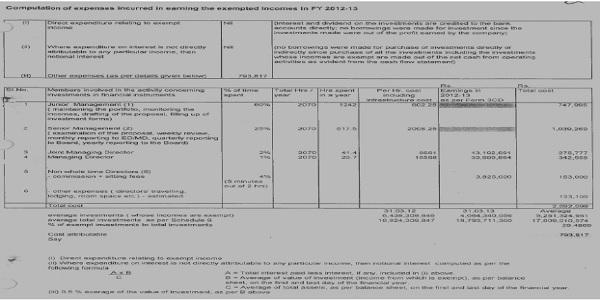
29. During the year under consideration, the assessee has made a suo motu disallowance of Rs.7,93,817 towards expenses incurred on earning exempt income u/s. 14A r.w.s. Rule 8D(2)(iii). The AO made a further disallowance of Rs.2,62,85,442 i.e., Rule 8D(i) Rs.9,78,581, Rule 8D(2)(i) Rs.28,817, Rule 8D(2)(iii) Rs.2,62,56,625 by stating that the assessee has to quantity the actual expenditure for disallowance and once Rule 8D is invoked, its application cannot be restricted to one limb alone. The CIT(A) confirmed the disallowance by stating that the assessee’s suo motu disallowance is not based on any tangible evidence since the assessee has not maintained any separate accounts for investments earning exempt income. With regard to the assessee’s contention before the CIT(A) that the AO has not recorded any satisfaction, the CIT(A) relied on the decision of Gujarat High Court in the case of Devarsons Industries P. Ltd. v. ACIT [2017] 84 taxmann.com 244 by stating that when the assessee has not discharged the initial onus towards disallowance of expenses incurred towards earning exempt income, the revenue could not be faulted with for applying Rule 8D.
30. Before us, the ld. AR reiterated the submissions made before the lower authorities. The ld. AR drew our attention to the computation of suo motu disallowance made by the assessee in page 242 of the PB as reproduced below;-
31.
32. The ld. AR also submitted that in the above suomoto disallowance the assessee has taken into consideration the personnel cost and other expenses relating to the investment activities and the AO has not examined the correctness of the same. The ld AR also submitted the AO ought to have recorded dissatisfaction as to the claim of the assessee having regard to its suomoto disallowance and that in the absence of any finding to the contrary on the computation done by the assessee, the AO cannot invoke the provisions of section 14A of the Act. The ld AR further submitted that from the financials of the assessee it would become evident that the own funds of the assessee are much higher than the investments which would support the claim that the investments earning exempt income are made out of own funds and therefore the assessee has not incurred any financial cost. It is therefore submitted that the disallowance under section 14A is not warranted.
33. The ld. DR relied on the orders of the lower authorities 34. We have considered the rival submissions and perused the material on record. Before we go into the facts of the case, we will look at the provisions of section 14Aand Rule 8D which are reproduced as follows:-
“Expenditure incurred in relation to income not includible in total income.
14A. (1) For the purposes of computing the total income under this Chapter, no deduction shall be allowed in respect of expenditure incurred by the assessee in relation to income which does not form part of the total income under this Act.
(2) The Assessing Officer shall determine the amount of expenditure incurred in relation to such income which does not form part of the total income under this Act in accordance with such method as may be prescribed, if the Assessing Officer, having regard to the accounts of the assessee, is not satisfied with the correctness of the claim of the assessee in respect of such expenditure in relation to income which does not form part of the total income under this Act.
(3) The provisions of sub-section (2) shall also apply in relation to a case where an assessee claims that no expenditure has been incurred by him in relation to income which does not form part of the total income under this Act :]
Provided that nothing contained in this section shall empower the Assessing Officer either to reassess under section 147 or pass an order enhancing the assessment or reducing a refund already made or otherwise increasing the liability of the assessee under section 154, for any assessment year beginning on or before the 1st day of April, 2001.]
Rule 8D. (1) Where the Assessing Officer, having regard to the accounts of the assessee of a previous year, is not satisfied with—
(a) the correctness of the claim of expenditure made by the assessee; or
(b) the claim made by the assessee that no expenditure has been incurred,
in relation to income which does not form part of the total income under the Act for such previous year, he shall determine the amount of expenditure in relation to such income in accordance with the provisions of sub-rule (2).
(2) The expenditure in relation to income which does not form part of the total income shall be the aggregate of following amounts, namely:—
(i) the amount of expenditure directly relating to income which does not form part of total income;
(ii) an amount equal to half per cent of the annual average of the monthly average of the opening and closing balances of the value of investment, income from which does not or shall not form part of total income :
Provided that the amount referred to in clause (i) and clause (ii) shall not exceed the total expenditure claimed by the assessee.”
35. From the combined reading of the above provisions, it is clear that for the purpose of application of section 14 r.w.r 8D(2)(iii) the AO has to record reasons as to why he is not satisfied with the correctness of the claim of expenditure by the assessee. We notice that the AO has not brought anything on record to factually state that the computation of disallowance made by the assessee as extracted above.
36. Further the AO has also not called for any details from the assessee or analysed the workings of the disallowance. In this regard we notice that the Hon’ble Supreme Court in the case of Maxopp Investment Ltd. v. CIT [2018] 91 taxmann.com 154 (SC) has held as follows:-
“41. Having regard to the language of Section 14A(2) of the Act, read with Rule 8D of the Rules, we also make it clear that before applying the theory of apportionment, the AO needs to record satisfaction that having regard to the kind of the assessee, suo moto disallowance under Section 14A was not correct. It will be in those cases where the assessee in his return has himself apportioned but the AO was not accepting the said apportionment. In that eventuality, it will have to record its satisfaction to this effect. Further, while recording such a satisfaction, nature of loan taken by the assessee for purchasing the shares/making the investment in shares is to be examined by the AO.”
37. In view of the above Hon’ble Apex Court judgment, it is clear that no disallowance can be made u/s 14A of the Act read with Rule 8D of the IT Rules, where the A.O. failed to record dissatisfaction of correctness of the claim of the assessee. A similar view has also been taken by the Hon’ble jurisdictional High Court in the case of Essilor India (P.) Ltd. v. Dy. CIT [IT Appeal No. 1001 of 2017, dated 28-1- 2021]. Therefore the disallowance made under section 14A r.w.r 8D(2)(iii) is deleted.
38. From the perusal of the Financial Statements (page 77 of paper book) of the assessee it is noticed that the Reserves and surplus of the assessee as on 31.03.2013 is much higher than the investments made by the assessee. Hence we see merit in the argument of the ld AR that no interest cost is incurred by the assessee for the purpose of earning exempt income warranting any disallowance. We notice that the similar issue was considered by Hon’ble Karnataka High Court in the case of CIT Vs. Micro Labs Ltd. (2016) 383 ITR 490, where it was held that no disallowance out of interest expenditure is called for. The relevant extract of the observations made by Hon’ble Karnataka High Court in the above said case is as below
“40. We have heard the rival submissions. A copy of the availability of funds and investments made was filed before us which is at pages 38 to 42 of the assessee’s paper book and the same is enclosed as ANNEXURE-III to this order. It is clear from the said statement that the availability of profit, share capital and reserves & surplus was much more than investments made by the assessee which could yield tax free income.
41. The Hon’ble Bombay High Court in Reliance Utilities & Power Ltd. 313 ITR 340 (Bom) has held that where the interest free funds far exceed the value of investments, it should be considered that investments have been made out of interest free funds and no disallowance u/s. 14A towards any interest expenditure can be made. This view was again confirmed by the Hon’ble Bombay High Court in CIT v. HDFC Bank Ltd., ITA No.330 of 2012, judgment dated 23.7.14, wherein it was held that when investments are made out of common pool of funds and non-interest bearing funds were more than the investments in tax free securities, no disallowance of interest expenditure u/s. 14A can be made.
42. In the light of above said decisions, we are of the view that disallowance of interest expenses in the present case of Rs.49,42,473 made under Rule 8D(2)(ii) of the I.T. Rules should be deleted. We order accordingly.”
Thereafter, it was held by Hon’ble Karnataka High Court as under:-
“The aforesaid shows that the Tribunal has followed a decision of the Bombay High Court in the case of CIT v. HDFC Bank Ltd. [2014] 366 ITR 505/226 Taxman 132 (Mag.)/49 taxmann.com 335 . When the issue is already covered by a decision of the High Court of Bombay with which we concur, we do not find any substantial question of law would arise for consideration as canvassed.”
39. Therefore, by placing reliance on the above judgment we hold that disallowance u/s 14A r.w. Rule 8D(2)(ii) is not warranted in the facts of the instant given case. It is ordered accordingly.
40. With regard to the disallowance under Rule 8D(2)(i), we notice that the assessee has not incurred any expenditure directly attributable to earning exempt income and the AO has not given any details for arriving at the amount of disallowance of Rs.9,78,58 1. In view of the same we delete the disallowance since the disallowance has to be with reference to actual expenditure and not notional expenditure.
42. Ground No. 6 raised by the assessee reads as follows:
“6 RECOMPUTATION OF DEPRECIATION CLAIMED UPON REDUCING THE INDUSTRIAL SUBSIDY FROM THE COST OF THE ASSET
6.1. That the CIT(A) grossly erred in upholding the action of the Respondent in recomputing the depreciation claimed by the Appellant by reducing the subsidy received by it from the cost of the asset.
6.2. That in doing so, the CIT(A) has lost sight of the fact that the object of the subsidy granted to the Appellant by the Government of Maharashtra under the Package Scheme of Incentive, 2001 was to encourage dispersal of industries to less developed areas of the State and promote the establishment of high-tech industries in less developed areas of the State coupled with the object of generating mass employment opportunities, and was not towards acquisition of any asset.
6.3. That the CIT(A) failed to appreciate that in terms of Section 43(1) of the Act and explanation 10 thereto, what has to be reduced from the cost of the asset is any portion thereof which has been met directly or indirectly by any other person or authority, and the Package Scheme of Incentive, 2001 introduced by the Government of Maharashtra was not towards acquisition of any asset.”
43. During the course of hearing the ld AR did not press for this ground with a liberty to contend the issue in any other proceedings including proceedings that may be initiated by the revenue in future and that there should be no estoppel for the assessee. The ld DR raise any counter arguments in this regard
44. We heard the rival submissions and perused the material on record. We dismiss this ground as not pressed granting the liberty to the assessee to contend this issue in any proceedings that the revenue may initiate in future.
45. EXPENDITURE CLAIMED U/S 37 OF THE ACT
46. Ground No. 7 raised by the assessee reads as under:
“7 DISALLOWANCE OF EXPENDITURE CLAIMED U/S. 37 OF THE ACT
7.1. That the CIT(A) erred in upholding the action of the Respondent is disallowing the amount of expenditure incurred towards activities undertaken by the Appellant as a part of its corporate social responsibility.
7.2. That the CIT(A) ought to have appreciated that the expenses incurred by the Appellant was not in the nature of capital expenditure or personal expenses, and therefore was eligible for deduction under Section 37 of the Act.”
47. During the year under consideration, the assessee incurred an expenditure of Rs. 1,17,49,470 towards Corporate Social Responsibility (CSR) activities and the same has been claimed as revenue expenditure. The assessee submitted before the AO that as a good corporate citizen and as a measure of gaining goodwill of the people living around its area of operation and helping the Govt., the assessee has incurred expenditure to promote the interest of under-privileged and impaired sections of the society through social work carried through monetary contributions for social work carried out by charitable institutions. The AO rejected the submissions of the assessee and disallowed the expenditure u/s. 37 by stating that the same is not incurred wholly and exclusively for business purposes.
48. The CIT(Appeals) confirmed the disallowance.
49. Before us, the ld. AR reiterated the submissions made before the lower authorities. Further, he submitted that the amendment brought to section 37(1) by Finance Act 2014, inserting Explanation 2 was brought prospectively from 1.4.2015 and prior to 1.4.2015 the expenditure incurred towards CSR is allowable u/s. 3 7(1) of the Act. The ld. AR in this regard relied on the decision of the Gujarat High Court in the case of PCIT v. Gujarat Narmada Vallely Fertilizers & Chemicals Ltd. [2020] 121 taxmann.com 82 (Guj). Further, the ld. AR submitted that the nature of expenditure is not in dispute and considering that the expenditure is incurred prior to the insertion of Explanation 2 to section 3 7(1), the CSR expenditure is allowable.
50. We have heard the rival submissions and perused the material on record. We notice that the Hon’ble Gujarat High Court in the case of Gujarat Narmada Valley Fertilizers & Chemicals Ltd. (supra) has dealt with the similar issue and held that –
“8. We are of the view that as long as the expenses are incurred wholly and exclusively for the purpose of earning the income from the business or profession, merely because some of these expenses are incurred voluntarily, i.e. without there being any legal or contractual obligation to incur the same, those expenses do not cease to be deductible in nature. In other words, it is not necessary that the businessman alone would incur any furtherance of his business pursuits. We find guidance from a passage from the judgment of the House of Lords in the case of Atheron v. British Insulated & Helsbey Cables Ltd. [1925] 10 Tax Cases 155, referred to with approval by the Supreme Court in the case of CIT v. Chandulal Keshavlal & Co. [1960] 38 ITR 601, which reads as follows :
“It was made clear in the above cited cases of Usher’s Wilshire Brewery v. Bruce (supra) and Smith v. Incorporated Council of Law Reporting [1914] 6 Tax Cases 477 that a sum of money expended not with a necessity and with a view to direct immediate benefit to the trade, but voluntarily and on the grounds of commercial expediency and in order to indirectly facilitate, carrying on of business may yet to be expended wholly and exclusively for the purpose of trade; and it appears to me that the findings of the CIT in the present case, bring the payment in question within that description. They found (in words which I have already quoted) that payment was made for the sound commercial purpose of enabling the company to retain the existing and future members of staff and for increasing the efficiency of the staff; and after referring to the contention of the Crown that the sum of Sterling Pound 31,784 was not money wholly and exclusively laid out for the purpose of the trade under the rule above referred to, they found deduction was admissible thus in effect, though not in terms, negativing the Crowns contentions, I think that there was ample material to support the findings of the CIT, and accordingly hold that this prohibition does not apply.”
8.1 Thus, the aforesaid makes it clear that even if an expense is incurred voluntarily it may still be construed as “wholly and exclusively”. Explaining this principle, the Hon’ble Supreme Court has, in the case of Sassoon J. David & Co. (P.) Ltd. (supra) inter alia observed that :
‘It has to be observed here that the expression “wholly and exclusively” used in s. 10(2)(xv) of the Act does not mean “necessarily”. Ordinarily, it is for the assessee to decide whether any expenditure should be incurred in the course of his or its business. Such expenditure may be incurred voluntarily and without any necessity and if it is incurred for promoting the business and to earn profits, the assessee can claim deduction under s. 10(2) (xv) of the Act even though there was no compelling necessity to incur such expenditure. It is I.T.A. No. 99/BLPR/2012 Assessment year: 2008-09 relevant to refer at this stage to the legislative history of s. 37 of the IT Act, 1961, which corresponds to s. 10(2)(xv) of the Act. An attempt was made in the IT Bill of 1961 to lay down the “necessity” of the expenditure as a condition for claiming deduction under s. 37. Sec. 37(1) in the Bill read “any expenditure.. laid out or expended wholly, necessarily and exclusively for the purposes of the business or profession shall be allowed.” The introduction of the word “necessarily” in the above section resulted in public protest. Consequently, when s. 37 was finally enacted into law, the word “necessarily” came to be dropped. The fact that somebody other than the assessee is also benefited by the expenditure should not come in the way of an expenditure being allowed by way of deduction under s. 10(2)(xv) of the Act if it satisfies otherwise the tests laid down by law.’
8.2 The words used in section 37(1) of the Act are “wholly and exclusively for the purpose of business”. In normal legal parlance the word “wholly” would mean entirely and the word “exclusively” would mean solely. Thus, it gives an impression or it could be argued that any element of expenditure not laid out entirely and solely for the purpose of profession or business would not be covered by section 37(1) of the Act. One needs to examine this from the perspective of the assessee who does make the expenditure. However, as explained by the Supreme Court the expression “wholly and exclusively” does not mean “necessarily”. It is for the assessee to decide whether any expenditure should be incurred in the course of its business.
8.3 We have noticed that Section 57(iii) of the Act contains similar phrases “wholly and exclusively for the purpose”. Section 57 of the Act is with regard to the deductions. Section 57(iii) reads as under :
“Section 57(iii) :- any other expenditure (not being in the nature of capital expenditure) laid out or expended wholly and exclusively for the purpose of making or earning such income.”
8.4 Section 37 talks about the expenditure wholly and exclusively for the purposes of the business whereas, Section 57(iii) talks about the expenditure wholly and exclusively for the purpose of making or earning such income.
8.5 In CIT v. Malayalam Plantations Ltd. [1964] 53 ITR 140 (SC), the Supreme Court observed that “the expression ‘for the purpose for the business’ is wider in scope than the expression ‘for the purpose of earning profits'”. Similar observation has also been made in CIT v. Birla Cotton Spg. & Wvg. Mills Ltd. [1971] 82 ITR 166 (SC), where the Supreme Court expressed the view that the expression ‘for the purpose of the business’ is essentially wider than the expression “for the purpose of earning profits”. The decision in Malayalam Plantations has been freely drawn upon by courts for laying down that the provisions of s. 37(1) and similar provisions of s. 10(2)(xv) of the 1922 Act in which the expression “for the purposes of the business” is used, have wider implication than the provisions of s. 10(2) of the 1922 Act which used the words “for the purpose of earning such…. profits” and the provisions of s. 57(iii) in which the expression “for the purpose of making or earning such income” is used. (See for example, Smt. Padmavati Jaykrishna v. CIT [1975] 101 ITR 153 (Guj.). That this view is justified is amply borne out by the different approaches adopted in two decisions of the Supreme Court in relation to a claim for deduction in respect of the same item of expenditure. In T.S. Krishna v. CIT [1973] 87 ITR 429 (SC), a claim for deduction in respect of wealth-tax paid on shares held by the assessee was held to be not a permissible deduction under s. 57(iii) even apart from or irrespectives of the provisions of s. 58(1A). As against this, we have the decision in Indian Aluminium Co. Ltd. v. CIT [1972] 84 ITR 735 (SC), wherein wealth-tax paid by the assessee, which was a trading company, on assets held by it for the purpose of its business, was held to be deductible as a business expense under s. 10(2)(xv). These two decisions illustrate that different approaches are necessary when the same item of expenditure has to be judged from the standpoint of s. 37(1) on the one hand and s. 57(iii) on the other and that the scope of the provisions is not the same. Reference may also be made in this connection to the decision of this court in Commissioner of Expenditure Tax v. Mrs. Manorama Sarabhai [1966] 59 ITR 262 (Guj.). In that case, it was pointed out that the words “for the purpose of” were used in s. 5(a) of the Expenditure-tax Act, 1957, in connection with the words “the business, profession, vocation or occupation” and also in conjunction with the words “earning income from any other source” and it was observed that (p. 266) :
“The legislature has thus provided disjunctively for different categories of expenditure and it is not right that the concept underlying one category should be imported into the other.”
These observations, though they are made in a different context, are apposite in judging the relative scope of ss. 37(1) and 57(iii). Even apart from authority, on a comparison of the language of s. 37(1) and s. 57(iii), it becomes clear that the scope of the former section is essentially wider than that of the latter. The word “business” used in s. 37(1) in association with the expression “for the purposes of” is a word of wide connotation. As observed by the Supreme Court in Narain Swadeshi Weaving Mills v. Commissioner of Excess Profits Tax [1954] 26 ITR 765:
“The word ‘business’ connotes some real substantial and systematic or organised course of activity or conduct with asset purpose.”
8.6 In the context of a taxing statute, the word “business” would signify an organised and continuous course of commercial activity, which is carried on with the end in view of making or earning profits. Under s. 37(1), therefore, the connection has to be established between the expenditure incurred and the activity undertaken by the assessee with such object. As against this, s. 57(iii) use the expression “for the purpose of” in conjunction with the words “making or earning of income” from “other sources”. The nexus thereunder must, therefore, be between the expenditure incurred and the income earned and not between the expenditure incurred and the activity which is the source of the income. [See Smt. Virmati Ramkrishna v. CIT [1981] 131 ITR 659 (Guj.)].
8.7 We may refer to a decision of the Karnataka High Court in the case of Mysore Kirloskar Ltd. (supra). The Court observed :
“While ‘the basic requirements for invoking sections 37(1) and 80G are quite different’, ‘but nonetheless the two sections are not mutually exclusive’. Thus, there are overlapping areas between the donations given by the assessee and the business expenditure incurred by the assessee. In other words, there can be certain amounts, though in the nature of donations, and nonetheless, these amounts may be deductible under section 37(1) as well. Therefore, merely because an expenditure is in the nature of donation, or, to use the words of the CIT(A), ‘promoted by altruistic motives’, it does not cease to be an expenditure deductible under section 37(1).”
8.8 In Mysore Kirloskar Ltd.’s case (supra), the Hon’ble Court proceeded to observe :
“Even if the contributions by the assessee is in the forms of donations, but if it could be termed as expenditure of the category falling in section 37(1), then the right of the assessee to claim the whole of it as a deduction under section 37(1) cannot be declined. What is material in this context is whether or not the expenditure in question was necessitated by business considerations or not. Once it is found that the expenditure was dictated by commercial expediencies, the deduction under section 37(1) cannot be declined. As to what should be relevant for examining this aspect of the matter, we may only refer to the observations of Hon’ble Supreme Court in the case of Sri Venkata Satyanarayna Rice Mill Contractors Co. v. CIT [1997] 223 ITR 101 :
” ……………… any contribution made by an assessee to a public welfare fund which is directly connected or related with the carrying on of the assessee’s business or which results in the benefit to the assessee’s business has to be regarded as an allowable deduction under section 37(1) of the Act. Such a donation, whether voluntary or at the instance of the authorities concerned, when made to a Chief Minister’s Drought Relief Fund or a District Welfare Fund established by the District Collector or any other fund for the benefit of the public and with a view to secure benefit to the assessee’s business, cannot be regarded as payment opposed to public policy. It is not as if the payment in the present case had been made as an illegal gratification. There is no law which prohibits the making of such a donation. The mere fact that making of a donation for charitable or public cause or in public interest results in the Government giving patronage or benefit can be no ground to deny the assessee a deduction of that amount under section 37(1) of the Act when such payment had been made for the purpose of assessee’s business.”
8.9 In the case of CIT v. Madras Refineries Ltd. (supra), the Madras High Court upheld the deductibility of the amount spent by the assessee even on bringing drinking water to locality and in aiding local school. While doing so, Their Lordships observed as follows :
“The concept of business is not static. It has evolved over a period of time to include within its fold the concrete expression of care and concern for the society at large and the locality in which business is located in particular. Being a good corporate citizen brings goodwill of the local community as also with the regulatory agencies and society at large, thereby creating an atmosphere in which the business can succeed in a greater measure with the aid of such goodwill “
8.10 We have also noted that the amendment in the scheme of section 37(1) is not specifically stated to be retrospective and the said Explanation is inserted only with effect from 1st April 2015. In this view of the matter also, there is no reason to hold this provision to be retrospective in application. As a matter of fact, the amendment in law, which was accompanied by the statutory requirement with regard to discharging the corporate social responsibility, is a disabling provision which puts an additional tax burden on the assessee in the sense that the expenses that the assessee is required to incur, under a statutory obligation, in the course of his business are not allowed deduction in the computation of income. This disallowance is restricted to the expenses incurred by the assessee under a statutory obligation under section 135 of Companies Act 2013, and there is thus now a line of demarcation between the expenses incurred by the assessee on discharging corporate social responsibility under such a statutory obligation and under a voluntary assumption of responsibility. As for the former, the disallowance under Explanation 2 to section 37(1) comes into play, but, as for latter, there is no such disabling provision as long as the expenses, even in discharge of corporate social responsibility on voluntary basis, can be said to be “wholly and exclusively for the purposes of business”. There is no dispute that the expenses in question are not incurred under the aforesaid statutory obligation. For this reason also, as also for the basic reason that the Explanation 2 to section 37(1) comes into play with effect from 1st April 2015, we hold that the disabling provision of Explanation 2 to section 37(1) does not apply on the facts of this case.”
51. In assessee’s case has incurred expenditure to promote the interest of underprivileged and impaired section of society and to gain goodwill of the people living in the area of operation of the assessee. Therefore respectfully following the decision of the Hon’ble Gujarat High Court in the case of Gujarat Narmada Valley Fertilizers & Chemicals Ltd. (supra), we hold that Explanation 2 to section 37(1) is not applicable to the assessee’s case and therefore the expenses incurred voluntarily by the assessee towards CSR expenditure is allowable us/. 3 7(1). The addition made in this regard is deleted. EXPENDITURE ON PURCHASE OF APPLICATION
SOFTWARE
52. Ground No.8 raised by the assessee reads as follows:
“8. DISALLOWANCE OF EXPENDITURE INCURRED TOWARDS PURCHASE OF APPLICATION SOFTWARE
8.1 That the CIT(A) grossly erred in disallowing the expenses incurred towards purchase of application software whose validity was beyond a period of one year, on the erroneous basis that the same were in the nature of capital expenditure. without appreciating that the software purchased being application software, which would become obsolete soon, no enduring benefit was bestowed on the Appellant.
8.2 That the CIT(A). erred in disregarding the binding decision of the Hon’ble Tribunal in Appellant’s own case for an earlier year and a few other rulings.”
53. As far as ground No.8 is concerned, the factual details are that the assessee is in the business of manufacturing and selling of fuel injection equipments, auto electric items, portable electric power tools, etc. During the previous year, the assessee incurred an expenditure of Rs.2,89,73,408/- towards purchase of various application software licence and claimed the same as deductible revenue expenditure. The claim of the assessee was not allowed by the AO on the ground that the expenditure in question was capital expenditure. The AO allowed depreciation on the amount claimed as deduction by the assessee of Rs.87,78,708/- and disallowed deduction on remaining sum of Rs.2,0 1,94,700/-.
54. On appeal by the assessee, the CIT(A) held as follows:-
“79. The appellant was specifically asked to provide details as to how many years the software license is used. The appellant was asked to provide copies of invoices and to give details as to how many software licenses are purchased which are used for multiple years (say 3 or 5 years or more). The appellant provided copies of four invoices of software licenses procured from Robert Bosch Engineering and Business Solutions Limited. The appellant claimed that these software licenses are used for only one year.
80. From the purchase invoices it was not clear as to how many years these licenses have been acquired. No other evidences were forthcoming. The appellant was also asked that if it is an annual expenditure similar purchase invoices for one earlier year and one later year may be provided. However, the same was not furnished by the appellant till the end of the appellate proceedings.
81. As regards payments like purchase from Robert Bosch Engineering and other Application software, the same is capital in nature as the same is not going to be used for a short span but at least for a few years till a higher version is released. Thus, the software used for more than one year / at least for a few years till a higher version is purchased is to be treated as capital, as it is enduring benefit. The law provides for 60% depreciation on software considering its life of 2-3 years. So, these software expenses cannot be considered as revenue in nature.
82. However, as regards License Fee, annual updates, AMC, Antivirus software and onsite support, the AO can verify from the records as to whether payment for the same is one-time payment as in the case of MS office or it is annual payment and the assessee can’t use the software if further payment is not made to renew the license. In case of latter, the same needs to be considered as revenue expenditure and payment related to the year under consideration needs to be allowed, else it would be capital expenditure.
83. I hold that expenditure on annual software license is to be allowed as revenue expenditure, whereas expenditure on software licenses for multiple years has to be capitalized and depreciation @ 60 % thereon is to be allowed.
84. I direct that the appellant should furnish the same before AO before giving appeal effect. In case the appellant fails to furnish verifiable details the entire expenditure on software is to be capitalized and depreciation @ 60 % thereon is to be allowed.
85. This ground of appeal is accordingly partly allowed.” 55. Aggrieved by the order of the CIT(A), assessee has raised ground 8 before the Tribunal. We have heard the rival submissions.
The learned counsel for the Assessee reiterated submissions made before CIT(A) as to how the expenditure in question was revenue expenditure. The learned DR relied on the order of the CIT(A).
56. We have given a careful consideration to the rival submissions. A resume of the judicial pronouncements on the issue whether expenditure incurred by a businessmen is capital or revenue, shows that there cannot be any specific or precise test, which can be applied conclusively or universally for distinguishing between capital and revenue expenditure. It is a blurred and undefined area in which anyone can get lost. Different minds may come to different conclusions with equal propriety. The cardinal rule is that the question whether a certain expenditure is on capital or revenue account should be decided from the practical and business view point and in accordance with sound accountancy principles and this rule is of special significance in dealing with expenditure on expansion and development of business. An advantage is to be considered as of enduring benefit if the benefit accruing is not of a transient nature but is of such durability as to justify it being treated as a capital asset. The expression “enduring benefit” has been explained by the Hon’ble Supreme Court in the ease of Assam Bengal Cement Co. Ltd. v. CIT 27 ITR 34 to mean enduring in the way that fixed capital endures. As held by Hon’ble Supreme Court in the case of Empire Jute Co. Ltd. v. CIT -124 ITR 1, there may be cases where expenses, even, if resulting in the advantage of an enduring benefit, may be properly chargeable to revenue account if the advantage consists merely in facilitating the assessee’s trading operations or enabling him to manage and conduct his business more efficiently or more profitably while leaving the fixed capital untouched. It is thus necessary that in order to treat any expenditure as capital expenditure, the same should result in accrual of advantage of enduring benefit and such benefit should accrue to the assesses in the capital field. What exactly is meant by accrual of benefit in the capital field is that the said benefit should form part of the profit-making apparatus of the assessee’s business. The question whether expenditure incurred on computer software is capital or revenue has to be seen from the point of view of its utility to a businessman and how important an economic or functional role it plays in his business. In other words, the functional test becomes more important and relevant because of the peculiar nature of the computer software and its possible use in different areas of business touching either capital, or revenue field or its utility to a businessman which may touch either capital or revenue field.
57. The approach of the CIT(A) in considering the period of use of software as determinative of whether the expenditure is capital or revenue, may not be correct approach, as per the tests laid down in the judicial pronouncements referred to above. The Assessee is in the business of manufacturing and selling fuel injection equipment, spark plus, auto electrical items, power tools etc., and also in the business of trading. The break-up of the expenditure of Rs.2,89,73,408/- claimed by the Assessee as deduction is given as annexure- 1 to this order. (Please annex page 375 of the paper book as annexure-1 to this order) Perusal of the same shows that a sum of Rs.1,00,00,370/- was paid for purchase of SAP license when the Assessee acquired SPX Services solution business, as sub-license fee. SAP stands for Systems Applications and Products in Data Processing. SAP, by definition, is also the name of the ERP (Enterprise Resource Planning) software as well as the name of the company. SAP is one of the world’s leading producers of software for the management of business processes, developing solutions that facilitate effective data processing and information flow across organisations. Its role therefore is to help conduct of business efficiently. It is in the day to day management of the business in the area of operations of the Assessee. The software is used in the areas such as finance and accounts, inventory control and management, materials management, sales and distribution, supply chain management, plant maintenance, production planning and control logistics, quality management etc. The Advantage to the Assessee is in the form of reducing in operating cycle time of the business, reduction in inventory carrying cost, improved vendor performance in terms of timing, consistency, quality and innovation, greater flexibility of operations, timely and updated critical management information, improved systems and procedures, faster decision making, effective cost control, more customer driven etc. Considering the nature of SAP software, the cost of SAP Licence-SPX, in our view should be regarded as revenue expenditure and allowed as a deduction, as it does not operates in the operations or profit making apparatus, rather it helps the business to be carried on more effectively and efficiently.
58. In so far as an expenditure of Rs. 1,19,73,038 is concerned, the same is claimed by the Assessee to be expenditure on acquiring application software, where the shelf life of the software was one year and less. The CIT(A) has given a finding that the evidence filed did not prove the shelf life of the software. The fact that these software were application software is not denied. Application software is user specific and it is not needed to run the system on the whole. Application software carries a specific purpose. Some characteristic examples for application software is MS Office, Photoshop and CorelDraw. Accounting softwares like tally, are also application software. The Hon’ble Karnataka High Court in the case of CIT Vs. IBM Ltd. 357 ITR 88 (Kar) has taken the view that payment of application software though there is an enduring benefit, it does not result into acquisition of any capital asset and merely enhances the productivity or efficiency and hence has to be treated as revenue expenditure. Following the same, we hold that the expenditure on application software has to be regarded as revenue expenditure and has to be allowed deduction.
59. In so far as the remaining sum of Rs.70 lacs which was claimed as deduction by the Assessee, the CIT(A) has held that payment towards License Fee, annual updates, AMC, Antivirus software and onsite support, the AO can verify from the records as to whether payment for the same is one-time payment as in the case of MS office or it is annual payment and the assessee can’t use the software, if further payment is not made to renew the license. In case of latter, the same needs to be considered as revenue expenditure and payment related to the year under consideration needs to be allowed, else it would be capital expenditure. He has also held that expenditure on annual software license is to be allowed as revenue expenditure. We are of the view that the above directions, are just and proper except with the modification that the period of the license would not be very material and that the nature of the expense and the field in which the same operates will be the deciding criteria. We accordingly modify the directions of the CIT(A) to the above extent. Thus Gr.No.8 is treated as partly allowed.
LEAVE AVAILMENT U/S. 43B(f)
60. Ground No.9 raised by the assessee reads as follows:
“9. DISALLOWANCE OF PROVISION MADE TOWARDS LEAVE A VAILMENT UNDER SECTION 43B(f) OF THE ACT
9.1. That the CIT(A) erred in upholding the action of the Respondent in disallowing the provision made towards ‘leave availment’ under Section 43B(f) of the Act.
9.2. That the CIT(A) failed to appreciate that that the utilization of leave by way of encashment is distinct from utilization of leave by way of availment.
9.3. That the CIT(A) failed to appreciate that Section 43B(f) of the Act would not have any application in the instant case as the provision made was not towards any payment in lieu of leave at the credit of the employee, which is a condition precedent for disallowance under the said provision.”
61. The factual details with regard to ground No.9 are that as per the leave rules of the Assessee, at the end of each year, each employee is entitled for a certain number of days leave based on his/her eligibility which is credited to the employees leave account. The employee is allowed to utilise the same either by availing or encashing as per the leave rules of the company. During the assessment proceedings. it was submitted that the utilization of leave by way of encashment is distinct from utilization of leave by way of availment. While utilisation of leave by encashment falls within the purview of the provisions of clause(f) of Section 43B, which lays down that expenditure on leave encashment will be allowed as deduction only on payment basis, the latter item viz., utilisation of leave by availment does not fall within the ambit of clause(f) of section 43B. Therefore, while the rigors of section 43B apply to the amount provided at the end of the year towards encashment of leave, it does not apply to the accrual of provision towards availment of leave. Having regard to the minimum number of days leave which each employee has to avail during every year(as per the leave rules of the company), the Assessee estimated that at least 33% of the provision made in each year would be discharged by way of payment towards availment of the leave by the employees and accordingly claimed the same as allowable. With regard to the balance 67%, the Assessee identified it as attributable to encashment of leave and consequently, disallowed the same under clause (f) of section 43B. This fact was appropriately disclosed against Clause 2 1(i) A of Tax Audit Report and again, during the assessment proceedings, the Assessee vide letter dated 08.11.2016 reiterated its claim for deduction. The total amount provided during the year was Rs.21,18,53,232/- towards current year’s leave entitlement of the employees. Of the said provision, 67% thereof being Rs. 14,19,41,668was disallowed by the assessee voluntarily. The balance 33% amounting to Rs. 6,99,11,566/- attributable towards leave availment was claimed as deductible expenditure in the current year. It was the plea of the Assessee that it has ascertained the actuarial valuation (to eliminate any event of contingency) in respect of leave balance standing to the credit of the employees at the end of the year. 62. The revenue authorities however did not agree with the distinction sought to be made by the Assessee that Sec.43B(f) of the Act would apply only in respect of that portion of the provision which relates to ‘availment of leave’ and not ‘encashment of leave’ and therefore clause(f) of Section 43B do not apply. The CIT(A) upheld the order of the AO observing as follows:
“86. The appellant has claimed that the utilization of leave by way of encashment is distinct from utilization of leave by way of availment. The appellant has also claimed that While utilization of leave by encashment falls within the purview of the provisions of clause(f) of Section 43B, the latter item viz., utilization of leave by availment does not fall within the ambit of clause(f) of section 43B. Therefore, it is claimed that the rigors of section 43B apply to the amount provided at the end of the year towards encashment of leave, it does not apply to the accrual of provision towards availment of leave.
87. In other words, the appellant has tried to bifurcate the entire payment on account of leave encashment in two categories. The first being Leave encashment and other being Leave availment.
88. The appellant has tried to distinguish between Leave encashment and Leave availment. It is claimed that in Leave encashment the employee comes to office and gets salary for the same plus the employee also gets the Leave encashment amount. In Leave availment the appellant claims that the employee does not come to office but the employee gets the gets salary for the same.
89. I have examined the issue. For both Leave encashment and Leave availment the employee has to have leave at his / her credit and must decide to avail it. Further, I find that both (Leave encashment and Leave availment) have to be allowable as per the rules of the appellant company (which are same for both). I find that in the case of leave availment since the employee does not come to office he/ she is not paid salary for not coming to office. The salary paid in the case of leave encashment only. Thus, I hold that the artificial distinction being made out by the appellant does not exist. The section 43B(f) clearly applicable and this is allowable only on the actual /payment and not otherwise.
90. The ground of appeal is therefore dismissed.”
63. Aggrieved by the order of the CIT(A), the assessee has raised ground 9 before the Tribunal. At the time of hearing, learned Counsel for the assessee brought to our notice decision of the Tribunal rendered in the case of DCIT Vs. M/s. Robert Bosch Engineering and Business Solutions Ltd., a subsidiary of the assessee in ITA No. 344/Bang/2014 for Assessment Year 2004-05, order dated 21.04.2017. This Tribunal on an identical submission made by the assessee as in this case was pleased to set aside the issue to the AO for fresh consideration with the following observations:
“26. Having carefully examined the orders of authorities below in the light of provisions of section 43B(f) of the Act, according to which a deduction otherwise allowable under this Act in respect of any sum payable by the assessee as an employer in lieu of any leave at the credit of his employee, shall be allowed irrespective of the previous year in which the liability to pay such sum was incurred by the assessee according to the method of accounting regularly employed by him, in computing the income referred to in section 28 of that previous year in which the liability to pay such sum is actually paid by him. The assessee has made certain provision on account of leave encashment, but in the succeeding year leave encashment of entire leave was not done and some portion of leave was availed by employees of assessee. Therefore, the entire provision should not have been disallowed by the revenue. Only that provision would be disallowed which relate to those leave which were encashed in succeeding year and for this purpose, necessary verification is called for. We therefore set aside the order of CIT(Appeals) and restore the matter to the file of the AO for readjudication of issue afresh after affording opportunity of being heard to the assessee in the terms indicated above.”
64. We are of the view that in the light of the parity of facts between the present case and the decision cited by the learned Counsel for the assessee, it would be just and appropriate to remand the issue to the AO for fresh consideration to decide the issue afresh after considering opportunity of being heard to the assessee.
DEDUCTION UNDER SECTION 80JJAA
65. Ground No.10 raised by the assessee reads as follows:
“10. DISALLOWANCE OF DEDUCTION UNDER SECTION 80JJAA OF THE ACT
10.1. That the CIT(A) erred in upholding the action of Respondent in not granting the deduction under Section 80JJAA of the Act in respect of the workmen employed by the Appellant.”
66. The factual details in so far as ground 10 raised by the assessee are as that the Assessee claimed deduction u/s. 80JJAA of the Act of a sum of Rs. 11,11,557, the breakup of which is as under:








