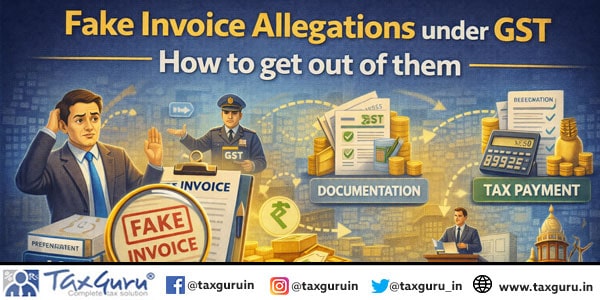
Few GST allegations cause as much panic as an accusation of “fake invoicing”. In practice, once this label is attached, the consequences escalate quickly—summons, search, arrest risk, bank attachment, and sometimes even PMLA proceedings.
What is worrying is that many businesses accused of fake invoicing are not fraudsters. They are genuine businesses that get trapped due to vendor failures, documentation gaps, or procedural lapses.
Based on litigation and advisory experience, let us explore in this article how fake invoice allegations typically arise—and how businesses can defend themselves effectively.
1. What Do GST Officers Mean by “Fake Invoices”?
Legally, fake invoicing under GST generally refers to:
- Issuing invoices without actual supply of goods or services, or
- Availing or passing on input tax credit (ITC) without receipt of goods/services, or
- Circular trading with no real economic activity/substance.
These allegations are usually framed under Section 132 of the CGST Act, which carries serious penal consequences, including arrest.
However, the department’s understanding of “fake” is often broader than the law itself, and that is where problems begin.
2. How Genuine Businesses Get Pulled into Fake Invoice Allegations
i. Vendor Non-Compliance (The Most Common Trap)
A very common pattern:
- Supplier does not file GSTR-1
- Supplier disappears or becomes non-traceable
- ITC does not reflect in GSTR-2B
The department then alleges that: “Invoices are fake because the supplier is fake.”
This leap is legally flawed, but practically devastating.
Ground reality:
A buyer does not control a supplier’s future compliance. Yet, businesses are routinely treated as if they do.
ii. Over-Reliance on GSTR-2B Without Context
While GSTR-2B is an important compliance tool, non-reflection in 2B does not automatically mean fake invoicing.
Issues arise due to:
- Delayed filing by vendors
- Amendments in later periods
- Technical mismatches
Still, many notices equate 2B mismatch = fake ITC, without examining underlying documents.
iii. Circular Trading Allegations Based on Data Analytics
GST authorities now rely heavily on data analytics.
Patterns such as:
- High turnover with low margins
- Multiple related entities
- Repetitive supply chains
are often flagged as “circular trading”, even where goods actually move.
Personal experience:
In several cases, the allegation collapses once transportation, inventory, and payment records are produced—but only after prolonged litigation.
iv. Documentation Gaps, Not Fake Transactions
Many businesses lose their footing due to:
- Missing transport documents
- Weak stock registers
- Poor linkage between invoice and payment
These are compliance failures, not evidence of fake supply.
Unfortunately, they are often treated as proof of fraud.
v. Statements Recorded Under Pressure
Statements recorded during search or summons proceedings often become the foundation of fake invoice cases.
Common problems:
- Statements given without document verification
- Admissions made to “close the matter”
- Language dictated by officers
Once recorded, such statements are difficult—but not impossible—to undo.
3. Why Fake Invoice Allegations Escalate So Fast
Once the word “fake” appears in internal files:
- Arrest under Section 69 is considered
- Provisional attachment of bank accounts is initiated
- ED references under PMLA may follow
The case moves from tax dispute to criminal narrative very quickly.
This is why early response strategy matters more than later defence.
4. Legal Position: What Courts Have Consistently Held
Courts across India have repeatedly emphasised that:
- ITC cannot be denied mechanically merely because the supplier defaulted
- Actual receipt of goods/services is the core test
- Documentary evidence outweighs assumptions
- Arrest is not a routine investigative tool in tax matters
In multiple rulings, High Courts have insisted that authorities must first:
- Examine transportation records
- Verify payment through banking channels
- Consider stock movement and usage
before branding transactions as fake.
5. How to Defend:
i. Build a Strong Factual Defence (Not Just Legal Arguments)
Your defence must show:
- Actual receipt of goods/services
- Physical or digital movement evidence
- Payment through banking channels
- Consumption or resale of goods
Fake invoice cases fail when facts are clearly documented.
ii. Vendor Due Diligence Is Your First Shield
Maintain:
- Vendor KYC documents
- GST registration proof
- Contractual terms
- Periodic compliance checks
Courts view documented diligence favourably.
iii. Handle Summons and Statements Strategically
- Never rush into oral explanations
- Prefer written submissions
- Review statements carefully before signing
- Retract promptly if statements are recorded under pressure
A poorly handled statement can do more damage than a weak ITC position.
iv. Challenge Arrests and Attachments Early
Arrest and provisional attachment powers have strict legal limits.
Courts intervene readily when:
- No independent satisfaction is recorded
- Action is disproportionate
- Business operations are crippled
Silence only strengthens the department’s narrative.
6. Separate Tax Liability from Criminal Allegation
Even if:
- ITC is disputed, or
- Tax is payable
that does not automatically mean fake invoicing or fraud.
This distinction is crucial in defending Section 132 and PMLA exposure.
7. Preventive Steps:
From a litigation perspective, businesses should:
- Shift to 2B-based ITC discipline
- Maintain real-time stock and transport records
- Periodically review high-risk vendors
- Preserve payment trails and usage records
- Create an internal GST investigation response protocol
Prevention is always cheaper than defence.
Final Thought
Fake invoice allegations are among the most aggressive tools in GST enforcement—but they are also among the most frequently over-used.
In my experience, many such cases are not about fraud, but about documentation, interpretation, and pressure-driven assumptions.
A calm, well-documented, and legally sound response can dismantle even the most serious allegations—provided it is done early and strategically.
*****
In case of any query and clarification for compliance, advisory and litigation for Taxation and require any support, you may like to connect with us.
Abhinarayan Mishra FCA, FCS, LL.B, IP, RV; Partner, KPAM & Associates, Chartered Accountants, SAM Law Associates LLP. New Delhi ; +91 9910744992; [email protected]; [email protected]