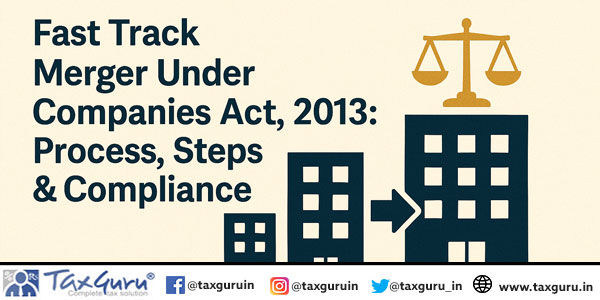
A Fast Track Merger (FTM) is a simplified and time-efficient merger mechanism introduced under Section 233 of the Companies Act, 2013. Unlike the regular merger procedure under Sections 230–232, an FTM does not require approval from the National Company Law Tribunal (NCLT).
This substantially reduces the time, cost, regulatory burden, and documentation typically involved in traditional mergers.
Fast Track Merger is specifically designed for group companies and smaller entities where the merger structure is straightforward and does not pose significant risk to public interest.
Eligible Companies Under Section 233
Fast Track Merger can be undertaken between:
1. Two or more small companies, or
2. A holding company and its wholly-owned subsidiary, or
3. Two or more start-up companies, or
4. A start-up company and a small company, or
5. Unlisted companies (except Section 8 companies) meeting the following conditions:
(a) Aggregate outstanding loans, debentures, or deposits ≤ ₹200 crore, and
(b) No default in repayment of such loans, debentures, or deposits
-
-
- as on a date not more than 30 days before the issue of notice under Section 233(1), and
- on the date of filing the scheme under Section 233(2).
-
Step-by-Step Procedure for Fast Track Merger (FTM)
Step 1: Preparation of Draft Scheme
Both companies prepare a comprehensive Draft Scheme of Merger, covering:
- Share exchange ratio or “no-consideration” structure (in WOS cases)
- Transfer of all assets and liabilities
- Treatment of charges and contracts
- Valuation (if applicable)
- Treatment of dissenting shareholders/creditors
- Revised authorised capital post-merger
Step 2: First Board Meeting
Both transferor and transferee companies hold a Board Meeting to:
- Approve the Draft Scheme
- Approve issuance of Form CAA-9 (notice inviting objections)
- Approve sending notice to ROC/OL/IT Department
- Fix dates for members’ and creditors’ meetings
- Authorize directors and professionals for filings
Step 3: Filing of Form CAA-9 (in GNL-1)
The companies send notice of the proposed scheme to:
- Registrar of Companies (ROC)
- Official Liquidator (OL)
- Jurisdictional Income Tax Department
- Any other concerned authority
Attach: Draft Scheme of Merger.
These authorities get 30 days to provide objections or suggestions.
Step 4: Incorporation of Objections & Finalization of Scheme
After receiving comments (if any), companies incorporate suggestions and finalize the scheme.
Prepare and approve:
1. Declaration of Solvency (Form CAA-10)
2. Statement of Assets & Liabilities
3. Auditor’s Report on the Statement of Assets & Liabilities
Step 5: Member and Creditor Approvals
(A) Members’ Approval – EGM
- Hold General Meeting.
- Scheme must be approved by 90% or more of total shareholding.
(B) Creditors’ Approval
- Obtain written NOC from:
- Secured creditors
- Unsecured creditors
- Representing 90% in value.
NOC must be on stamp paper in the prescribed format.
Step 6: Filing of MGT-14
File Form MGT-14 for approval of resolutions passed under Section 117.
Attach the special resolution and explanatory statement.
Step 7: Filing of Form CAA-11
File Form CAA-11 with the Regional Director (RD), attaching:
- Final Scheme
- Results of meetings
- NOCs from creditors
- Declaration of Solvency (CAA-10)
- CAA-9 and objections received
Step 8: Examination by Regional Director (RD)
The RD reviews the scheme along with comments from ROC/OL/IT.
- If satisfied → RD issues approval order in Form CAA-12
- If objections remain unresolved → RD refers the scheme to NCLT in Form CAA-13
Step 9: Filing of INC-28
Upon approval, both companies must file INC-28 with ROC, attaching the RD order.
Once INC-28 is filed, the scheme becomes effective, and:
- Transferor company stands dissolved without winding up
- All assets & liabilities automatically vest with the transferee company
| Form | Purpose | Key Attachments |
|---|---|---|
| CAA-9 | Notice inviting objections from ROC/OL/IT | Scheme, MOA/AOA, BR, audited BS, list of shareholders |
| CAA-10 | Declaration of Solvency | BR, Statement of A&L, Auditor’s Report, audited financials |
| CAA-11 | Filing final Scheme with RD | Approved Scheme, Meeting results/NOCs, CAA-9 copy |
| MGT-14 | Filing special resolution | Special Resolution, Explanatory Statement, Shorter-notice consent |
| CAA-12 | RD’s Approval Order | – |
| CAA-13 | Appeal to NCLT (if disapproved) | As required |
| INC-28 | Filing RD Order with ROC | RD Order, Authorised capital fee proof |