
ITO Vs Bhandari Automobiles Private Limited (ITAT Kolkata)
Ad-Hoc 10% Expense Disallowance Deleted: ITAT Says AO Cannot Make Additions on Pure Guesswork
The Kolkata ITAT upheld deletion of massive ad-hoc disallowance of ₹2.23 crore made against Bhandari Automobiles Private Ltd., holding that the Assessing Officer cannot arbitrarily disallow expenses without identifying specific defects or inflation in expenditure.
The assessee, an authorized dealer of Tata Motors and Maruti Suzuki vehicles, was engaged in vehicle sales, servicing, repairs, spare parts and lubricant business. During scrutiny assessment, the AO made a blanket 10% disallowance across multiple expenditure heads including repairs & maintenance, office expenses, advertisement, travelling, sales commission, business promotion and miscellaneous expenses, resulting in addition of ₹2.23 crore. The disallowance was primarily based on alleged non-production of complete bills, vouchers and supporting evidence.
However, the CIT(A) deleted the addition after noting that ledger accounts, cash books and other records were indeed produced before the AO and that the turnover and nature of business involved voluminous transactions. The appellate authority observed that without examining overall profitability, comparable cases or pinpointing any specific unverifiable expense, the AO could not resort to arbitrary percentage-based disallowance.
The ITAT affirmed these findings and further noted that the assessee had furnished comparative expense analysis for earlier and current financial years showing that most expense ratios had actually reduced during the relevant year. The Tribunal held that the expenses claimed were neither excessive nor unreasonable and there was no material establishing inflation or bogus expenditure.
Accordingly, the Tribunal dismissed the Revenue’s appeal and upheld deletion of the entire ad-hoc disallowance, reiterating that additions cannot be sustained merely on conjectures, surmises and generalized suspicion.
FULL TEXT OF THE ORDER OF ITAT KOLKATA
These matters consist of an appeal filed by the Revenue vide ITA No.2734/Kol/2025, and Cross Objection No.23/Kol/2026, filed by the assessee, both arising out of the same order passed by the Ld. CIT(A) dated 27.12.2019, for the assessment year 2017-18.
2. The brief facts of the case of the assessee is that Appellant company filed its return of income electronically on 06/11/2017 showing a total income of Rs. 3,09,40,870/-. The return was duly processed u/s. 143(1) by the CPC. During the year, the appellant company was engaged in the trading business as dealer of vehicles manufactured by Tata Motors Ltd. and Maruti Suzuki Ltd. and at the same time engaged in the business of selling of spare parts, accessories and lubricants, servicing and repairing of vehicles. The case was selected for complete scrutiny through Computer Aided Scrutiny Selection (CASS) for various reasons. Various notices were issued and assessment was completed by making following additions:
1. On account of disallowance in respect delay in payment Employee’s contribution towards PF and ESIC-Rs. 1,59, 19,754/-
2. On account of non-deduction of TDS u/s 40(a) (ia) – Rs.3,84,700/-
3. On account of ad-hoc disallowed expenses – Rs.2,23,69,439/-
Aggrieved by the said order assessee preferred appeal wherein appeal of the assessee has been partly allowed by the Cit(A) by observing thus:-
i). I have examined the assessment order and rival contentions on the disallowance made in respect of employees’ contribution to PF/ESI deposited beyond the due dates under the respective welfare statutes. Statutorily, section 2(24)(x) treats employees’ contributions received by the employer as income; a deduction is permitted by section 36(1)(va) only if such sums are credited to the employees’ accounts in the relevant fund on or before the due date under the said statutes. Section 43B, on the other hand, regulates deduction of, inter alia, employer’s contribution on actual-payment basis up to the due date of filing of return under section 139(1). The provisions operate in distinct spheres. The Supreme Court in Checkmate Services (P) Ltd. v. CIT (Supra). has conclusively held that section 43B does not govern employees’ contribution under section 36(1)(va) and cannot extend the statutory due date; amounts paid beyond the due dates under the relevant Acts are not deductible, even if paid before the return-filing due date. The Court also noted the Finance Act, 2021 insertions; Explanation 2 to section 36(1)(va) and Explanation 5 to section 43B which clarify this position. Earlier decisions that applied Alom Extrusions to employees’ contributions (e.g., Vijay Shree) cannot survive in view of the Supreme Court’s ratio; Alom section 43B and was confined thereto E PAR contribution under Extrusions case (Supra) concerned employer’s.
ii) In light of the binding pronouncement in the case of Checkmate Services (Supra), I hold that employees’ contribution deposited after the due dates under the PF/ESI enactments is not allowable under section 36(1)(va). Accordingly, the disallowance in respect of employees’ contribution to the extent of Rs.72,79,215/- is confirmed for violation of Section 36(1)(va).
iii) With respect to the disallowance of the employer’s contribution to PF/ESI, the law is well-settled by the Hon’ble Supreme Court in CIT v. Alom Extrusions Ltd. (2009) 319 ITR 306. The Court held that the deletion of the second proviso to section 43B by the Finance Act, 2003 is curative in nature and therefore retrospective from 01.04.1988.
Consequently, any employer’s contribution to PF/ESI paid before the due date of filing of return under section 139(1) is allowable as deduction, notwithstanding that such payment may have been made after the due date prescribed under the respective welfare enactments. This principle has been consistently applied thereafter. In the present case, the assessing officer is directed to allow deduction to the extent of Rs. 86,40,539/- (1,59,19,754-72,79,215) if the same was deposited before the due date of filing of return for the relevant assessment year. Accordingly, the ground no. 1 is partly allowed.
6. Ground no, 2 pertains to the ad-hoc disallowance of Rs. 2,23,69,439/being 10% of the expenses at various heads, including Repairs and maintenance, Office Expenses, Advertisement, Travelling and Conveyance, Printing and Stationary, Sales Commission, Business Promotion, Repairs of pre-owned cars and commercial cars and Miscellaneous Expenses. The reasons cited by the AO on page 7 and 8 of the assessment order includes the failure of the appellant to substantiate the expenses with complete details of bills and vouchers, as well as the proof of evidence of TDS deduction as per provisions of Income Tax Act, 1961. However the appellant company pleaded that the turnover of the company is huge and so are the expenses and therefore, due to volume of the documents involved, it was not feasible to produce the documents unless specified as to what specific documents under which head were to be produced. I have perused the information is tabulated on page 9 of the assessment order which enables to have a fair idea of the nature of expenses and volume of the documents involved. In the case at hand, ledger cashbook and other documents were produced before the AO and the same has been duly recorded by the AO in the assessment order. Without evaluating the overall fairness of the disclosed profit on the basis of comparable cases and without recording specific findings with respect to appropriateness of the profit so disclosed by the Appellant, tinkering with the expenses shown by the appellant is unfair and hence, unsustainable. The appellant has argued vehemently against the said addition and has relied on various judicial pronouncements while assailing the impugned addition. Business of such a nature, volume and extent cannot sustain without adequate record keeping and non-submission of the voluminous records per se does not and should not lead to such an ad-hoc disallowance. Therefore, in the interest of justice, the ground no. 2 of the appellant is allowed and the ad-hoc addition of Rs. 2,23,69,439/- is hereby deleted.
7. Ground no. 3 pertains to addition of Rs. 3,84,700/- on account of non-deduction of TDS u/s-40a(ia) on the payments made to the auditors. During the assessment proceedings the assessing officer noted that TDS has not been deducted on payment made to auditors and the same was confirmed by the representative of the appellant that the said payments have not been subjected to TDS. The ground taken by the appellant that the tax liability was discharged by recipients does not absolved the appellant from the liability cast by the legal fiction created u/s- 40a(ia). The submissions made by the appellant has been perused and it is seen that the assessing officer was justified only to the extent of disallowance of 30% of the amount involved in view of the amended Section 40a(ia). The other averments made in the submission in this regard are neither borne out from the assessment order nor from the facts available on record in as much as no such claims were made before the AO, nor an amount of Rs. 36,000/- has been visibly disallowed in the computation of income, other than discussed above. Such unsubstantiated claims made at this stage cannot be held to be tenable. Therefore, in view of these findings, the addition of Rs. 3,84,700/- is restricted to 30% i.e. Rs. 1,15,410/-. The appellant gets relief of Rs. 2,69,290/- Accordingly. ground no. 3 is partly allowed.
8. Ground no. 4 is consequential in nature and therefore, cannot be adjudicated at this stage and is accordingly dismissed. Ground no. 5 is dismissed being devoid of merit, as from the assessment order, it is noted that adequate opportunity has been provided to the appellant before passing the assessment order. Ground no. 6 is general is nature and is accordingly dismissed without adjudication.
9. In the light of the discussions made hereinabove, the appeal is partly allowed, with the order as above.
3. Being aggrieved by and dissatisfied the Revenue has filed appeal before us by taking following grounds: –
The Ld. CIT(Appeals) has erred in deleting the addition of Rs. 2,23,69,439/- for disallowance of 10% of expenses by terming it as ad-hoc disallowance.
3. Contrary to that the Ld. AR supports the impugned order by submitting that there is no infirmity in the impugned order as the Ld. CIT(A) has rightly deleted the addition of Rs. 2,23,69,439/- added by the Assessing Officers as such addition made by the Assessing Officers was not based on the facts rather entirely on conjectures and surmises. The Ld. AR submits that for the purpose of disallowance certain expense items had been chosen at the own free will of the Assessing Officers and uniform disallowance of 10% of the expenses has been done without mentioning –
(a) which particular expense could not be substantiated with bills, vouchers.
(b) How a satisfaction has been raised that such expenses was inflated.
The Ld. AR further submits that assessee has submitted a comparison table of the expense in financial year 2015-16 and financial 2016-17 that goes to show that expenses claimed in the concurrent year that is financial year 2016-17 was less in most of the cases, so the expenses claimed in the assessment year under consideration were neither unreasonable nor excessive which can justify any disallowance.
4. Upon hearing the submission of the counsel of the respective parties and on perusal of the impugned order we find that the Revenue has challenged the only one ground that is the deletion of addition of Rs. 2,23,69,439/- for disallowance of 10% expense by terming it as an ad hoc disallowance. CIT(A) in its order have gone through the table which was mentioned in the page 9 of the assessment order that enables to have a fair idea of the nature of expenses and volume of the documents involved. It is pertinent to mention here that ledger, cash book and other documents were produced before the AO and the same has been duly recorded by the AO in the assessment order. Assessee has also placed a table of comparison of expenses of the company of the financial year 2015-16 with financial year 2016-17 which is as belows:-
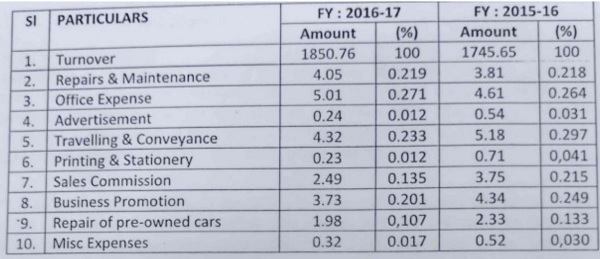
5. Looking at the table we find that expenses claimed in the assessment year under consideration were neither unreasonable nor excessive. Going over the discussion made above we find substance in the arguments of the Ld. AR that there is no infirmity in the impugned order of the CIT(A) on this issue. Accordingly, we dismiss the appeal of the Revenue order of the CIT is hereby upheld.
CO-23/26
Assessee has also filed the cross-objection which in course of argument has submitted that he is not pressing the CO. Accordingly, we dismiss the appeal of the Revenue and order of the CIT is hereby upheld.
As a result both the appeal are here by dismissed
Kolkata, the 15th May, 2026.





