Income Tax : This explains why recent income disclosure intimations lack statutory support and create uncertainty. The key takeaway is that vag...
Income Tax : Explains when home-loan interest can be added to the cost of acquisition and how the AY 2024-25 amendment blocks double benefits. ...
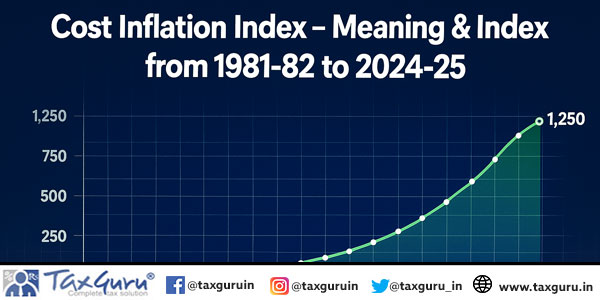
Income Tax : This guide explains the concept, calculation formula, and notified values of CII from 2001-02 to 2025-26, as per CBDT. A must-read...
Income Tax : Learn whether PMS fees can be deducted from capital gains under Section 48 of the Income-tax Act, 1961. This article explains the ...
Income Tax : Summary: As per the Finance Act 2024, the long-term capital gains (LTCG) tax on listed securities has been raised from 10% to 12.5...
Income Tax : Calculate Long term capital gain on sale of capital Assets other then shares with the help of Indexation.- We have given below the...
Income Tax : The issue was whether a share transfer without consideration constituted taxable capital gains. The Tribunal held that genuine fam...
Income Tax : The decision underscores that failure to follow the prescribed valuation procedure under section 50C leads to invalidation of addi...
Income Tax : The Tribunal held that enhancement of income without issuing notice under section 251(2) is invalid. Such action violates principl...
Income Tax : The case examined whether compensation paid to exit prior agreements was a sham arrangement. The Tribunal ruled it was a valid bus...
Custom Duty : The case addressed whether a custodian could be held liable for duty when container contents differed from declared goods. The Tri...
Corporate Law : Explore the new Competition Commission of India (CCI) Lesser Penalty Regulations 2024. Learn about conditions, procedures, and ben...
Custom Duty : Stay informed about the Union Budget 2024-25 changes in ICES. Learn how the Directorate General of Systems manages updates and the...
Madras High Court held that provisions of Section 26E of the SARFAESI Act and Section 34 of the Recovery of Debts and Bankruptcy Act, 1993 (RDB Act) would prevail over the provisions of Section 24 of the Tamil Nadu General Sales Tax Act, 1959 (TNGST Act).
ITAT Mumbai held that the rate of tax on a short term capital gain on depreciable assets u/s. 50 has been held to be the rate of long term capital gain @ 20% as per Section 112 of the Income Tax Act. Accordingly, appeal of assessee allowed.
It also referred to similar findings in Matrix Partners India Investment Holdings, LLC vs DCIT and other precedents, reinforcing that exempt income did not form part of the computation of total income under Indian law.
ITAT Mumbai held that addition under section 56(2)(x) of the Income Tax Act not justified since value adopted by the DVO and actual purchase price declared by the assessee falls within the tolerance limit of 10%. Accordingly, appeal allowed.
During the assessment proceedings, it was observed that the assessee sold two trademarks “Coldarin” and “Raricap”. The gains accrued on the transfer of both these capital assets gave rise to income chargeable to tax under the head “Capital Gains”.
Allahabad High Court dismissed the writ petition and held that seizure of goods under section 129 of the IGST/ CGST Act can be done even on the ground of under valuation. Thus, power of seizure of goods correctly exercised.
It was held that considering the provisions of CBDT Circular No. 1916 and the explanation provided by the assessee, the seized gold jewellery up to the specified thresholds for each family member should be treated as explained.
ITAT Ahmedabad held that once the unaccounted receipts from the sale of properties are subjected to taxation as part of the capital gains computation, the related unaccounted expenditures stand explained and cannot be taxed separately as unexplained expenses.
Karnataka High Court ruled on V.S. Chandrashekar vs. ACIT regarding tax treatment of land transactions, applicability of Section 50C, and capital gains classification.
ITAT Cuttack held that revisionary proceedings under section 263 of the Income Tax Act is liable to be quashed since assessee is entitled for exemption u/s. 11 and hence twin conditions are not satisfied in as much as there is no loss of revenue.