Income Tax : This guide explains the penalty and prosecution framework under the Income-tax Act for AY 2026-27. It highlights the consequences ...
Income Tax : The Income Tax Department explains when interest is payable for delayed return filing, advance tax defaults, deferment of instalme...
Income Tax : The article explains how offences such as wilful tax evasion, failure to file returns, non-payment of TDS/TCS, falsification of re...
Income Tax : This article explains the advance tax provisions under the Income-tax Act, including liability thresholds, exemptions, and instalm...
Income Tax : This article outlines major offences under the Income-tax Act that may result in prosecution, including tax evasion, non-payment o...
Income Tax : Request to CBDT to permit filing of Form 10IC after expiration of time limit by condoning delay Issuance of Order under Section ...
Income Tax : All Odisha Tax Advocates Association has filed an PIl before Orissa High Court with following Prayers- (i) Admit the Writ Petition...
Income Tax : At the end of May the Income Tax Return forms are released for the Assessment Year 2015-16 and same been held back by finance mini...
Income Tax : ITAT held interest from head office and overseas branches is not taxable as payment to self, while interest from overseas banks al...
Income Tax : ITAT held an assessment passed after the taxpayer's death was invalid in law, quashed the order, and treated all remaining issues ...
Income Tax : ITAT Jaipur held that a one-day delay in filing Form 10DA could not defeat a Section 80JJAA deduction when the form was on record ...
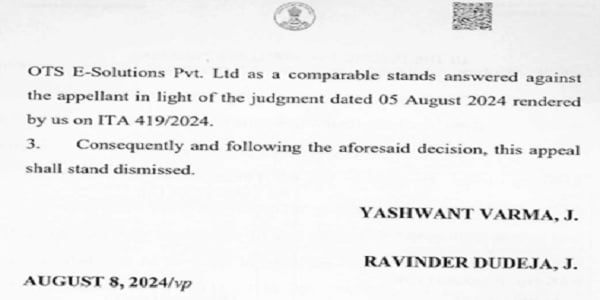
Income Tax : Transfer pricing principles dictate that a captive, risk-mitigated service provider could not be benchmarked against full-fledged,...
Income Tax : ITAT held ₹33 crore settled rights over the entire land, allowing full indexed acquisition cost and rejecting proportionate rest...
The Tribunal held that offshore supply receipts could not be taxed under Section 44BB where the Revenue failed to prove the existence of a Permanent Establishment in India. The addition of Rs. 99.50 crore was therefore deleted.
Whistleblower reward of Rs. 8.16 crore received by the assessee from the U.S. SEC for providing information and substantial assistance in enforcement proceedings was a taxable revenue receipt.
Mumbai ITAT held that a reassessment notice issued beyond three years was invalid because approval was obtained from the Principal CIT instead of the prescribed higher authority under Section 151. The reassessment proceedings and assessment order were quashed.
ITAT Mumbai held that reassessment proceedings were invalid because approval under Section 151 was obtained from an authority not competent under the amended law. The notice under Section 148 was declared void.
The ITAT Mumbai held that a reassessment notice issued beyond three years was invalid where the alleged escaped income was less than ₹50 lakh. The consequential assessment order was quashed.
Adjustment under section 143(1)(a)(iv) based on disallowance reported in Form 3CD was held to be within CPC’s jurisdiction. However, rectification under section 154 enhancing income without complying with section 154(3) was quashed.
Mumbai ITAT ruled that where a capital asset was acquired before 01.04.2001, the claim for adopting fair market value as on that date must be examined on merits. The key takeaway is that statutory valuation rights cannot be rejected on technical grounds alone.
The Mumbai ITAT held that reassessment initiated beyond three years was invalid because the alleged escaped income was only ₹5 lakh, far below the ₹50 lakh requirement under Section 149(1)(b). As a result, the reassessment and consequential assessment order were quashed.
The Tribunal sent the issue of deduction for political donations back to the Assessing Officer after finding that bank transaction details had not been properly verified. Fresh adjudication was directed after giving the assessee an opportunity of hearing.
Assessments arising from searches conducted after 01.04.2021 must strictly comply with the reassessment framework under sections 147 and 148. Failure to adhere to statutory jurisdictional requirements, including mandatory approvals and satisfaction for use of third-party material, rendered the entire assessment void.