Authors Note: I was managing the finances of a client who wanted to get his home reconstructed—that is, demolishing the existing one and constructing a new one. He had a substantial amount invested in mutual funds long ago, with significant gains. The question was how Section 54F (Section 86 as per the Income Tax Act, 2025) applies to the purchase or construction of a new house. Would it be applicable in this case?
In my client’s case, all the conditions were satisfied. He wanted to sell his mutual funds and use the proceeds for demolishing and reconstructing his house. However, he was concerned about receiving a notice from the tax department, given the large amount involved. Therefore, before advising him, I thoroughly reviewed the Income Tax Act and relevant judicial pronouncements. Let’s analyse it. Happy reading!
Section 54F: Capital gain on transfer of certain capital assets not to be charged in case of investment in a residential house
Introduction
Technically speaking, when an assessee demolishes an existing house on his own land and constructs a new residential house, in that case income tax department may question the availability of exemption as per Section 54 which is applicable when the original asset is a residential house or in my client’s case i.e. section 54F where original asset is any other long-term capital asset i.e. equity mutual finds.
Here the question arises that whether “construction” for the purposes of section 54 or 54F covers demolition followed by new construction on the same plot, or whether commencement of construction before the date of transfer disallow the assessee to claim exemption and how incidental costs like cost of demolition, reconstruction, as well as the land component shall be treated for computing the exempt amount.
This law have been interpreted by important high-court and tribunal rulings, but what the bare income tax act says?
Above I just discussed section 54F in one single line, but let’s expand a bit, Section 54 which was introduced for capital gain on transfer of a residential house, it gives assessee an exemption if capital gain is invested in purchase or construction of another residential house but the purchase should be made 1 year before or 2 years after transfer and the construction should be completed within 3 years.
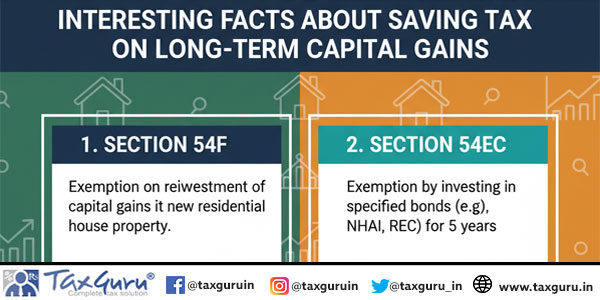
Whereas, section 54F was introduced for the capital gain on transfer of any long-term capital asset other than a residential house, here the exemption is proportionate to investment of net consideration in purchase/construction of one residential house within the same timelines, the deposit should be made to the capital gains account scheme if not utilised before filing time limit.
Here law says that the investment should result in a residential house property owned by the assessee with other conditions such as not owning more than one other residential house on date of transfer, but law doesn’t expressly say that construction must start after the date of transfer, rather the focus of law is mainly on completion/purchase within prescribed periods.
Leading case laws
Section 54F Exemption: Does Starting Construction Before Sale Disqualify You?
CIT vs. Bharti Mishra (Delhi HC) (2014) 265 CTR 374
Demolition of an old house and construction of a new house on the same plot qualifies as “construction” for the purpose of Section 54F, hence the commencement of construction prior to the date of sale does not automatically deny the assessee where conditions that are specified i.e. completion of construction within 3 years is done, and investment of net consideration is proved and there is compliance with CGAS rules i.e. amount is transferred to Capital gains account scheme before due date of ITR, In this case the delhi high court upheld the exemption and focussed on a beneficial interpretation of the provision.
Capital Gains Tax: Demolition vs. Extension Under Section 54/54F
CIT v. V. Pradeep Kumar (Madras HC) (2006)
In this case the high court of Madras delt with facts where the assessee claimed that the “construction” was only an extension/alteration of current premise but here the factual evidence did not showed it to be a genuine reconstruction for the purpose of creating a new residential house, held against the assessee. After analysing all the underlying facts, circumstances, and background information that was relevant to above case, the court gave a decision in favour of department. Hence, just mere extension of an existing structure will not qualify for an exemption as per section 54F even if all the conditions are fulfilled. In this case Pradeep Kumar remains authority for the proposition that substance matters if works are not truly construction of a new residential house, So, court said exemption can be denied.
CIT v. Ashok Narayan (Karnataka HC) (2009) 318 ITR 246
In this case, the karnataka high court in it’s decision that was cited in revenue/assessee authorities has also accepted that reconstruction on the same plot as qualifying construction, subject to facts that must show the genuine reconstruction to create a residential house and there should be proper compliance with timelines. By last two judgements I wanted to tell my readers that, the courts distinguished the cases of such full reconstruction from the cases of only repairs or extensions.
Pushpa v. ITO (Kerala HC) and various Tribunal rulings
Several decisions at tribunal and high-court levels have applied the same principles that is where the demolition and then fresh construction results in a new residential house, then the exemption of section 54F is available but in case only repairing or extension of residential property is done, or making improvements or changing the use of property is seen like converting the residential property in to shops, then in those cases the exemption may be refused.
Hence the courts continue to treat Sections 54/54F as beneficial to assessee and law shall not be interpreted strictly or technically, which could prevent the substantial justice from being served. Though the exact application depends on the nature of the project and whether those three conditions as I discussed above are properly complied with.
Practical Implications for Taxpayers
I have read and understood many such case laws as discussed above. On interpreting these cases, I find that the courts focus on substance over form. This means the key question is whether the work constitutes a genuine reconstruction or a new construction—that is, a complete demolition followed by construction of a fresh building—or whether it is merely a repair or extension. In cases of substantial structural change, exemption may be allowed.
I advised my client to maintain proper evidence, such as photographs of the existing building, photographs after demolition, and photographs during/after the new construction. Modern cameras and smartphones with location-tagging functions can support this documentation.
Another important aspect is the time of commencement of construction. Starting construction before the date of transfer is not an automatic bar to exemption. Courts have held that exemption may still be available if the construction is completed within the statutory period prescribed under the relevant section and other conditions are satisfied.
A further scenario arises under the “one-house rule” or change of use of property. If the reconstructed property results in multiple units—whether residential, commercial, or partly commercial (such as shops or offices)—the Income Tax Department may scrutinise the claim more closely. While some decisions have allowed multiple residential units to qualify, this depends on the specific facts of each case.
Finally, as highlighted earlier, proper documentation and evidence are critical at the assessee’s end. This includes architectural plans, municipal permissions, contractor agreements, detailed cost break-up (demolition cost, construction cost), bank transfer records or payment proofs, invoices, and the completion certificate. All such documents should be preserved to substantiate the exemption claim.
Things to remember while filing ITR
Assessee should state that the demolition and reconstruction is a genuine construction resulting in a new residential house and give dates of commencement of demolition as well as completion, along with that he must attach the architect’s certificate that the works constitute a new construction with structural changes rather than only extension or repair. Also, the utilisation of net consideration should be shown or in case construction is not completed before due date of filing ITR, in that case, the proof of CGAS deposit should be shown with the bank certificates.
In case the construction started prior to transfer, then the commercial/technical reasons need to be explained, it might be urgent safety demolition and emphasise completion within statutory period, here a case law of CIT v. Bharti Mishra (Delhi HC) (2014) 265 CTR 374 can be used.
The risk of litigation
First one is the “mere extension vs new construction” on factual grounds as I discussed in the case of CIT v. V. Pradeep Kumar (Madras HC) (2006) above.
Second one is in the case of change of use that means construction converted to shops or may be multiple commercial units, in that case the court may favour the department as no residential house is created or in the case of non-compliance with CGAS provisions or timelines hence the deposit proof and completion date is important.
Conclusion
Demolition of an old house followed by new construction on the same plot can qualify for exemption under Section 54/54F, provided it results in a fresh residential house and all statutory timelines are met. Courts, particularly the Delhi High Court in Bharti Mishra, have held that starting construction before the transfer is not a bar if completion is within three years and proceeds are invested correctly.
However, factual scrutiny remains critical—mere extensions or repairs do not qualify. Proper documentation, CGAS compliance, and proof of genuine construction are essential to safeguard exemption claims.
Author can be contacted at [email protected]