Summary: The Ministry of Finance has issued detailed FAQs on the tax treatment under the Unified Pension Scheme (UPS), notified in January 2025 for Central Government employees. The UPS applies to new recruits from April 1, 2025, and existing employees under NPS have the option to shift to it by September 30, 2025. Contributions made by both the government and employees to the individual corpus are deductible under Sections 80CCD(1) and 80CCD(2) of the Income Tax Act, 1961. An additional 8.5% government contribution to the pool corpus is not taxable as it does not form part of the employee’s income. Partial withdrawals up to 25% of an employee’s contributions are exempt from tax. At retirement, lump sum payments, withdrawals up to 60% of the corpus, and transfers to the pool corpus are eligible for exemptions under relevant provisions. However, excess amounts beyond benchmark limits may attract tax on 40% of the surplus. Pension payouts are taxable as salary, while family pension is taxed under “Income from Other Sources.” The FAQs clarify scenarios with examples to guide employees in making informed retirement planning decisions. The document is accessible on the DFS website.
Ministry of Finance
DFS releases detailed FAQs on the tax treatment under UPS; NPS Tax Benefits applicable to UPS
Posted On: 23 SEP 2025
The Unified Pension Scheme (UPS) was notified by the Ministry of Finance, Government of India, vide Notification No. F. No. FX-1/3/2024-PR dated 24.01.2025. The scheme is applicable to new recruits joining the Central Government services on or after 01.04.2025, and offers an option to existing Central Government employees under NPS to opt into UPS.
To implement this framework, the Pension Fund Regulatory and Development Authority (PFRDA) notified the PFRDA (Operationalisation of the Unified Pension Scheme under NPS) Regulations, 2025 on 19.03.2025.
To support employees in making an informed choice, the Department of Financial Services (DFS) has released detailed FAQs on the tax treatment under UPS. These can be accessed on the DFS website or directly via the following link:
https://financialservices.gov.in/beta/sites/default/files/2025-09/FAQs-on-tax-treatment-under-Unified-Pension-Scheme-UPS.pdf
Employees are encouraged to peruse the FAQs and assess the benefits of UPS in alignment with their retirement planning goals.
The last date for eligible employees and past retirees under NPS to opt for UPS is 30.09.2025.
FAQs on tax treatment under UPS
Q.1 What is the tax treatment for the contributions made by the Central Government to the Individual corpus of the subscribers under the Unified Pension Scheme (UPS)?
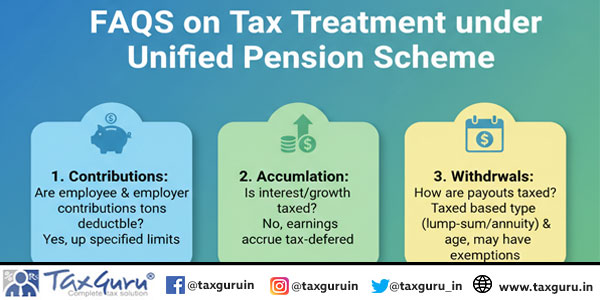
Ans: The Central government contributes 10% of monthly emoluments (Basic Pay + Dearness Allowance) of the employees to the individual corpus. This contribution is eligible for deduction under section 80 CCD (2) of the IT Act, 1961 [Section 124(1) of the Income Tax Act, 2025] as UPS is an option under the National Pension System.
Q.2 What is the tax treatment for the employee’s contributions towards the UPS?
Ans: The employee’s contribution towards UPS, up to 10% of monthly emoluments (Basic Pay + Dearness Allowance), is eligible for deduction under the Section 80 CCD(1) of the IT Act, 1961 [Paragraph 1(y) of Schedule XV of the Income Tax Act, 2025] as UPS is an option under the National Pension System.
Q.3 What is the tax treatment of the contribution by the government to the Pool Corpus which is 8.5% of (basic pay + Dearness Allowance)?
Ans. The additional contribution provided by the Central government, amounting to 8.5% of monthly emoluments (Basic Pay + Dearness Allowance), is made at an aggregate level basis directly to the pool corpus. This contribution is not towards the individual corpus. Therefore, this contribution is not treated as income in the hands of the employee, neither as salary nor as perquisite and is not chargeable to tax.
Q.4 Is the amount partially withdrawn by a subscriber from their individual account/corpus under the Unified Pension Scheme (UPS) taxable?
Ans. The amount partially withdrawn to the extent of 25% of his own contribution from the Individual Corpus is exempted from tax under Section 10(12B) of the IT Act, 1961 [Schedule III Table: Sl.No 4 of the Income Tax Act, 2025] as UPS is an option under the National Pension System.
Q.5 Upon superannuation or retirement, an employee under the Unified Pension Scheme (UPS) is required to authorise the transfer of the value or units from their individual corpus to the pool corpus. What is the tax treatment of such a transfer within the UPS?
Ans. For subscribers to the Unified Pension Scheme (UPS), any amount transferred from the Individual Corpus to the pool corpus at the time of superannuation or retirement is deemed not to have been received by the assesses in the relevant previous year. Such transfers within the UPS framework are not taxable as income under Section 80 CCD(6) of the IT Act, 1961 [Section 124(12) of the Income Tax Act, 2025].
FAQs on tax treatment under UPS
Q.6 Is income tax payable on the lump sum payment received from the Unified Pension Scheme (UPS) at the time of retirement?
Ans. The lump sum payment payable to an employee at the time of superannuation or retirement is calculated as 10% of monthly emoluments (Basic Pay + Dearness Allowance) for every completed six months of qualifying service. This entire amount is exempt from income tax under Section 10(12AB) of the IT Act, 1961. [Schedule II Table: SI.No 16 of the Income Tax Act, 2025].
Q.7 A subscriber under the Unified Pension Scheme (UPS) is allowed to withdraw a portion of the individual corpus at the time of superannuation or retirement. Is this amount taxable?
Ans. A subscriber shall have an option to withdraw an amount not exceeding 60% of the Individual corpus or Benchmark Corpus, whichever is lower at the time of superannuation or retirement. This amount is exempt from taxation under Section 10(12AA) of the IT Act, 1961 [Schedule II Table: S1.No 15 of the Income Tax Act, 2025].
Q.8 An employee can exercise investment choices for the Individual Corpus. If the Individual Corpus exceeds the Benchmark Corpus for a particular employee, the excess amount is credited to the employee in lumpsum. Is this excess amount taxable?
Ans. The amount up to 60% of the Individual corpus is exempt from taxation under section 10(12AA) of the IT Act, 1961 [Schedule II Table: SI.No 15 of the Income Tax Act, 2025]. Accordingly, the 60% of the excess of Individual Corpus over the Benchmark corpus is also exempt. The remaining 40% of the excess amount will be chargeable to tax.
Q.9 What is the tax treatment for payouts received by an employee under UPS?
Ans. The amount of monthly payouts received by an employee is in the nature of pension and hence is chargeable to income tax under the head “Salaries”.
Q.10 What is the tax treatment for payouts received by the spouse of the deceased employee who was under UPS?
Ans. The amount of monthly family payouts is in the nature of Family Pension, received by the spouse of a deceased employee, who was a subscriber to UPS, is chargeable to tax under the head “Income from other sources”.
Illustrative Example 1:
At the time of superannuation or retirement:
- Monthly emoluments are Rs 3,00,000/-;
- Period of service is 25 years
- The individual corpus is Rs 2,00,00,000/-
FAQs on tax treatment under UPS
- The benchmark corpus is Rs 1,80,00,000/-
- Rs 20,00,000/- is credited to the employee in lumpsum (Excess of Individual corpus over the Benchmark corpus)
- Amount of Rs 1,08,00,000/- is withdrawn. (60% of IC or BC, whichever is lower i.e. 60% of Rs. 1,80,00,000/-)
- No partial withdrawals were made.
TAX TREATMENT
i. The lump sum payment is calculated @ 10% of Monthly emoluments for every six monthly completed period of qualifying service (10%x3,00,000x25x2) which comes to Rs 15 Lakhs. This is exempted under Section 10(12AB) of the IT Act, 1961 [Schedule II Table: SI.No 16 of the Income Tax Act, 2025].
ii. The excess of individual corpus over the benchmark corpus of Rs. 20 Lakh is exempted upto 60% i.e upto Rs. 12 Lakh under Section 10(12AA) of the IT Act, 1961 [Schedule II Table: SI.No 15 of the Income Tax Act, 2025]. The remaining Rs. 8 Lakh is chargeable to tax and therefore shall be added to the total income of the individual under the head “Salaries” for the tax year in which the payment is paid or allowed or due, whichever is earlier.
iii. The withdrawal of Rs 1.08 crore is exempted under Section 10(12AA) of the IT Act, 1961 [Schedule II Table: SI.No 15 of the Income Tax Act, 2025].
iv. Note: Please refer to the answer to Q. 3 as well.
v. The transfer of 40% of the remaining individual corpus (Rs 72 Lakh) to the pool corpus is not chargeable to tax under Section 80 CCD (6) of the IT Act, 1961 [Section 124(12) of the ].
Illustrative Example 2:
At the time of superannuation or retirement:
- Monthly emoluments are Rs 3,00,000/-;
- Period of service is 30 years
- The individual corpus is Rs 2,00,00,000/-
- The benchmark corpus is Rs 2,20,00,000/-
- Individual corpus is less than the Benchmark corpus and, therefore, there is no excess amount to be credited to employee.
- Amount of Rs 1,20,00,000/- is withdrawn. (60% of IC or BC, whichever is lower i.e. 60% of Rs. 2,00,00,000/-)
- No partial withdrawals were made.
TAX TREATMENT
i. The lump sum payment is calculated @ 10% of Monthly emoluments for every six monthly completed period of qualifying service (10% x 3,00,000 x 30 x 2) which comes to Rs 18 Lakhs. This is exempted under Section 10(12AB) of the IT Act, 1961 [Schedule II Table: SI.No 16 of the Income Tax Act, 2025].
ii. The withdrawal of Rs 1.20 crore is exempt under Section 10(12AA) of the IT Act, 1961 [Schedule II Table: SI.No 15 of the Income Tax Act, 2025].
iii. The transfer of 40% of the remaining individual corpus (Rs 80 Lakh) to the pool corpus is not chargeable to tax under Section 80 CCD(6) of the IT Act, 1961 [Section 124(12) of the Income Tax Act, 2025].