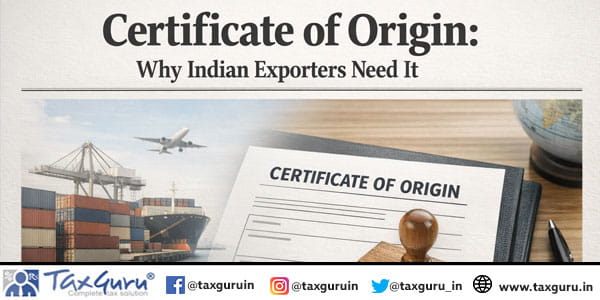
A Certificate of Origin (COO) is an important export document that proves that the goods are made in India. It is used in international trade so that the importing country can know the source of the product. This document helps customs officers decide how much import duty the buyer must pay and whether the shipment qualifies for lower duty under trade agreements.
For Indian exporters, the rules for the COO are given in the Foreign Trade Policy and the procedures issued by DGFT. Exporters must apply online and submit correct documents to get the certificate. If the COO is not provided, the buyer may have to pay higher duty, the goods may get delayed at customs, and payment under Letter of Credit can also be held. Therefore, the Certificate of Origin is necessary for duty benefits, smooth customs clearance, and proper compliance in export transactions.
Rules for Certificate of Origin in India
Foreign Trade Policy and Handbook of Procedures
The Certificate of Origin in India is issued based on the rules given in the Foreign Trade Policy and the Handbook of Procedures. These rules explain who can issue the certificate and what documents are required from the exporter.
Only certain approved bodies like Chambers of Commerce, Export Promotion Councils, and Commodity Boards are allowed to issue the Certificate of Origin. Before giving the certificate, they check the exporter’s documents to confirm that the goods are made in India and meet the origin conditions.
Role of DGFT
The DGFT (Directorate General of Foreign Trade) manages the online system for applying for the Certificate of Origin. Exporters have to apply through the e-COO portal using their IEC number.
The DGFT also decides which organizations are allowed to issue the certificate and sets the process they must follow. The issuing agency checks the documents and then provides the Certificate of Origin online.
Types of Certificates of Origin
Non-Preferential Certificate of Origin
A non-preferential Certificate of Origin only proves that the goods are made in India. It does not give any customs duty benefit to the buyer. It is mainly used for customs clearance in the importing country and for trade records.
Many countries ask for this certificate to check the source of goods and to follow their import rules. Even though it does not reduce duty, it is still an important document for completing export formalities.
Preferential Certificate of Origin
A preferential Certificate of Origin helps the buyer pay lower or zero import duty under trade agreements signed by India with other countries. This makes Indian goods cheaper and more competitive in the international market.
To get this certificate, the exporter must follow the Rules of Origin, which means the goods must be properly made or processed in India. The exporter must also submit correct documents to prove this.
Major Trade Agreements Covered
India has trade agreements with countries and regions like:
- ASEAN countries
- Japan
- Korea
- UAE
- Australia
- EFTA countries
Each agreement has different rules for origin and documents. Exporters must check the correct agreement before applying for the preferential Certificate of Origin.
Rules of Origin and Substantial Transformation
Wholly Obtained Goods
Some goods are fully made or produced in India without using any imported material. These are called wholly obtained goods. Examples include agricultural products grown in India, minerals taken from Indian soil, or animals raised in India. These goods automatically qualify as “Made in India” and can easily get the Certificate of Origin.
Substantial Transformation
For many products, raw materials may come from different countries, but the final product is made in India. In such cases, the product will be treated as Indian origin only if it is properly manufactured or processed in India.
This is checked based on:
- How much value is added in India
- Whether the product’s tariff (HS) classification changes after manufacturing
- Whether a specific manufacturing process is done in India
Exporters must keep proper records of raw materials, production process, and cost details to prove this.
Risk of Wrong Origin Declaration
If an exporter gives wrong information and claims that goods are made in India when they are not, it is called misdeclaration. This can cause serious problems.
Customs may:
- Cancel duty benefits
- Ask for repayment of duty with penalty
- Stop future export benefits
- Suspend IEC in serious cases
They may also check documents even after the goods are cleared.
Digital Issuance Through e-COO Platform
India has started an online system called the e-COO platform for getting the Certificate of Origin. Now exporters do not need to apply physically. They can apply online, upload their documents, and get the certificate in digital form. This system is used for both preferential and non-preferential Certificates of Origin.
Mandatory Electronic Filing
It is now compulsory to apply for the Certificate of Origin through the online portal. Exporters have to log in using their IEC, upload the invoice, packing list, and shipping documents, and submit the application. The authorized agency checks the details and issues the certificate online.
Features of e-COO 2.0
The new system allows multiple users to work under one IEC, which is helpful for export teams. It also uses Aadhaar verification and digital signatures for secure filing. The process is faster, reduces paperwork, and makes everything more transparent.
Legal Validity of Electronic Certificates
The digital Certificate of Origin is fully valid. Customs authorities and banks accept the electronically issued certificate for customs clearance and export payment. So exporters can safely use the online COO without needing a physical copy.
Self-Certification Mechanism for Approved Exporters
In some trade agreements, trusted exporters are allowed to declare on their own that their goods are made in India. They do not need to take a Certificate of Origin from a Chamber of Commerce every time. This is called self-certification. This makes the export process faster and saves time because the exporter does not have to apply for the certificate for each shipment.
But there is one important condition. The exporter must keep proper records like purchase details, manufacturing proof, and invoices. Customs officers can check these records anytime. If the exporter gives wrong information or does not keep proper documents, this facility can be cancelled and penalties may be charged.
Role of Certificate of Origin in Customs and Trade Finance
Customs Clearance
When your goods reach the buyer’s country, the customs officer checks the Certificate of Origin to see where the goods were made. Based on this, they decide how much import duty the buyer has to pay. If the goods qualify under a trade agreement, the buyer gets lower duty.
The certificate also helps customs make sure that the goods are really from India and not wrongly declared. If the details in the Certificate of Origin do not match the invoice or shipping documents, customs may stop the goods. This can cause delay, extra charges, and problems for the buyer.
Letter of Credit Compliance
When export payment is done through a Letter of Credit (LC), the bank checks all the export documents before giving money to the exporter. The Certificate of Origin is one of the important documents required by the bank.
If the certificate is missing or has wrong details, the bank will not release the payment. This can delay your money and affect your business. So, a correct Certificate of Origin helps in getting payment on time and completing the export process smoothly.
Documentation and Procedural Requirements
When an exporter wants to get a Certificate of Origin, they must submit some basic export documents. These documents help the issuing authority confirm that the goods are actually made in India. The main documents include the commercial invoice, packing list, shipping bill, and bill of lading or airway bill. In some cases, the exporter also needs to give a declaration from the manufacturer stating that the product is produced in India.
All the details in these documents must be the same. The product name, HS code, quantity, invoice number, and buyer details should match in every document. If there is any difference, the authority may stop the application and ask for correction. This can delay the certificate and also delay the shipment. Therefore, exporters should always check their documents carefully before applying for the Certificate of Origin.
Consequences of Non-Compliance
If an exporter does not take a Certificate of Origin or gives wrong information in it, many problems can happen. The biggest problem is that the buyer will not get the benefit of lower customs duty under trade agreements. This makes the product more expensive for the buyer and they may cancel the order or choose another supplier.
Customs authorities in the importing country may also hold the shipment for checking. This can cause delay, extra charges, and loss of trust. In serious cases, the exporter may have to pay penalties, return the duty benefit, or face action under export rules. If mistakes happen again and again, the exporter’s IEC can be suspended and future exports can be stopped. It can also damage the business relationship with foreign buyers.
Strategic Importance for Indian Exporters
The Certificate of Origin is not just a legal document; it also helps exporters grow their business. When the exporter provides this certificate, the buyer pays less import duty, which makes the product cheaper and more attractive in the international market. This gives Indian exporters a price advantage over competitors from other countries.
It also helps in faster customs clearance because the importing country gets all the required information about the origin of goods. Banks also require this document for payment in many export cases, especially when the shipment is done under a Letter of Credit. Providing proper documents builds trust with buyers and shows that the exporter is professional and follows international trade rules.
By understanding the Rules of Origin and using the online e-COO system correctly, exporters can avoid delays, reduce risks, and make their export process smooth and efficient. This ultimately helps in getting more orders and expanding business in global markets.
Conclusion
The Certificate of Origin is an important document for Indian exporters because it proves that the goods are made in India and helps buyers get lower customs duty under trade agreements. It is also required for customs clearance and for receiving payments through banks in many export transactions. The process has now become easier with the online e-COO system and self-certification facility for approved exporters, which saves time and reduces paperwork.
However, exporters must carefully maintain proper records, follow the Rules of Origin, and ensure that all details in the certificate match the invoice and shipping documents. Any mistake can lead to delays, loss of duty benefits, or penalties. Proper handling of COO compliance helps exporters avoid legal issues and makes their products more competitive in global markets. For professional assistance, you may contact Compliance Calendar LLP at [email protected] or call 9988424211.
Frequently Asked Questions (FAQs)
Q1. What is a Certificate of Origin and why is it important for exporters?
Ans. A Certificate of Origin is a document that confirms that the exported goods are manufactured in India. It is important because it helps in customs clearance, allows buyers to claim lower import duty under trade agreements, and acts as proof of origin for legal and banking purposes.
Q2. Is a Certificate of Origin compulsory for all export shipments?
Ans. It is not required for every shipment, but many importing countries and buyers demand it. It becomes compulsory when the importer wants to claim preferential duty benefits under Free Trade Agreements.
Q3. How does a Certificate of Origin help in getting lower customs duty?
Ans. When goods are exported under a trade agreement, a preferential Certificate of Origin allows the importer to pay reduced or zero customs duty. This makes Indian products more competitive in international markets.
Q4. Who can issue a Certificate of Origin in India?
Ans. It is issued by DGFT-authorized bodies such as Chambers of Commerce, Export Promotion Councils, and Commodity Boards through the online e-COO platform.
Q5. What is the difference between preferential and non-preferential COO?
Ans. A non-preferential COO only proves the goods are made in India.
A preferential COO provides duty benefits under trade agreements like India–UAE CEPA, India–Japan CEPA, and ASEAN FTA.
Q6. What documents are required to apply for a Certificate of Origin?
Ans. Exporters generally need a commercial invoice, packing list, shipping bill, bill of lading or airway bill, HS code, and a manufacturer or origin declaration.
Q7. Can I apply for a Certificate of Origin online?
Ans. Yes, exporters must apply through the DGFT e-COO portal. The certificate is issued digitally and is legally valid.
Q8. What happens if there is an error in the Certificate of Origin?
Ans. Any mismatch in HS code, product description, or consignee details can lead to customs delay, rejection of preferential duty, and payment issues under Letter of Credit.
Q9. Can an exporter self-certify the origin of goods?
Ans. Under certain trade agreements, approved exporters can self-declare origin, but they must maintain proper records for verification by authorities.
Q10. What are the consequences of not submitting a Certificate of Origin?
Ans. Without a COO, the importer may pay higher duty, the shipment may be delayed at customs, and the exporter may face payment delays or loss of future business.