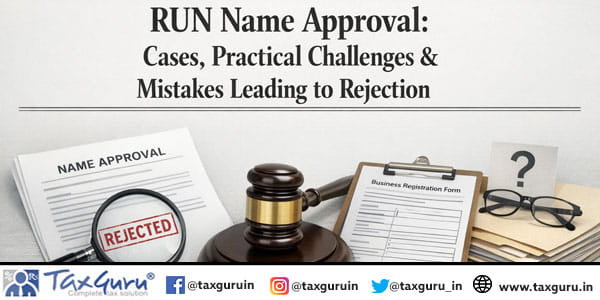
Over a period of handling multiple applications and reviewing CRC remarks, it becomes evident that approval is not merely dependent on availability of name, but on a combination of regulatory checks, practical interpretation, and proper structuring.
Based on such practical experiences and resubmission observations, this article attempts to decode the common challenges, mistakes, and key considerations involved in RUN name approval.
Trademark Conflict – The Silent Deal Breaker
Trademark conflict remains one of the most common yet often overlooked reasons for rejection of RUN applications. In several practical instances, proposed names have been rejected despite the MCA auto-check reflecting no apparent issue. CRC remarks in such cases clearly indicate that the proposed name includes a registered trademark and require submission of NOC along with PAN of the authorized signatory. This highlights the importance of conducting an independent trademark search rather than relying solely on MCA auto-check. Where such conflicts exist, it becomes essential to obtain proper NOC, attach Board Resolution in case of a body corporate, and provide PAN details of both the signatory and the entity.
Restricted Words – More Than Just a Name Choice
Another frequently encountered issue relates to the use of restricted words such as “Group”, “Consortium”, or “Conglomerate”. CRC typically requires submission of a list of entities forming part of such group along with their consent and supporting Board Resolutions. In the absence of an actual group structure and adequate supporting documentation, the use of such words often leads to objections.
Similarly, resemblance with an existing company or LLP name continues to be a significant ground for rejection. Even where there is no exact match, phonetic similarity or close resemblance may result in the proposed name being considered undesirable. Accordingly, conducting a proper MCA search and carefully evaluating the structure of the proposed name becomes essential. In cases where similarity cannot be avoided, obtaining NOC from the concerned entity becomes necessary.
Object Clause & NIC Code – Where Many Go Wrong
Issues relating to object clause and NIC code selection are also commonly observed. CRC remarks often indicate that the proposed objects are too wide, diverse, or unclear, or require clarification regarding their applicability. This underlines the need to ensure that the object clause is specific, aligned with the proposed business activity, and supported by an appropriate NIC code. The alignment between name, object clause, and business activity plays a crucial role in the approval process.
Technical Errors – Small Mistakes, Big Impact
On the technical side, errors such as filing multiple RUN applications through different SRNs for the same purpose are also flagged, as such duplication is not permitted. Maintaining consistency and filing through a single SRN is therefore important.
Documentation Gaps – The Most Avoidable Errors
Documentation gaps further contribute to resubmission remarks. Missing PAN, improperly executed NOC, or absence of Board Resolution are common issues that can delay approval. Even minor deficiencies in documentation can result in resubmission, indicating that accuracy and completeness of attachments are critical.
When Issues Combine – Complex Rejections in Practice
In certain cases, rejections arise from a combination of multiple issues — for instance, trademark conflict, resemblance with existing companies, and use of restricted words together. Such complex remarks demonstrate that CRC scrutiny is not merely procedural but involves detailed evaluation of multiple parameters. These situations also highlight that even small gaps, when combined, can lead to outright rejection instead of simple resubmission.
Practical Takeaways – What Actually Matters
From a practical standpoint, it becomes evident that RUN name approval is not merely a preliminary formality but requires careful consideration, strategic drafting, and regulatory alignment. Trademark conflict remains the primary reason for rejection, MCA auto-check alone is insufficient, object clause and NIC alignment are critical, documentation must be precise, and CRC review is detailed and case-based. A well-prepared RUN application can significantly reduce resubmissions, avoid delays, and ensure smoother execution of the process.