The National Financial Reporting Authority (NFRA), under Section 132 of the Companies Act, 2013, conducted an audit quality inspection of a chartered accountant firm and identified significant deficiencies in its quality control systems and audit practices. The inspection revealed gaps in independence verification, client acceptance procedures, documentation of consultations, time reporting, and internal monitoring mechanisms, indicating non-compliance with SQC 1 and auditing standards. At the engagement level, serious lapses were observed in audit documentation, revenue verification, related party transactions, impairment assessment, going concern evaluation, and reliance on management representations without sufficient evidence. The firm also failed to properly document materiality judgments, external confirmations, and audit conclusions, raising concerns about audit quality and reliability. While the firm acknowledged several deficiencies and committed to improvements, NFRA emphasized the need for robust documentation, independent verification, and stronger governance to ensure compliance with auditing standards and enhance audit quality.
National Financial Reporting Authority
INSPECTION REPORT 2024
Audit Firm: M/s Umamaheswara Rao & Co.
Firm Registration No. 004453S
Inspection Report No. 132.2.2024-07
March 27, 2026
National Financial Reporting Authority
7th Floor, Hindustan Times House
18-20, Kasturba Gandhi Marg
New Delhi 110001
https://nfra.gov.in
PART A
Executive Summary
Section 132 of the Companies Act 2013, inter alia, mandates National Financial Reporting Authority (NFRA) to monitor compliance with Auditing Standards, to oversee the quality of service of the professions associated with ensuring compliance with such standards, and to suggest measures required for improvement in quality of their services. Under this mandate, NFRA initiated audit quality inspection of the Chartered Accountant firm M/s Umamaheswara Rao & Co. in September 2025. The scope of the inspection included a review of firm-wide quality controls to evaluate Audit Firm’s adherence to SQC1 and review of selected Audit Documentation of the annual statutory audit of financial statements for the year ending 31.03.2023 and 31.03.2024. Two focus area, namely Revenue Recognition and Loans & Advances, and one engagement specific area selected based on risk, were taken for inspection in each audit engagement. The on-site inspection was carried out during the month of December 2025.
During the inspection, the Inspection Team held discussions with the Audit Firm personnel, reviewed policies and procedures and examined documents to arrive at the prima facie observations. These observations were discussed with and conveyed to the Audit Firm. After examining the replies of the Audit Firm, NFRA conveyed a draft inspection report to the Firm on 16.02.2026. The replies and documents submitted by the Audit Firm have been examined and this report is issued. This public version of the final inspection report excludes confidential or proprietary information, as pointed out by the Audit Firm. The key observations in this report are summarised as follows:
The key observations in the Final Inspection Report, pertaining to the requirements of SQC 1 are summarised as follows.
a. Annual partner-level independence verification was limited to the review of Partner’s Income Tax Return (ITR) only, which does not meet comprehensively the requirements of Section 141 (3) of the Companies Act, 2013. Independence confirmations with respect to Auditors’ experts were also not consistently obtained and documented by the Firm.
(Para 12-17)
b. The Firm maintains policies regarding acceptance and continuance of the audit engagements through the checklists; it is seen that the Firm relies on client referrals for client acceptance without independent corroboration. The process can be improved to strengthen integrity assessments.
(Para 18-20)
c. The Firm’s consultation policies identify the panel of external experts; however, consultations were informal and undocumented. Responsibility to appoint EQCR is also not appropriately laid out. Physical access controls of the archived Audit files though partly implemented, are not being uniformly applied in all branches.
(Para 21-24)
d. Time sheets detailing the deployed engagement time were not maintained in the audit files. In the absence of such documentation, evidence regarding allocation of time, effort and supervision exercised by the engagement team over various audit areas is not verifiable from the audit files.
(Para 25-27)
e. Firm’s criteria regarding personnel compensation inter alia include “client acquisition and feedback”, which may create risks to auditor independence and objectivity. This may be revised to make it in compliance with SQC 1.
(Para 28-30)
f. Monitoring at the firm level, including internal inspections, is documented as checklist only, without any planned design rationale. The absence of the action taken on inspection reports and exclusion of some partners from internal inspection is also seen.
The Firm may strengthen its monitoring mechanism.
(Para 31-32)
Summary of findings regarding Audit Engagements
A. Company A (FY 2023-24)
Review of the audit documentation of Company ‘A’ indicated certain areas for improvement across key aspects of the audit, including going concern assessment, use of management experts, revenue verification, CARO reporting, evaluation of Internal Financial Controls, and auditor’s reporting.
(Para 33-35; 39-48)
B. Company B (FY 2023-24)
The audit reflects gaps in documentation and evidentiary support across areas such as revenue, related-party advances, investments, trade receivables, and disclosures.
(Para 36-38; 49-56)
C. Company C & D (FY 2022-23)
The Companies C & D being group companies and auditors being Principal Auditor for the group, insufficiencies noted in audits were in respect of documentation of materiality judgments, appointment and evaluation of EQCR workings, documentation of consultations undergone, assessment of contingent liabilities, audit procedures to assess the borrowings, impairment assessment of investments in subsidiaries and failure to obtain External Confirmations.
(Company C: Para 57-69; Company D
Para: 70-77)
Inspection Overview
1. Section 132 of the Act, inter alia, mandates NFRA to monitor compliance with Auditing Standards, to oversee the quality of service of the professions associated with ensuring compliance with such standards, and to suggest measures required for improvement in the quality of their services. The relevant provisions of NFRA Rules, 2018 prescribe procedures for this, including the evaluation of the sufficiency of the auditor’s quality control system and the manner in which the auditors document the quality control procedures. Under this mandate, NFRA initiated audit quality inspections in September 2025 of the Audit Firm. The overall objective of audit quality inspections is to evaluate compliance of the Audit Firm / Auditor with auditing standards and other regulatory and professional requirements, and the sufficiency and effectiveness of the quality control system of the Audit Firm / Auditor, including:
(a) adequacy of the governance framework and its functioning;
(b) effectiveness of the firm’s internal controls over audit quality; and
(c) system of assessment and identification of audit risks and mitigating measures
2. Inspections involve a review of the quality control policy, review of certain focus areas, test check of the quality control processes, and test check of audit engagements performed by the Audit Firm during the selected Inspection year.
3. Inspections are intended to identify areas and opportunities for improvement in the Audit Firm’s system of quality control. Inspections, however, are not designed to review all aspects and identify all weaknesses in the governance framework or system of internal control or audit risk assessment framework and are also not designed to provide absolute assurance about the Audit Firm’s quality of audit work. In respect of selected audit assignments, inspections are not designed to identify all the weaknesses in the audit work performed by the auditors in the audit of the financial statements of the selected companies.
4. Inspections are intended to identify areas and opportunities for improvement in the Audit Firm’s system of quality control. Inspection reports are also not intended to be either a rating or a marketing tool for Audit Firms.
Audit Quality Inspection Approach
5. Selection of Audit Firms for the inspections for the FY 2022-23 and FY 2023-24 was to assess quality control in the firms other than top six firms, based upon the extent of public interest involved, as evidenced by the size of the firm, its composition and nature, the number of audit engagements of NFRA entities completed in the year under review, complexity and diversity of preparer’s financial statements (henceforth, Companies) audited by the firm and other such risk indicators. M/s Umamaheswara Rao & Co. was one of the Audit Firms selected as per the above parameters.
6. The selection of individual audit engagements of the Audit Firm was largely risk-based, using financial and non-financial risk indicators identified by NFRA. Accordingly, the Audit Files in respect of four (4) Audit Engagements relating to the statutory audit of financial statements for the year ending 31.03.2023 and 31.03.2024 were reviewed during the inspection. All four companies are dealing in power sector.
7. The scope of the inspection of M/s Umamaheshwara Rao & Co. was as follows:
a. Review of firm-wide quality controls to evaluate the Audit Firm’s adherence to SQC 1, Code of Ethics and the applicable laws and rules. The inspections of the Audit Firm for the FY 2022-23 and FY 2023-24 covered elements of the firm’s quality control system, including independence, governance structure regarding acceptance and continuation of audit clients, human resources, engagement quality control and the Audit Firm’s internal quality inspection program.
b. Review of individual Audit Engagement Files- A sample of four (4) individual audit engagement files pertaining to the annual statutory audit of financial statements for the year ending 31.03.2023 and 31.03.2024 were selected. Three significant audit areas were to be covered in respect of each audit engagement viz., Revenue Recognition, Loans and Advances, due to their inherent higher risk of material misstatement and one engagement specific focus area.
c. The selected sample of four individual audit engagements is not representative of the Firm’s total population of the audit engagements completed by the Firm for the years under review.
Inspection Methodology
8. An entry meeting was held with Ws Umamaheswara Rao & Co. on 11.09.2025 at NFRA office. The Firm presented an overview of the Governance and Management Structure, Firm-wide System of Quality Control, their audit approach and methodologies, including IT Systems. The on-site inspection was carried out in the month of December 2025. The inspection methodology comprised meetings, walkthroughs, presentations and interviews with certain members of the leadership team as well as the Engagement Teams of the selected audit engagements.
9. The areas of weaknesses or deficiencies on the part of the Audit Firm, included in the inspection reports, should be understood as areas of potential improvement and not a negative assessment of the work of the Audit Firm unless specifically indicated otherwise.
Audit Firm’s Profile
10. M/s Umamaheswara Rao & Co., having six branch offices with head office situated at Hyderabad, and has 14 partners. The Firm was statutory auditor of 244 and 219 entities during FY23 and FY24 respectively. Four of these Company audits were selected for review and deficiencies were observed.
Acknowledgement
11. NFRA acknowledges the general co-operation extended by M/s Umamaheswara Rao & Co. during the inspection.
PART B
Review of Firm-Wide Audit Quality Control System
Observations regarding the Audit Firm’s quality policies and on the application of the quality policies based on a review of sample audit engagements are discussed below. Any deviation of the Firm’s policy from the applicable law or any deviation in the application of the Firm’s policy in practice is reported.
A. Independence
Al. Inadequate Independence Verification of the Engagement Teams
12. The firm verifies annual independence confirmations through partners’ ITR-based investment checks. We note that the engagement team members other than partners should also be checked for independence requirements. Further, ITR based verification is quite limiting in nature, as it does not comprehensively present all the investments undertaken by the engagement team members.
13. In response, the Firm submitted that, considering the limited number of listed entity audits undertaken and the small size of the Firm, verification of partners’ ITRs along with written declarations is sufficient, and in line with its quality policies. The Firm further stated that these controls were reasonable during the period under review, and without prejudice agreed to further strengthen its procedures on a prospective basis.
14. We observe that although the Firm’s client portfolio predominantly comprises unlisted public and private companies, however, the procedure followed by the Audit Firm for annual independence check is not as per the requirements of Section 141(3) of the Companies Act, 2013. The Firm should adopt, implement and document a comprehensive independence verification framework applicable to all the engagements, irrespective of listing status, in accordance with the requirements of Companies Act, 2013 and SQC 1.
A.2 Inadequate Independence Verification of the Auditors’ Expert
15. Independence declarations are not obtained from all the experts working on Engagement. It was noticed that there are instances where EP has taken consultations on audit engagements from empaneled audit experts, however, the Independence requirement was neither checked nor documented before consultations. This is not in compliance with the requirements of SQC 1. The absence of such documentation raises concerns regarding identification and evaluation of independence threats before availing expert consultations.
16. The Firm acknowledged that documentation relating to evaluation of independence threats in respect of experts engaged on audit assignments was inadequate and agreed to strengthen its processes.
17. The Firm is required to establish policies and procedures to identify, evaluate, and document threats to independence due to the Auditors’ Expert, and the safeguards are appropriately applied.
B. Client Acceptance and Continuance Policies
18. The Firm has a documented policy and framework for acceptance and continuance of client relationships, supported by standard checklists. However, it is noted that the Firm relies heavily on referrals and partner judgement, and do not check and document the client integrity. In the absence of independent background checks or external verification, the integrity assessment process lacks objectivity.
19. The Audit Firm submitted that, as its assurance practice largely involves unlisted entities and engagements obtained through referrals, such referrals are evaluated based on the referrer’s standing and partner judgement, along with an understanding of the client’s business and regulatory environment. Without prejudice to the above, the Firm acknowledged the need to further strengthen its integrity assessment framework through additional independent corroborative procedures and enhanced documentation and stated that it would refine its processes on a prospective basis.
20. We note that while the Firm has documented policies, checklists, and Managing Partner oversight, however, these do not replace the need for independent and objective verification. The Firm needs to strengthen its acceptance and continuance process and improve documentation of judgements taken.
C. Engagement Performance
Deficiencies in Engagement Performance, Consultation Documentation and EQCR Governance
21. On review of the Firm’s policies and engagement performance practices and discussion with Engagement Partners on consultation, it was observed that although the Firm’s Audit Manual specifies list of internal and external consultation experts for specialized audit and accounting matters, consultations are conducted informally and no related documentation was found in the audit files. Further, while the audit quality manual lists the partners eligible to act as Engagement Quality Control Reviewers (EQCRs) based on qualifications and experience, the manual does not clearly define the authority and process for selection and appointment of the EQCR. Audit files are maintained in hard copy form, and while certain branch offices have physical access controls, such controls are absent in some of the branches. These deficiencies indicate that the Firm’s engagement performance practices are not fully aligned with the requirements of Paragraphs 46-85 of SQC 1.
22. The Firm acknowledged the gap in documentation of its consultations and stated that, where complex or significant matters arise, consultations are undertaken by the engagement partner or senior team members with identified experts based on professional judgement and circumstances of the engagement. The Firm further noted that such consultations were informal and not consistently documented during the period under review, and submitted that post the exit meeting with NFRA, measures have been initiated to strengthen documentation in this regard.
23. With respect to the selection and appointment of the EQCR, the Firm acknowledged that its EQCR Policy did not explicitly specify the authority responsible for such appointments for individual engagements. The Firm submitted that, in practice, EQCR appointments were determined at the partner level, considering the nature of the engagement, independence requirements, and availability of suitably qualified partners. To enhance clarity and consistency, the Firm has strengthened its policy framework to explicitly designate the Managing Partner as responsible for the formal selection and appointment of the EQCR prospectively.
24. The Firm acknowledged that physical access controls of the archived audit files, though implemented in most branches, were not uniformly applied. The Firm has submitted that it will strengthen and standardize physical access control measures across all the branches on a prospective basis, including storage of audit files in restricted-access areas with defined branch-level responsibility and oversight, to ensure consistency in documentation security practices.
D. Human Resource
D1. Absence of Documentation in respect of Time Reporting by Engagement Team
25. As per the Firm’s Audit Quality Manual, the engagement team is required to maintain Time Reports documenting time spent on each engagement, nature of work and audit areas covered. However, during inspection, it was observed that the audit files reviewed did not contain Time Reports. In the absence of such documentation, evidence regarding allocation of time, effort and supervision exercised by the engagement team over various audit areas is not verifiable from the audit files.
26. In response, the Firm acknowledged the gap and submitted that, although prescribed in the Audit Quality Manual, engagement execution and supervision during the period under review primarily relied on direct partner involvement, and therefore, Time Reports were not consistently prepared. The Firm acknowledged the importance of Time Reporting and committed to strengthen its implementation prospectively.
27. While noting the Firm’s submissions, we observe that Paragraphs 36-45 of SQC 1 require the Firm to establish procedures to ensure adequate competence, capability and supervision of engagement teams. Time Reports provide objective evidence of staff deployment, time allocation and supervision, and their absence impairs the Firm’s ability to establish compliance with the requirements of SQC 1.
D2. Compensation Framework and Potential Risks to Independence
28. As per the Firm’s Audit Quality Manual, the firm’s personnel compensation system, inter alia, includes factor such as “client acquisition and feedback”. While it may be intended to promote professional excellence, inclusion of client-related parameters may create risks to auditor independence and objectivity by potentially incentivizing commercial considerations over audit quality and professional judgement.
29. In response, the Firm submitted that its compensation framework primarily emphasizes audit quality, technical competence, ethical compliance and monitoring outcomes, and is not intended to impair independence. The Firm further submits that its policies expressly state that commercial considerations shall not override the quality of the audit, however, noted observation for improvement in policy documents.
30. While noting the submission, we observe that inclusion of such parameters, even if not applied, may give rise to perceived independence risks. As per SQC 1 and SA 220, remuneration policies must promote audit quality, ethical compliance and independence. The Firm has committed to revising its Manual in this regard.
E. Monitoring
Inadequate Documentation and Follow-up of Internal Inspections
31. The firm claimed that they had conducted internal inspections. However, it comprised only of a checklist, without having any documentation of scope of inspections, basis for selection of engagements, partner coverage, communication of identified deficiencies, corrective actions taken, updates to policies and procedures, and root cause analysis. Further, the exclusion of certain partners from the inspection process and the absence of an action-taken report indicate weaknesses in policy framework, firm wide controls, documentation and follow-up of the outcome of the inspections. These observations indicate non-compliance with the requirements of paragraphs 89-93 of SQC 1.
32. The Firm acknowledged the observation and confirmed that internal inspections were carried out as part of its monitoring activities under SQC 1. However, it accepted that documentation as per the requirements of SQC 1 was not comprehensively maintained during the period under review. The Firm submitted that, considering its size and risk profile, it proposes strengthening its monitoring framework on a prospective basis.
PART C
This section discusses deficiencies observed in a few selected audit engagements. The inspection covered four individual audit engagements, and focused on two audit areas viz. Revenue Recognition and Loans & Advances, and one engagement specific issue including e.g. identification and assessment of risk of material misstatement, internal controls, design and execution of audit procedures in response to assessed risk (test of controls, test of details, sample sizes and analytical reviews etc.), accounting estimates, accounting policies, disclosures and evaluation of identified misstatements. The observations are discussed below:
Review of Individual Audit Engagement Files
Audit of Revenue
Company ‘A’ for the FY 2023-24
33. The Company was engaged in thermal power generation. In comparison to the previous year, during FY 2023-24, revenue from operations increased by approximately by 9%, however, cost of fuel consumed declined sharply by about 39%. This unusual trend required heightened audit attention under SA 240 and SA 315, particularly in view of these amounts being more than the materiality levels.
34. In reply, the Audit Firm explained that reduction in fuel costs was due to lower coal prices and an improved coal mix. The Firm also stated that it had examined revenue and fuel costs through analytical procedures and reconciliations in line with SA 240 and SA 520, and no fraud indicators were identified.
35. Contrary to reply, we note that publicly available coal price indices showed an overall increase of about 5% during the period, rather than the reduction in the prices. Further, review of the audit file shows that the documentation largely recorded management explanations. There was no audit evidence of an independent assessment as to whether the unusual trend represented a fraud risk factor or a risk of material misstatement. There was also no clear linkage between the analytical procedures performed and conclusions under SA 240. The explanations for the sharp reduction in fuel costs appear to be post-dated rationalization. The Firm has acknowledged this gap and is committed to improving its documentation on a prospective basis.
Company ’13’ for the FY 2023-24
36. The Company was engaged in the business of thermal based power generation, and vis-a-vis the previous year, in FY 2023-24, its Revenue from operations had significant increase of 43%. Auditor mentioned in its working paper that increase in revenue was due to the higher Plant Load Factor (PLF) and improved power supply under Power Purchase Agreements (PPAs) and regarded Revenue as low risk, being supported by PPAs and Invoices.
37. However, audit file lacked any evidence of performing appropriate audit procedures to assess the significant rise in revenue. This was potentially not in compliance with requirements of SA 230, SA 240, SA 315, and SA 330, as significant revenue fluctuations required documented risk assessment, audit responses, and substantiated conclusions.
38. In response, the Firm stated having performed appropriate procedures regarding revenue recognition, identifying & assessing RoMM and addressing these assessed risks. However, we note that these procedures were not part of the audit file. Firm needs to strengthen its policies and procedures in this regard for the future audits.
Other matters of non-compliances
Company A for FY 2023-24
Audit of Going Concern basis
39. The Company was under Corporate Insolvency Resolution Process (CIRP) from the year 2019 and the financial statements of the FY 2023-24 were prepared on a going concern basis under the direction of the Resolution Professional (RP); however, review of the audit documentation revealed that there was no documented assessment of the projected cash flows, sources of funding, expected outflows, or the feasibility of management’s / RP’s plans, as per SA 570 (Revised).
40. In reply, the Audit Firm stated that its going concern assessment was performed in the context of CIRP, based on continued operations, existence of long-term Power Purchase Agreements, fuel arrangements, surplus cash generation, and that the issuance of a Qualified Opinion reflected uncertainty regarding the outcome of the resolution process rather than assured financial viability; however, Firm acknowledged that detailed cash flow projections for the required period were neither obtained nor documented due to perceived limitations in CIRP cases.
41. We note that, in the absence of such assessment and supporting documentation, the acceptance of the going concern assumption and issuance of a Qualified Opinion were not supported by sufficient appropriate audit evidence, a deficiency which the Firm has accepted. The Firm has committed to strengthen their policies and procedures in this regard for their future engagements.
Matters pertaining to Audit Documentation and Management Expert
42. The Company was involved in multiple legal litigations across different jurisdictions in India, as disclosed in Notes to the financial statements (FS) for FY 2023-24. The auditors stated that legal opinions obtained by the RP from the legal experts had been reviewed by them. However, the audit file did not contain any documentation to evidence that such reviews were actually performed. There was no documented assessment of the competence and objectivity of the legal experts. Further, there was no evaluation as to whether their work was relevant and reliable as audit evidence, as required under paragraph 8 of SA 500. This was particularly important given the significance of litigation matters in a CIRP environment.
43. In response, the Audit Firm stated that these matters were addressed through the ‘Basis for Qualified Opinion’ and ‘Emphasis of Matter’ paragraphs, based on legal advice and disclosures made in Notes to FS, with related assessments carried out under Ind AS 37 and SA 540 in accordance with SA 706.
44. However, the audit file did not contain any assessments of the legal opinions, nor did it show a clear link between the inputs from the experts and the audit conclusions. This shows weakness in the auditor’s ability to decide whether these litigation matters required recognition of a provision or disclosure as a contingent liability. It also raises concerns of non-compliance with SA 500 and SA 230. The Firm has acknowledged this gap and accepted the need to strengthen its audit documentation and approach in future.
Independent Auditor’s Report, CARO and Internal Financial Controls Reporting (ICFR)
45. The Firm issued a Qualified Opinion on the financial statements for FY 2023-24. The Company did not recognize interest costs relating to the pre-CIRP period. Given the magnitude and nature of the unrecognized interest, the decision to issue a Qualified Opinion instead of an Adverse Opinion or a Disclaimer required careful evaluation under SA 705. However, the audit file did not contain performing appropriate audit procedures to assess whether the effects of such non-recognition were pervasive to the financial statements to consider alternative audit opinions.
46. In response, the Audit Firm stated that the matter was evaluated in the context of CIRP, that recognition and enforceability of interest depended on approval of a resolution plan under the Insolvency and Bankruptcy Code, 2016, and that in the absence of an approved plan, the interest amount could not be reliably estimated, and hence it was concluded that the matter was non-pervasive and issued a Qualified Opinion. We note that in the absence of clear and documented reasoning on pervasiveness and alternative opinions, the basis for issuing a Qualified Opinion was not supported by sufficient appropriate audit evidence.
47. In CARO report under Clause (xiii), the audit firm incorrectly reported that the Company was in compliance with Sections 177 and 188 of the Companies Act, 2013, as there was no Board of Directors during CIRP.
48. Additionally, the unmodified opinion on ICFR lacked a valid basis due to absence of documented entity-level controls, risk assessment, and indicators of material weakness.
The Firm has acknowledged the deficiencies in para 45 and 47 and accepted the inspection observations for improvement and future corrective action.
Company B for the FY 2023-24
Inadequacy of audit procedures relating to Related Parties
49. As per the Internal Auditor’s Report, the Company invested by subscribing to 0.05% interest rate Optionally Convertible Debentures (OCD) of a related party. Vide Management Representation Letter (MRL), management had asserted that related party transactions were at arm’s length. The auditor was required to assess it, however, the same was not done.
50. In response, the Firm submitted that it had assessed the risk related to the said related party transaction and performed appropriate procedures to address the risk of misstatement. The Firm, however, acknowledged that this assessment was not documented in the audit file.
51. While noting the Firm’s acceptance of failure to document arm’s length assessment, it is pertinent to note that 0.05% interest to a related party, is an extraordinarily low return which should have required detailed scrutiny. The Firm’s working in this regard is inconsistent with the requirements of paragraph 24 of SA 550, which clearly mandates the auditor to obtain sufficient appropriate audit evidence where management asserts that a related party transaction has been conducted on arm’s length terms. Therefore, Firm needs to strengthen its policies and procedures in this regard for the future audits.
Audit of Trade Receivables
52. On perusal of Note to Financial Statements, it is noted that 63% of trade receivables were due for ‘less than six months’, however, these receivables were not put to Expected Credit Loss (ECL) testing, and no documentation was found justifying the same. Further, 8.4% of the trade receivables were aged between one and two years, but they were also not subjected to any ECL assessment.
53. In response, the Firm stated that the audit team had evaluated management’s ECL methodology, reviewed ageing and customer recoverability, and verified subsequent receipts traced to bank statements and ledgers up to a date close to the audit report, concluding that no additional ECL provision was required. Detailed subsequent receipt schedules and bank extracts were available in soft copy, not included in the audit file, however, demonstrated the same to the inspection team during the onsite inspection. The Firm noted the need to improve documentation of audit workings in future engagements.
54. The auditor claims to have performed the required procedures, however, there was no documentation of the outcome of the work done. Therefore, Firm needs to strengthen its policies and procedures in this regard for the future audits.
Inadequate Disclosures
55. In Note related to Legal Matters, the Company disclosed a legal case with a PSU Co., but did not disclose the amount of the litigation. The auditor clarified that it was disclosed under another Note in the ageing of receivables table. Ind AS 37 requires disclosure of material legal disputes and related receivables to be disclosed clearly and completely. Disclosure of the dispute without quantifying the related receivable, and absence of cross-reference between the notes, results in incomplete and internally inconsistent disclosure, which is not aligned with Ind AS requirements.
56. Firm in its response further stated that the audit team had evaluated the matter through review of legal correspondence, opinions and management’s assessment, and concluded that no provision was required under Ind AS 37 and Ind AS 109. The Firm has acknowledged that explicit disclosure or cross-referencing of the amount in the legal-matter note would have improved consistency and noted to recommend to management clearer cross-reference disclosures in future audits.
Company C for the FY 2022-23
Determination of Materiality
57. As per Audit File, materiality was determined as follows: Planning Materiality (PM): 1% of total assets, Performance Materiality: 60% of PM and a Clearly Trivial Threshold: 5.15% of PM. As per paragraph 14 of SA 320, audit documentation is required to include the determination of materiality for the financial statements as a whole, materiality for specific classes of transactions where applicable, performance materiality, and any revisions to these amounts during the audit. However, the audit file did not contain any working papers supporting the determination of materiality. Specifically, there was no documentation explaining the basis for selecting total assets as the benchmark, the rationale for applying percentages of 1%, 60%, and 5.15%, or the professional judgment exercised in arriving at these thresholds. Consequently, compliance with the documentation requirements of SA 320 could not be evidenced.
58. In response, the Firm stated that total assets were selected as the benchmark considering the capital-intensive nature of the business, consistent with paragraph A3 of SA 320, and that the percentages applied were based on size, risk and internal guidance of the firm. The Firm also acknowledged that these qualitative considerations were not sufficiently documented.
59. While noting the Firm’s explanation, it is observed that the absence of supporting documentation of the rationale and judgements do not meet the documentation requirements of paragraph 14 of SA 320.
Appointment of Engagement Quality Control Reviewer (EQCR)
60. As per paragraph 3.7 on page 7 of Firm’s Quality policy, EQCR reviewer must not be involved in the engagement, and as per page no. 19 of Audit Manual for FY23 of the Firm, the EQCR was to be nominated by the Quality Control Partner of the Firm. However, in the instant engagement, it was observed that instead of the Quality Control Partner of the Firm, the Engagement Partner (EP) decided to have an EQCR and selected the component auditor as the EQCR. The EQCR, being component auditor for 12 subsidiaries of Company ‘C’, would have impaired the objectivity of having the review. This is in violation of provisions of Para 63 of SQC 1 as well as the Firm’s Quality policy.
61. The Firm stated that the EQCR partner was undertaken voluntarily due to group complexity and that a component auditor was selected as EQCR due to familiarity and resource constraints. The Firm acknowledged that this appointment was not in line with its Quality Policy and created an appearance of impaired objectivity and conveyed its full commitment to segregate roles in future. The Firm’s acceptance for future corrective action is noted.
Audit of Contingent Liabilities
62. In the Standalone Financial Statements of the Company, contingent liability of significant amount has been disclosed in the form of corporate guarantees issued in favour of lenders to its subsidiaries. We note from the Consolidated Financial Statements that since FY 2020, several subsidiaries had defaulted on repayment of loan principal and interest in respect of which such guarantees were issued. However, there was no audit documentation evidencing the auditor’s evaluation of whether, considering such defaults, provisions were required to be recognized instead of disclosure as contingent liabilities. Further, it is also noted that few of these subsidiaries were audited by component auditors, other than the Firm. As per paragraph 12 and 18 of SA 600, the Firm being the principal auditor was required to assess and document the procedures adopted by the component auditors to reach significant conclusions, however no audit documentation was found in this regard.
63. In response, the Firm submitted that the corporate guarantees, primarily issued in respect of project-specific subsidiaries, and the audit team had obtained guarantee documents, reviewed compliance with loan terms, and obtained management representations in this regard. Also, the Firm clarified that, out of 28 subsidiaries, only three were audited by other auditors, with the remaining were audited by the Firm itself. The Firm further acknowledged the documentation gaps and undertook to strengthen audit documentation for engagements involving significant guarantees and multiple components by incorporating dedicated working papers evidencing such assessments in future engagements.
64. We observe that the auditor had noted only about the conclusion regarding not having any material impact on the invocation of the corporate guarantees. However, the basis of the said conclusion was not documented, which is not as per the requirements of paragraph 4 of SA 500. Further, in accordance with SA 600 (paragraphs 12 and 18) while considering work of component auditor, the principal auditor is required to obtain sufficient appropriate audit evidence regarding the work of component auditors, regarding procedures performed, and conclusions reached, which is missing in this case. The Firm’s acceptance for future corrective action is noted.
Audit of Borrowings
65. It is noted that during FY23, the Company had short-term borrowings, and therefore they were required to ensure accuracy, authorization, existence, completeness, valuation, rights / obligations, occurrence, cut-off, and classification etc. of the borrowings. However, there is no audit documentation found in this regard.
66. In response, the Firm stated that audit procedures were performed to verify borrowing terms, interest computation, fund receipt, and year-end balance confirmation; however, we do not find outcome of such procedures performed. The Firm further submitted that audit evidence was actually maintained in the audit files of various subsidiaries for which the Firm was the component auditor, but the same was not cross-referenced with the audit files of the holding Company. The Firm has also agreed to future corrective action in this regard, which is noted.
Observations on Impairment Assessment
67. The Company disclosed long-term investments in subsidiaries, of significant amount under non-current assets. Certain subsidiaries had no revenue and had accumulated losses, yet no impairment of these investments was assessed / recognized. Review of the audit file revealed no documentation evidencing assessment of impairment indicators or the basis for concluding that no impairment was required, rendering compliance with impairment evaluation requirements not demonstrable.
68. In response, the Firm submitted that investments comprised of Equity and Compulsorily Convertible Debentures (CCDs), and provision of petty amount for some of the subsidiaries was also made. Most of the subsidiaries were special purpose vehicles with initial-year losses, typical of renewable projects. It also stated that impairment indicators were considered and concluded that no other-than-temporary diminution existed.
69. However, as per SA 230, workings on impairment assessments and conclusions must be adequately documented. The audit file lacked consolidated, cross-referenced evidence supporting the conclusions. The Firm acknowledged the gap and has undertaken to strengthen impairment documentation for future engagements.
Company D for the FY 2022-23
Audit of Advances, Investments and Related Party Transactions
70. The Company gave advances of significant amounts to related parties and also had noncurrent investments in equity, preference shares and CCDs of subsidiaries. Although the EP identified investments and receivables as the key risk areas and included an Emphasis of Matter on “Value of Investments” and “Loans and Advances to Related Parties”, however, the audit file contained no substantive audit working papers for verification of revenue, loans and advances, investments or related party transactions. Only compliance checklists with conclusions were available, without any documentation or supporting evidence, which was not in compliance with the requirements of SA 230 and SA 500.
71. In response, Firm stated that financial statements had disclosed that the Company worked as an intermediate holding and project development entity for wind power SPVs, with assets largely comprising investments in, and advances to, subsidiaries, which are integral to its business model. Notes to the standalone financial statements also disclosed accumulated losses and erosion of net worth of investee companies, which management considered as temporary in nature; accordingly, no provision was recognized and an Emphasis of Matter was included under SA 706 without modifying the opinion. However, it was acknowledged by the firm that these were not adequately cross-referenced. The Firm has also undertaken to strengthen documentation through dedicated working papers in future engagements.
72. The Firm has acknowledged the inspection observation that disclosure and inclusion of an Emphasis of Matter under SA 706 cannot substitute for a documented and evident impairment assessment of investments as required under the applicable financial reporting framework. In the absence of clear, contemporaneous audit documentation of impairment assessment, compliance with audit and accounting requirements cannot be authenticated.
Failure to obtain External Confirmations
73. In respect of external confirmations, the audit file does not evidence that balance confirmation requests were sent or controlled by the auditor, as required under SA 505. Although two confirmations from the Banks were available, these were received by the Company and not directly by the auditor. Similarly, confirmations relating to advances to subsidiaries, interest on CCDs and receivables were initiated by the Company, with no evidence of auditor-controlled dispatch or receipt, and the confirmations also bore the same authorized signatory across different subsidiaries. Accordingly, the confirmation process appears mechanical and not in compliance with the requirements of SA 505.
74. In response, Firm accepted that Banks and certain receivable / loan balances were subjected to external confirmations obtained through the Company. Confirmations for advances to subsidiaries, interest in CCDs and other receivables were sent through the Company, addressed to the auditor and agreed with the books and audited fmancial statements of the respective subsidiaries. The Firm, however, noted the observation and has undertaken to obtain confirmations directly in future engagements.
75. External confirmation requests were sent to and responses received from third parties through the management; rather than being prepared, dispatched, and received under the direct control of the auditor as mandated under Para 7 of SA 505. The EP relied on third party confirmations provided by the management not addressing the fundamental purpose of external confirmations. The Firm needs to strengthen its policies and procedures in this regard for the future audits.
Engagement Quality Control Review (relevant for all the four engagements)
76. Paragraph 63 of SQC 1 and Para 20 & 25 of SA 220 require policies, procedures and practice to be put in place specifying documentation requirements for Engagement Quality Control Reviews. However, the Firm’s quality policy does not prescribe such documentation requirements. Further, in all the four audit files reviewed, EQCR documentation was inadequate, comprising only checklists on independence, ethical compliance, accounting standards and SAs, recording conclusions without documenting the basis viz. the specific working papers reviewed, discussions on significant matters, or the nature and extent of the review. The EQCR sign-off dates were also absent. Accordingly, EQCR documentation requires strengthening to comply with SQC 1 and to adequately evidence the review performed.
77. Firm stated that the EQCR had reviewed the financial statements, audit report drafts, and key working papers relating to material balances and significant risks, and the checklist recorded the documents reviewed and included the EQCR sign-off date. However, the Firm has also acknowledged the inspection observation and undertaken the strengthening of EQCR process and documentation by recording the specific working papers reviewed, discussions on significant matters conducted, and ensuring consistent dating of all the EQCR documents.
Part D
Chronology of Events
| Si. No. | Date | Events/ Correspondence |
|---|---|---|
| 1 | 28.03.2025 | Intimation of On-site Inspection from NFRA to the Audit Firm. |
| 2 | 05.09.2025 | Request sent to provide information for the Pre-Inspection briefmg. |
| 3 | 09.09.2025 | Reminder sent to provide remaining information in connection with the |
| Pre-Inspection briefing. | ||
| 4 | 11.09.2025 | Walkthrough of Firm’s policies, Tools and Technology used by the Firm at NFRA. |
| 5 | 17.11.2025 | Intimation for on-site inspection at Hyderabad. |
| 6 | 11.12.2025 to
19.12.2025 |
Onsite Inspection conducted. |
| 7 | 26.12.2025 | Communication of Inspection Team’s Observation to the Firm. |
| 8 | 09.01.2026 | Response received from UMRC on observations dated 26.12.2025 |
| 9 | 02.02.2026 | Communication of Draft Inspection Report from NFRA to the Audit Firm. |
| 10 | 10.02.2026 | Submission of reply to Draft Inspection Report |
| 11 | 16.02.2026 | Print ready Inspection Report sent for final response. |
| 12 | 19.02.2026 | Final response received on Print Ready Inspection Report. |
| 13 | 27.03.2026 | Publication of Inspection Report on the website of NFRA as per Rule 8 of NFRA Rules 2018. |
Appendix A: Audit Firm’s Response to the Inspection Report
Pursuant to Section 132(2) of the Companies Act, 2013 and Rule 8 of NFRA Rules, 2018, the Authority is publishing its findings relating to non-compliances with SAs and sufficiency of the Audit Firm’s quality control system. As part of this process, the Audit Firm provided a written response to the draft Inspection Report, which is attached hereto. NFRA based on the request of the Audit Firm has excluded the information from this report which was considered proprietary.
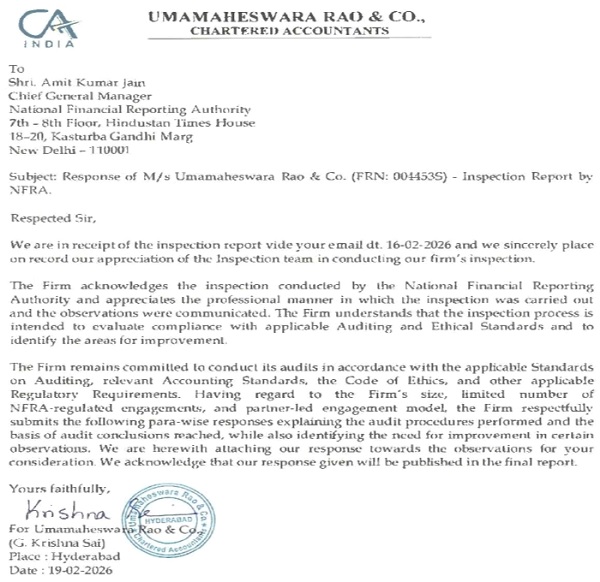
Response to Inspection Report of NFRA
Response to Fans 12-17: Independence Verification of Engagement Teams and Auditors’ Experts
The Firm respectfully submits that during the period under review, annual independence verification was carried out through written declarations and review of partners’ Income Tax Returns and other detailed procedures. These procedures were applied in practice across all engagements. The Firm acknowledges the inspection observations on independence evaluations and undertakes to strengthen its. documentation on a prospective basis.
Response to Pans 18-20: Client Acceptance and Continuance
The Firm notes NFRA’s observation regarding reliance on referrals and partner judgement considering the nature of the entities, industry familiarity, historical association, and prior audit experience. While such assessments were performed, the observation relates to enhanced independent corroboration and clearer documentation for client acceptance. While such assessments were based on professional judgement, the Firm undertakes to improve its framework by incorporating additional independence corroborations from insights in other publicly available data bases- and documenting the same.
Response to Pans 21-24: Engagement Performance and EQCR
Audit engagements were performed under a partner-led model with direct involvement of the Engagement Partner in planning. execution and review. Consultations were undertaken wherever required, appropriate considerations were applied across all the engagements. The observation relates primarily to documentation relating to consultations, EQCR governance and uniformity of controls at certain locations. The Firm has strengthened its policies and documentation practices prospectively.
Response to Pares 25-32 Time Reporting, Compensation Framework, Monitorial& end Internal Inspections
During the period under review, audit supervision and direction were exercised primarily through direct partner involvement While time reporting records were not consistently formalized, supervision was substantively carried. out. Henceforth, the Firm has strengthened its time reporting and documentation mechanisms. The Firm has also enhanced articulation and documentation of safeguards addressing independence considerations. The Firm’s compensation framework is fundamentally anchored in audit quality, technical competence, ethical compliance and monitoring outcomes, and does not impair independence: policy safeguards explicitly state that commercial considerations cannot override the audit quality. The firm has taken necessary steps to further strengthen its monitoring framework.
Response to Paras 33-35: Audit of Revenue – Company A
The audit file evidences analytical procedures supported by verification of (i) Power Purchase Agreement (PPA) schedules, ( ii) generation and dispatch records. (iii) invoice reconciliations, and (iv) detailed coal cost analysis. Publicly available coal price indices shall not be directly comparable to the client’s case in the backdrop of long-term procurement contracts, which resulted in cost efficiencies. The coal cost workings were verified, and the audit conclusion was based on substantive procedures performed and documented, and not solely on management explanations. In the absence of fraud risk indicators, reliance was placed on substantive testing and increase in coal price indices had no bearing in the given circumstances. The Firm notes the observation and will enhance explicit documentation of fraud risk assessment in future engagements.
Response to Paras 36-38: Audit of Revenue – Company B
It is submitted that the Plant Load Factor (P13) is verified through operational data and substantive testing of PPA terms, invoicing sequences and subsequent realizations were fully verified and evidenced through detailed schedules and audit documentation. As suggested, the Firm will specifically record a summary of the audit procedures and further strengthen documentation.
Response to Paras 3941: Audit of Going Concern basis – Company A
As demonstrated from the audit working papers reliance was placed on the operational continuity during the period of Corporate Insolvency Resolution Process (CIRP) like i) power generation ii) long-term PPAs, fuel supply arrangements, and surplus cash generation which satisfy that the operations are carried out on a going concern basis.
In accordance with SA 570 the firm identified events and conditions arising from the Company being under the CIRP and the absence of an approved resolution plan as at the date of audit, which indicated the existence of a material uncertainty relating to going concern and was reported in the Basis of Qualified Opinion Paragraph in the Audit Report However as suggested during the inspection we will strengthen the documentation with reference to recording the Basis of acceptance of the going concern assumption.
Response to Paras 4244: Matters pertaining to Audit Documentation and Management Expert
As demonstrated during the review of the documentation of legal matters many of which were long standing, the matters requiring provision and/or disclosure of contingent liability were recorded during the review of legal matters by the Engagement Partner. Further the matter is appropriately incorporated through the Basis for Qualified Opinion and Emphasis of Matter paragraphs. However, as suggested we will improve the audit documentation in terms of clear linkage between experts’ inputs, audit assessments, and audit conclusions in the working papers.
Response to Paras 45-48: Independent Auditor’s Report, CARO Reporting and Internal Financial Controls Reporting (ICFR)
The Qualified Opinion represented the appropriate audit response to the non-pervasive deferral of CIRP-related interest costs pending outcome of Resolution Plan and was supported by documented risk assessment control testing and audit procedures. The Firm will strengthen documentation articulating the rationale for the audit opinion, consideration of alternative opinions, and. IFCoFR review, including entity-level controls and indicators of material weal mess, in future engagements.
Response to Paras 49-51: Inadequacy of audit procedures relating to Related Parties
The audit team performed procedures to understand the structure. terms and commercial rationale of the OCDs, including review of the debenture subscription agreement, Board minutes and management explanations, and assessed that the transaction had a commercial basis aligned with the Company’s Renewable Energy Obligation. Even though the arm’s length assessment was not captured in a separately identifiable working paper, the procedures performed supported the audit conclusion. The Firm will strengthen documentation to explicitly evidence the arm’s length assessment in future engagements.
Response to Pans 52-56: Audit of Trade Receivables and disclosures
During the audit ageing analysis, review of customer correspondence and disputes, evaluation of management’s recoverability assessment and verification of subsequent receipts and litigations were performed to assess ECL, based on which the Engagement Partner concluded the provision. The Firm will strengthen indexing and archiving of soft-copy audit documentation and improve cross-referencing of disclosures for enhanced clarity in future engagements.
Response to Paras 57-64: Determination of Materiality and Contingent Liabilities
We undertake to strengthen the materiality documentation template to require specific recording of the benchmark considered and reasons for selection/rejection of the specific percentage applied and qualitative factors considered for all future engagements and to further strengthen documentation for engagements involving significant guarantees, contingent liabilities, and multiple components by incorporating separate working papers.
Response to Pares 65.56: Audit of Borrowings
The audit team verified the terms of borrowings, interest calculations, receipt of funds and obtained external confirmation of year-end balance to ensure accuracy of borrowings reflected in the financial statements, as demonstrated during inspection and in audit file. The Firm will consolidate the audit workings into a single cross-referenced working paper to more clearly evidence compliance with the Standards on Auditing in future engagements.
Response to Para 67-72.: Observations on Impair’ meat Assessment, Audit of Advances, Investments and Related Party Transactions
As suggested by the inspection we undertake to strengthen the audit documentation with respect to impairment assessment by maintaining consolidated documentation, cross-referenzing the audit evidences to support the conclusions. It is submitted that the impairment assessment is documented in the audit working papers and audit opinion is arrived at considering the impairment assessment. However, as suggested by the inspection audit documentation will be improved wits regard to the details of the procedures carried out, linking the audit evidences to substantiate in line with Auditing Standards.
Response to Pans 73-75: Failure to obtain External Confirmations
The Firm is totally committed to comply with the Standards on Auditing and related regulatory requirements. The Firm notes the inspection observation and will strengthen its external confirmation procedures to ensure confirmations are obtained and controlled directly by the auditor in future engagements