

Articles by this Author
Income Tax
Income Tax
ITAT Deletes TP Addition as Nokia Shutdown Led to Distress Sale of Finished Goods
Income Tax
Income Tax
ITAT Remands Case as CIT(A) Ignored Survey Findings on Accommodation Entries
Income Tax
Income Tax
Reassessment After 4 Years Quashed as No Failure to Disclose Material Facts: Bombay HC
Income Tax
Income Tax
Agricultural Land Outside Municipal Limits Not a Capital Asset; Section 153C Proceedings Invalid Without Incriminating Material
Income Tax
Income Tax
Replacement of Machinery Giving Enduring Benefit Is Capital Expenditure: Madras HC
Income Tax
Income Tax
Companies with significantly higher turnover are not comparable: ITAT Bangalore
Income Tax
Income Tax
ITAT Visakhapatnam Quashes Reassessment as Section 148 Notice Time-Barred
Income Tax
Income Tax
United Spirits Case: Remand in TP Case Does Not Extend Section 153 Limitation
Income Tax
Income Tax
Assessment on Non-Existent Entity Held Void; ITBA Glitch Not a Valid Defense: Delhi HC:
Income Tax
Income Tax
No Section 270A(8) Penalty for TP Adjustment Without Proof of Deliberate Concealment: Madras HC
Income Tax
Income Tax
Corporate Restructuring Not a Sufficient Cause for 802-Day Delay u/s 253(3): ITAT Panaji
Income Tax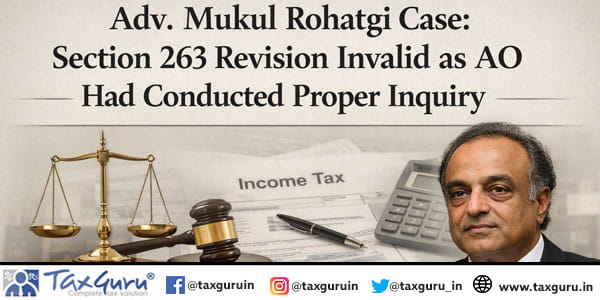
Income Tax
Adv. Mukul Rohatgi Case: Section 263 Revision Invalid as AO Had Conducted Proper Inquiry
Income Tax
Income Tax
Reassessment Solely on Audit Objection Invalid; Rule of Law Overrides Revenue Considerations: Delhi HC
CA, CS, CMA
CA, CS, CMA

