The RCM-Refund Model: A Comprehensive Constitutional Solution to ITC Conundrum under Section 16(2)(c)/16(2)/74A/76/Rule 86(b) of CGST Act and as a Vested Right
Introduction
The Goods and Services Tax (GST) regime, envisioned as a unified and efficient indirect tax system, fundamentally relies on the seamless flow of Input Tax Credit (ITC). This mechanism, designed to eliminate the cascading effect of taxes, is the bedrock upon which the entire structure of GST rests. However, Section 16(2)(c) of the Central Goods and Services Tax Act, 2017 (hereinafter referred to as “the CGST Act”), has emerged as a significant impediment to this foundational principle, creating a jurisprudential quagmire that has led to widespread litigation and commercial distress. This provision makes a recipient’s entitlement to ITC conditional upon the supplier’s actual remittance of the collected tax to the government exchequer. Consequently, bona fide purchasers, who have diligently paid the tax to their suppliers, find themselves in an untenable “Catch-22” situation, being penalized for the fiscal delinquency of a third party over whom they have no control.
This article delves into the profound constitutional and commercial challenges posed by Section 16(2)(c) and proposes a radical yet pragmatic solution: a mandatory shift to a Reverse Charge Mechanism (RCM) coupled with a direct refund system for all business-to-business (B2B) transactions. It is contended that this “RCM-Refund” model not only resolves the inherent constitutional infirmities of the current system but also aligns with the strategic litigative approach of “Last Hour Therapy,” offering a constructive and viable alternative to the judiciary and the legislature.
- I. The Statutory Framework of ITC under Section 16 of CGST Act, 2017
- II. Crystallization of ITC into a Vested Right
- III. Evidentiary Supremacy of Bank Transactions
- IV. ITC under GST regime is a mere concession not fully a substantive, vested right its conditional
- V. Proposed Panacea: RCM-Refund Model – A Detailed Exposition
- VI. Mechanism:
- VII. Resolution of Legal Conflicts:
- VIII. Comparison of Current vs. Proposed Mechanism
- IX. "Last Hour Therapy": A Strategic Imperative in Constitutional Litigation
- X. Addressing Practical Hurdles and Mitigating Risks
I. The Statutory Framework of ITC under Section 16 of CGST Act, 2017
Section 16 of the CGST Act is the cornerstone of the ITC mechanism, meticulously laying down the eligibility criteria and conditions for its availment. Section 16(1) establishes the fundamental entitlement of every registered person to take credit of input tax charged on any supply of goods or services, which are used or intended to be used in the course or furtherance of their business. However, this entitlement is subject to the conditions and restrictions stipulated in Section 16(2). These conditions are cumulative and must be satisfied for a valid claim. They include: (a) possession of a tax invoice or debit note; (b) receipt of the goods or services; (c) the tax charged in respect of such supply has been actually paid to the Government, either in cash or through utilization of ITC; and (d) the registered person has furnished the return under Section 39. The judiciary has consistently held that the availment of ITC is contingent upon adherence to these statutory mandates, as the credit itself is a benefit conferred by the statute as discussed in Union of India vs Vkc Footsteps India Pvt. Ltd..
Furthermore, the second proviso to Section 16(2) introduces a crucial condition related to the payment of consideration. It mandates that where a recipient fails to pay the amount of consideration for the supply, along with the tax payable thereon, to the supplier within a period of one hundred and eighty days from the date of issue of the invoice, an amount equal to the ITC availed by the recipient shall be added to their output tax liability, along with interest. This provision underscores the legislative intent to link the benefit of ITC with the actual completion of the commercial transaction, which includes the payment of consideration. The Supreme Court has affirmed that such conditions imposed by the legislature for availing tax benefits are within its legislative competence and must be strictly construed M/S Radha Krishan Industries vs The State Of Himachal Pradesh. Therefore, demonstrating that payment has been made to the supplier is not merely a procedural formality but a substantive condition for the retention of ITC.
II. Crystallization of ITC into a Vested Right
While the eligibility to claim ITC is governed by statutory conditions, once a taxpayer meticulously complies with these conditions, the credit transitions from a conditional benefit to a vested property right. A vested right is one that is absolute, complete, and not contingent upon any future event. When a recipient is in possession of a valid invoice, has received the goods, and has paid the consideration (including tax) to the supplier, their entitlement to the credit becomes indefeasible. The Gujarat High Court, in a landmark decision, has extensively deliberated upon the nature of ITC, holding that the right to credit under the GST regime is a substantive right that cannot be denied unless the conditions stipulated are not fulfilled Synergy Fertichem Pvt.Ltd vs State of Gujarat. Any subsequent action by the tax authorities to deny or reverse such credit must be based on concrete evidence of non-compliance by the recipient, not on the default of a third party, such as the supplier.
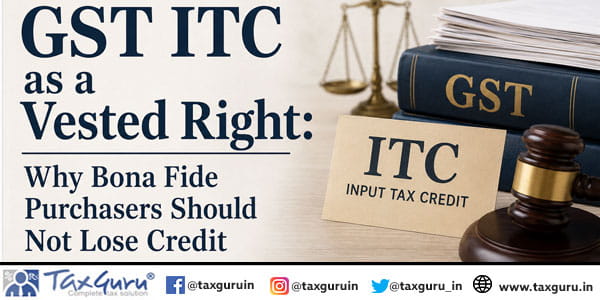
The argument that ITC is a vested right is further fortified by the principles of constitutional law. Article 300A of the Constitution of India provides that no person shall be deprived of his property save by authority of law. Once ITC has been validly availed and reflected in the Electronic Credit Ledger, it assumes the character of property. Denying this credit to a bona fide recipient, who has fulfilled all their statutory obligations, for the fault of a defaulting supplier (who has failed to remit the tax to the government) would be arbitrary and violative of Article 14 of the Constitution. The entire architecture of GST, as explained by the Supreme Court, is to create a unified economic system based on a seamless flow of credit, and any interpretation that obstructs this flow for a compliant taxpayer would undermine the very object of the law Union of India vs M/S Mohit Minerals Pvt. Ltd.. Therefore, the recipient’s fulfilment of conditions, particularly the payment of consideration, is the defining event that crystallises the right to ITC.
III. Evidentiary Supremacy of Bank Transactions
In the context of fulfilling the conditions under Section 16, payment made through a banking channel (such as NEFT, RTGS, IMPS, or cheque) provides an unimpeachable and auditable trail of the transaction. It serves as conclusive evidence that the recipient has discharged their obligation towards the supplier, thereby satisfying the second proviso to Section 16(2). This documentary evidence is paramount in disputes where the tax authorities seek to deny ITC on the grounds that the supplier has not paid the tax to the government. The Madras High Court has observed that the department cannot reverse ITC from a recipient without a proper inquiry into the supplier’s actions and without establishing any collusion on the part of the recipient, M/S. Jayachandran Alloys (P) Ltd vs The Superintendent Of Gst And Central. A bank statement reflecting the payment to the supplier is the strongest piece of evidence a recipient can produce to demonstrate their bona fides and shift the onus of recovery onto the defaulting supplier.
The use of banking channels for payment effectively negates any allegation of the transaction being a mere paper entry or a sham arrangement designed to fraudulently avail ITC. It establishes the genuineness of the underlying supply and the flow of consideration, which are the twin pillars of a valid commercial transaction. In the erstwhile tax regime, courts have consistently held that rights that have accrued to an assessee cannot be taken away arbitrarily, and this principle holds strong in the GST era, Filco Trade Centre Pvt. Ltd vs Union Of India. By making payment through a bank, the recipient not only complies with the statutory mandate but also creates a robust evidentiary shield against potential challenges from the revenue authorities, thereby securing their vested right to the input tax credit.
IV. ITC under GST regime is a mere concession not fully a substantive, vested right its conditional
Input Tax Credit under the GST regime is not a mere concession but a substantive, vested right that accrues to a registered person upon the fulfilment of the conditions prescribed in Section 16 of the CGST Act. While the law imposes strict conditions for its availment, these are meant to ensure the integrity of the tax system, not to penalize bona fide taxpayers. The act of making payment to the supplier through a verifiable banking channel is a critical step that provides conclusive proof of the recipient’s compliance and the genuineness of the transaction. It solidifies the recipient’s claim and transforms the conditional entitlement into an absolute right. The judiciary has consistently leaned towards protecting the interests of a compliant recipient, holding that the onus of tax remittance lies with the supplier, and the recipient cannot be made to suffer for the supplier’s default. This principle is a cornerstone of tax jurisprudence, ensuring that a taxpayer’s vested rights are not unjustly defeated by the actions of another party M/S. N.C. Alexender vs The Commissioner Of Customs. Therefore, as long as a recipient can demonstrate, through evidence such as bank statements, that they have paid the consideration and complied with all other conditions, their vested right to Input Tax Credit must be upheld, ensuring that the foundational promise of GST as a seamless and efficient tax system is realized.
V. Proposed Panacea: RCM-Refund Model – A Detailed Exposition
The proposed remedy involves a fundamental re-engineering of the tax payment and credit availment process, offering a systemic solution to the constitutional and commercial challenges. Under this “RCM-Refund” model, for all B2B transactions, the primary responsibility to pay the GST shifts from the supplier to the recipient via the Reverse Charge Mechanism.
VI. Mechanism:
Direct Payment by Recipient: The recipient of goods or services would directly deposit the applicable GST amount into the government’s cash ledger. This payment would be made at the time of supply, as per the existing RCM provisions.
Subsequent Refund Claim: Immediately upon making this direct payment, the recipient would be entitled to claim this amount as an Input Tax Credit or seek a direct refund, depending on their tax liability and business operations. The credit would be available without any condition related to the supplier’s compliance.
VII. Resolution of Legal Conflicts:
This structural shift offers a comprehensive resolution to the core legal conflicts inherent in the current system:
Elimination of the “Impossible Demand”: By making the recipient the primary taxpayer, the model completely eliminates the “impossible demand” of guaranteeing the supplier’s compliance. The recipient’s right to credit becomes absolute and indefeasible the moment they remit the tax directly to the government. This severs the problematic linkage between a supplier’s default and a recipient’s ITC, rendering the recipient functus officio once their direct payment obligation is discharged.
Resolution of Agency Conflict and Prevention of Unjust Enrichment: The RCM model removes the State’s reliance on suppliers as collection agents for B2B transactions. The recipient becomes the direct payer, and the State’s revenue is secured directly from the ultimate claimant of the credit. This prevents any possibility of “double dipping” and ensures that the State’s revenue is collected efficiently and equitably.
Alignment with Article 14: The RCM-Refund model inherently distinguishes between compliant and non-compliant recipients. A recipient who pays the tax directly to the government is unequivocally compliant and is entitled to their credit. This eliminates the arbitrary treatment of bona fide and fraudulent purchasers, thereby upholding the principle of equality.
Transformation of ITC into a Vested Right (Article 300A): A crucial aspect of this model is the use of the cash ledger for tax payment. When a recipient pays tax directly into the cash ledger, the subsequent credit is no longer a “concession” or “rebate,” a characterization often used by the Revenue to justify stringent conditions. Instead, it becomes a direct refund or adjustment of tax already paid, strengthening the argument that ITC is a vested right or property protected under Article 300A of the Constitution. The credit arises from the recipient’s own payment, making it an undeniable entitlement.
VIII. Comparison of Current vs. Proposed Mechanism
| Feature | Current System (Forward Charge) | Proposed System (RCM + Refund) |
|---|---|---|
| Payment Responsibility | Buyer pays supplier; Supplier pays State. | Buyer pays State directly (RCM). |
| Risk of Default | Borne by the Buyer (ITC reversal). | Borne by the State (only if the buyer fails to pay RCM). |
| Legal Status | Buyer is a “guarantor” for supplier. | Buyer is functus officio upon payment. |
| State Enrichment | Potential for “Double Dipping” (from supplier and recipient). | Single taxable event; no double recovery. |
| ITC Nature | Often viewed as a concession, subject to supplier compliance. | Vested right, arising from direct payment by the recipient. |
| Compliance Burden | Buyer must verify supplier compliance, leading to uncertainty. | Buyer’s compliance is direct and verifiable, reducing uncertainty. |
IX. “Last Hour Therapy”: A Strategic Imperative in Constitutional Litigation
The RCM-Refund proposal is more than a mere policy suggestion; it represents a potent and sophisticated strategy in constitutional litigation, best described as “Last Hour Therapy.” This approach involves presenting the court with a workable, constitutionally sound alternative when challenging a statutory provision. Instead of solely arguing for a provision to be struck down—an action courts are often reluctant to take due to the risk of creating a legislative vacuum—this strategy provides a constructive pathway forward.
By proposing the RCM-Refund model, the litigant demonstrates that the objective is not tax evasion but the establishment of a fair, efficient, and constitutionally compliant tax system. It reframes the legal challenge from a purely negative (“this law is unconstitutional”) to a positive one (“this law is unconstitutional, and here is a better, constitutional way to achieve the same legislative objective”). This proactive stance is judicially appealing as it assists the court in moulding the relief. It moves beyond the “read down” approach, as seen in various High Court judgments, which provide relief on a case-by-case basis, and instead offers a permanent, systemic fix that the judiciary can recommend for legislative consideration. This approach empowers the courts to act as guardians of the Constitution while simultaneously facilitating legislative reform, thereby ensuring that the spirit of GST is upheld.
X. Addressing Practical Hurdles and Mitigating Risks
While the RCM-Refund model presents a robust legal solution, it is imperative to acknowledge and address the practical challenges associated with its implementation.
a. Working Capital Strain: The primary concern is the potential strain on the working capital of businesses, as funds would be paid to the government upfront and claimed back later. While this is a legitimate concern, it must be weighed against the current alternative of arbitrary and complete denial of ITC, which often leads to far greater financial distress and litigation. The strain can be significantly mitigated by implementing a statutorily mandated, time-bound, and automated refund process. Provisions for interest on delayed refunds, similar to existing GST refund mechanisms, would further alleviate this concern. Such a restriction, if reasonable and temporary, is far more likely to pass the test of Article 19(1)(g) than the current impossible condition.
b. Administrative Burden: Shifting to a universal RCM model would undoubtedly increase the administrative burden on the Revenue, which currently relies on millions of suppliers as its collection agents. It would require processing a vastly larger number of direct payments and subsequent refunds. However, in an era of advanced data analytics, artificial intelligence, and a robust technological backbone like the GSTN, this is a surmountable challenge. Administrative inconvenience, while a practical consideration, cannot be a valid defence for the continuation of an unconstitutional statutory provision that undermines fundamental rights. Investment in technology and streamlining of refund processes would be essential.
c. Statutory Overhaul: The implementation of this model would necessitate a significant amendment to the CGST Act, moving beyond the current “read down” approach suggested by courts in various cases. This is not a minor tweak but a paradigm shift in the collection mechanism. However, this should be viewed not as an insurmountable obstacle but as a necessary evolution of the GST law. A tax regime’s success and longevity depend on its perceived fairness, constitutional validity, and adaptability to emerging challenges. Fundamental reforms often require legislative amendments, and this is a crucial step for establishing a truly robust and equitable tax system.
Conclusion
The Gordian knot created by Section 16(2)(c) of the CGST Act demands a bold and decisive cut. Piecemeal judicial relief, while providing temporary succour, cannot rectify the fundamental injustice embedded in the law. The proposed RCM-Refund model offers a comprehensive, systemic, and constitutionally sound solution. It realigns the tax liability with control, eliminates the doctrine of impossibility, adheres to the principle of proportionality, prevents the unjust enrichment of the State, and upholds the constitutional rights enshrined in Articles 14, 19(1)(g), and 300A. By presenting this model as a form of “Last Hour Therapy” in litigation, stakeholders can guide the discourse towards a constructive legislative reform. It is imperative for policymakers to consider this overhaul to restore the promise of GST as a truly seamless and equitable indirect tax system, thereby fostering certainty, trust, and ease of doing business between the taxpayer and the State.